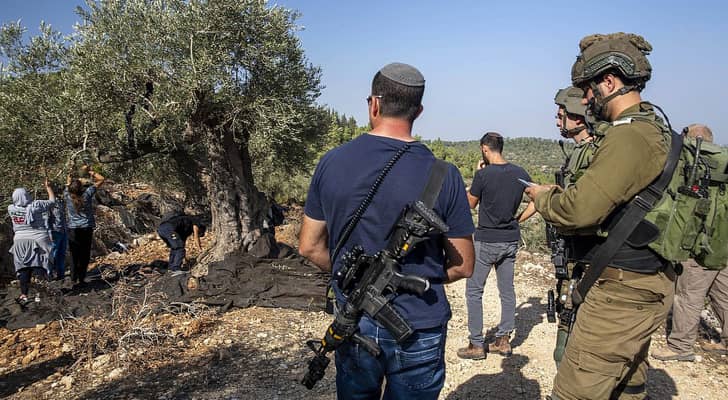
Armed 'Israeli' settlers harass Palestinian farmers and activists during the olive harvest in the village of Jibya, occupied West Bank, October 28, 2022. (Anne Paq/Activestills)

UN warns: record 'Israeli' settler attacks on olive harvest
Note: AI technology was used to generate this article’s audio.
- UN agencies and NGOs reported over 400 'Israeli' settler attacks during the 2026 West Bank olive harvest
- Since September, settlers damaged over 4,000 trees, stole or vandalized 25,000 kg of produce, and expanded attacks into Areas A and B
- Officials accused 'Israeli' authorities of complicity rather than protecting farmers
- Attacks and military restrictions jeopardize 80,000 to 100,000 families
'Israeli' settlers have carried out more than 400 attacks resulting in casualties or property damage during the 2026 olive harvest in the Occupied West Bank, marking the most violent harvest season on record, United Nations agencies and humanitarian non-governmental organizations announced on Friday.
The UN assessment aligns with figures broadcast by 'Israeli' Army Radio, which reported that settler attacks during the Palestinian olive harvest have surged by 74% over the past two years.
According to the Humanitarian Country Team for the Occupied Palestinian Territory -which comprises the heads of UN entities alongside international and Palestinian NGOs- more than 4,000 trees and saplings have been damaged since September, while over 25,000 kilograms of agricultural produce have been vandalized or stolen.
The group noted that the violence has increasingly spread into Areas A and B -territories placed under full or partial Palestinian Authority administration under the 1995 Oslo II Accords where such incidents were historically less frequent- and has also targeted solidarity activists, journalists, and diplomats.
'Israeli' authorities acquiescence, support and participation
Humanitarian officials stated that repeated appeals urging 'Israeli' authorities to protect Palestinian farmers and ensure safe access to their groves have gone unheeded.
"Instead, we’ve seen acquiescence, support and participation," the statement said.
During the first nine months of 2026 alone, 'Israeli' authorities uprooted or damaged more than 10,000 Palestinian-owned trees and saplings across the Occupied West Bank, the majority of which were olive trees.
Near 'Israeli' settlements and behind the West Bank Barrier, 'Israeli' forces continue to bar landowners from accessing their groves without prior military authorization.
Even when access windows are scheduled, the allotted time is frequently too brief and is often undermined by cancellations, entry denials, expulsions, or settler assaults, the team reported.
The expansion of settlements has left few Palestinian communities unaffected by access barriers, which in practice extend well beyond the boundaries indicated on 'Israeli'-issued "coordination" maps, leaving thousands of farmers unable to harvest their crops.
Livelihoods, food security under threat
Between 80,000 and 100,000 Palestinian families in the Occupied West Bank depend on olives and olive oil for their livelihoods, a sector that accounts for roughly 15% of the territory's agricultural gross domestic product (GDP) and carries deep cultural and social significance.
Year-round movement restrictions also prevent farmers from carrying out essential agricultural maintenance such as pruning, fertilization, and pest control, steadily eroding tree productivity, future yields, and broader food security.
"This year’s harvesting window is closing, but there is still some time to act," the Humanitarian Country Team said, urging 'Israeli' authorities in the strongest terms to halt all attacks on Palestinians in accordance with international law and guarantee free, safe, and reliable access to farmland.
"Perpetrators must be stopped and held to account," the group added, calling on UN Member States to exert their influence to ensure protective measures are enacted immediately and maintained year-round.