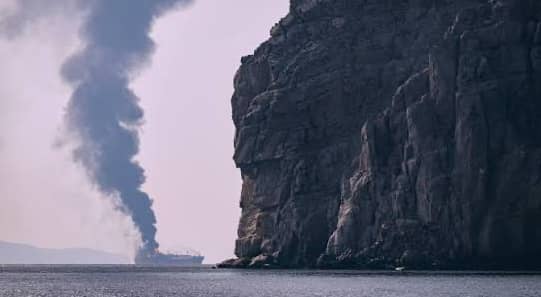
Tanker on fire in Hormuz

Day 269 | Gulf on edge as Iran claims US drone shootdown, tankers hit by sea mines
Tensions across the Gulf escalated on Sunday as Iran and the United States exchanged competing military claims amid growing fears of renewed hostilities. Iran’s Islamic Revolutionary Guard Corps (IRGC) claimed to have shot down another US MQ-1 reconnaissance drone over the Strait of Hormuz, bringing its claimed tally to 20, and released footage purportedly showing the interception. The IRGC Navy also said two supertankers struck naval mines near the strait, while US President Donald Trump warned that American forces would sink any Iranian vessels attempting to breach the US naval blockade. Trump also said he was leaning toward resuming major military operations against Iran after the New Year if diplomatic efforts failed to produce an agreement.
Maritime security remained a major concern, with the IRGC claiming that two supertankers were damaged by mines after navigating unauthorized routes, while earlier reports cited explosions and attacks on commercial vessels around the Strait of Hormuz. British endurance swimmer Lewis Pugh also said he witnessed a tanker being attacked just 30 minutes after beginning a 15-kilometer swimming challenge in the waterway. Meanwhile, Iran's foreign minister reiterated Tehran's conditions for a diplomatic settlement, as reports continued to point to disagreements between Washington and Tel Aviv over potential targets in any renewed military campaign.
Saudi Arabia also reported a series of missile and drone threats attributed to the Houthis. The Saudi-led coalition said it intercepted ballistic missiles and drones targeting Riyadh, the southern region and western parts of the kingdom. Houthi military spokesperson Yahya Saree, meanwhile, claimed Saudi forces had carried out 81 airstrikes and missile attacks across Sanaa and seven other Yemeni governorates within 24 hours, bringing the alleged total since the renewed escalation began to 5,581. Saree also claimed Houthi forces struck Saudi Arabia's Rabigh oil refinery and a radar installation in Al-Dawasir, while rejecting Saudi allegations that the group had threatened Mecca.
Elsewhere, Bahrain's Interior Ministry said Iranian attacks on the kingdom had injured two people, a Bahraini citizen with disabilities and a Pakistani resident, who remains in critical condition. The injuries followed an earlier reported attack on a civilian industrial facility that caused a fire and material damage. Bahrain's Foreign Ministry condemned the strikes and said the kingdom reserved the right to take necessary measures to defend its sovereignty. In Iraq, government forces entered Jurf al-Sakher, a stronghold of Iran-backed Kataeb Hezbollah, under a reported arrangement intended to avoid confrontation with the armed group amid mounting US pressure on Baghdad.
Deadly strike hits telecommunications building in Yemen’s Hodeidah: Houthi media
Houthi-affiliated media reported an attack on the western Yemeni city of Hodeidah, saying an airstrike hit a building belonging to the state-run Telecommunications Corporation and left people dead and wounded.
The reports described the incident as an attack on the city but did not immediately specify the number of casualties or the extent of the damage.
Hodeidah, a strategic Red Sea port city, has been a major flashpoint in Yemen's conflict and a frequent target of military operations amid wider regional tensions. Its ports and surrounding infrastructure are particularly significant because they serve as major entry points for commercial goods and humanitarian supplies into Yemen.
The reported strike comes amid a renewed escalation in Yemen. On Nov. 20, the Saudi-led coalition said it had carried out strikes on Hodeidah port, targeting what it described as facilities used for weapons smuggling and missile transportation. The operation came as fighting between the Houthis and forces aligned with Yemen’s internationally recognised government intensified, with the conflict increasingly spilling into regional confrontations involving Saudi Arabia.
Iran unveils new weapon as commanders warn US of 'humiliation'
- Iran unveiled a new launcher capable of firing two liquid-propellant missiles simultaneously, according to state television.
- Footage showed IRGC chief Ahmad Vahidi and Aerospace Force commander Majid Mousavi touring an underground missile facility.
- Vahidi warned that the damage inflicted on Iran's adversaries was "only the beginning," while Mousavi said the country's military capabilities had expanded.
Iran has unveiled a new missile launcher capable of firing two missiles simultaneously, as senior Islamic Revolutionary Guard Corps (IRGC) commanders showcased the country's underground missile facilities and issued defiant warnings to the United States.
Iranian state television reported on Saturday that the newly unveiled system can launch two liquid-propellant missiles at the same time, marking the first public presentation of the launcher.
Footage broadcast by state television showed IRGC chief Ahmad Vahidi and the head of its aerospace forces, Majid Mousavi, touring an underground missile facility. The two commanders were seen riding on a vehicle through extensive underground tunnels lined with missiles, launch systems and other military equipment.
During the visit, Vahidi warned that the damage inflicted on Iran's adversaries was only the beginning, predicting further setbacks for its enemies.
"The damage suffered by our enemy is only the beginning. We shall witness their humiliation," he said.
Mousavi, meanwhile, claimed that Iran's military capabilities had expanded through its two most recent conflicts, adding that the country possessed advanced weapons capable of deterring its adversaries.
"Our capabilities have grown during the last two conflicts, and our high-performance weaponry can intimidate the enemy," he said.
The announcement comes amid the ongoing regional war, which erupted on Feb. 28 after US and ‘Israeli’ strikes killed Iran's Supreme Leader Ayatollah Ali Khamenei.
Tehran retaliated with waves of missile and drone attacks targeting ‘Israel’ and several countries across the region. Armed groups backed by Iran in Lebanon, Yemen and Iraq also became involved in the conflict.
US and ‘Israeli’ forces subsequently carried out extensive strikes against Iranian military infrastructure, targeting missile facilities and nuclear sites. However, the full extent of the damage to Iran's weapons programmes and military capabilities remains unclear.
Iran has continued to highlight its underground military infrastructure throughout the conflict. Earlier this month, state television released footage of another underground missile facility containing ballistic and cruise missiles alongside various launch systems.
The latest unveiling appears aimed at demonstrating that Tehran retains significant missile capabilities despite months of attacks on its military infrastructure.
Read more: IRGC commander: New weapons, battlefield surprises await the enemy
Trump invokes Iran, oil prices in post-election attacks on Democrats
- He alleged Iran launched more drones and missiles over the previous week than at any point in more than a year, claiming all were intercepted.
- Trump claimed Iran had killed 81,000 protesters, without providing evidence for the figure.
- He attributed the decline in oil prices following the election to developments he had predicted, calling the situation a "Giant Hoax."
US President Donald Trump has linked a decline in stock and oil prices following the Nov. 3 midterm elections to the Democrats' performance, while accusing Iran of escalating its attacks and making unsubstantiated claims about Somalians in Minnesota.
In a series of posts on Truth Social, Trump revisited predictions he said he had made ahead of the elections, arguing that a Democratic victory would hurt financial markets and encourage Iran to increase its military activity.
"As everyone remembers, I predicted two things concerning the November 3rd Midterm Elections," Trump wrote, claiming that stock markets had fallen substantially and that Iran had become more aggressive in its attacks.
He alleged that Iran had launched more drones and missiles over the previous week than at any point in more than a year, adding that all had been intercepted and caused no damage.
Trump also blamed Democrats and Iran for keeping oil prices high before the election, claiming that prices had since fallen by a record amount.
"Isn't it interesting that Oil prices have dropped precipitously after the Midterm Elections? I said that was going to happen," he wrote in a separate post, describing the situation as a "Giant Hoax."
However, market movements do not, on their own, establish that the election results caused the changes in stock or oil prices. US stocks posted mixed results on Nov. 3, while oil prices were already under pressure amid developments surrounding the Iran conflict.
Trump also claimed that Iran had killed 81,000 protesters, presenting the figure as the latest death toll. He did not provide a source for the number. Independent monitoring of casualties during Iran's 2026 protests has produced substantially different documented figures, with the scale of the crackdown making verification difficult.
In another post, Trump turned his attention to Minnesota's Somali community, claiming that Somalians had "completely take[n] over" the state and that "almost 95%" were receiving some form of welfare.
The remarks echo previous attacks by Trump on Somali Americans in Minnesota, where he has repeatedly linked the community to allegations of public funds fraud.
However, the welfare claim requires qualification. A December 2025 FactCheck.org review cited Minnesota demographic data indicating that 84% of people reporting Somali ancestry benefited from certain public assistance programmes, mostly Medicaid. The figure does not mean that 84% receive cash welfare, and it is not equivalent to Trump's broader claim. The same review found that 95% of Somali Minnesotans were US citizens, while 58% were born in the United States.
The posts come as Trump continues to blame Democrats for economic developments and heightened tensions with Iran following the midterm elections, while renewing his criticism of immigrant communities in the United States.