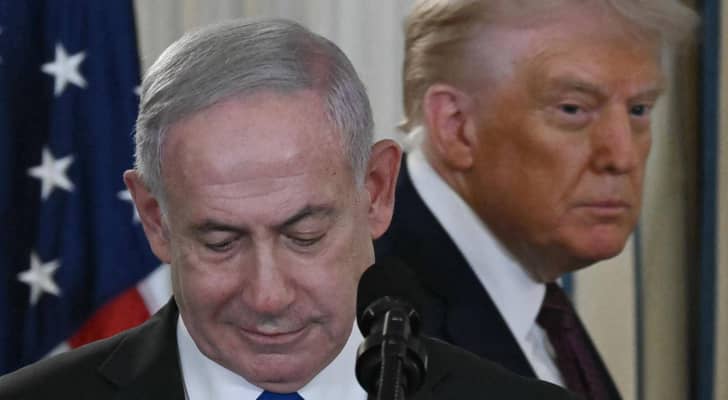
US President Donald Trump and 'Israeli' Prime Minister Benjamin Netanyahu.

US-'Israeli' divergences over Iran strike options: Report
Note: AI technology was used to generate this article’s audio.
- US, 'Israeli' officials are debating whether potential joint strikes on Iran should hit only military sites or also target oil and gas infrastructure
- Hardliners argue hitting energy facilities could topple Iran's struggling economy and regime
- Decisions are delayed by differing goals, Washington focuses on the Strait of Hormuz and nuclear containment, while 'Israel' prioritizes nuclear and missile alleged threats
Extensive deliberations are underway across political and security establishments regarding the nature of any potential joint military operation by the United States and 'Israel' against Iran, according to a report by the 'Israeli' news outlet Walla, which highlighted diverging views over whether to expand targets to include Iran's economic lifeline.
The report stated that officials are weighing whether any joint campaign should remain focused on military infrastructure -such as air defense systems and missile bases in the first and second rings- or shift direction to strike key economic assets in order to maximize pressure and undermine the Iranian regime's ability to survive.
Split over targeting energy sector
According to Walla, policymakers are divided into two main camps regarding the prospect of striking Iran's economic infrastructure:
- The hardline camp: Officials advocating this approach argue that the Iranian regime has reached a historic economic low, meaning targeted strikes on national infrastructure -including oil and gas pumping and production facilities as well as export terminals- could precipitate the collapse of the regime's capacity to endure.
- The cautious camp: Conversely, other officials warn that an attack on Iran's energy sector could ignite a global energy crisis and provoke an unrestrained Iranian response capable of destabilizing the entire Middle East.
Diverging priorities, retaliation assessments
The report noted that tension between the desire to achieve immediate deterrence and the pursuit of long-term strategic change is currently shaping decision-making in both Washington and Tel Aviv, delaying a final resolution on military action.
This hesitation also stems from fundamentally different strategic priorities between the two allies.
While the United States remains primarily focused on eliminating threats to navigation in the Strait of Hormuz and dismantling Iran's nuclear program, 'Israel's' focus centers on both the nuclear program and Iran's ballistic missile capabilities.
These deliberations are taking place ahead of an in-depth assessment of potential Iranian retaliation, not only against 'Israel', American troops, and US assets across the Middle East, but also against regional states that Tehran views as cooperating with Washington and Tel Aviv.