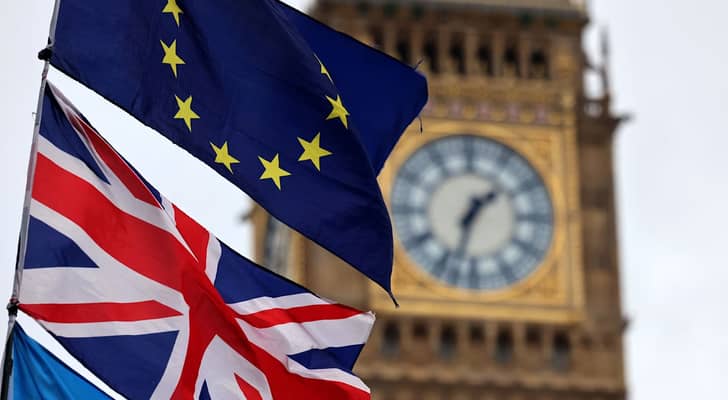
Six years After Brexit, UK PM Weighs ‘Breturn’ to EU
Note: AI technology was used to generate this article’s audio.
- Citing sluggish trade and 62% public support, Burnham called Brexit a net loss, though analysts warn reentry would be divisive and lose prior currency
- Boris Johnson, David Cameron dismissed the move as a distraction, while economists warned EU alignment could bring stricter AI rules
Six years after Britain’s turbulent departure from the European Union, UK Prime Minister Andy Burnham has reignited one of the country’s most divisive political debates, signaling openness to a major strategic shift toward closer integration, and potentially rejoining the bloc.
During a visit to Brussels on Friday, the Labour Party leader unveiled a package of agreements intended to mark a "reset" in bilateral relations, including proposals to scrap most border checks on food and agricultural goods and revive a student-exchange program.
Burnham framed the trip as the starting point for a broader national conversation on how closely Britain should align with its largest trading partner, declaring that "in a more dangerous world, we are stronger together."
However, the negotiations underscored the hurdles facing any deeper rapprochement.
While Burnham presented the initial agreements as finalized, European negotiators clarified that full implementation remains contingent on securing lower university tuition rates for EU students in Britain, an issue both sides agreed to negotiate over the next six months.
Economic strain fuels "Bregret"
Britain formally left the EU four years after the 2016 referendum in which 52% of voters backed Brexit. While the issue had largely receded from the forefront of British politics, public dissatisfaction over post-Brexit trade barriers -compounded by the pandemic and energy price spikes triggered by the war in Ukraine- has steadily shifted public sentiment.
Recent polling averages indicate that 62% of Britons now favor rejoining the EU, compared with 38% who prefer remaining outside.
"The Brexit we were given has not worked," Burnham said in a speech earlier this week, adding that the country had "lost more than we have gained." Research by Goldman Sachs estimates that rejoining the EU’s single market could boost the British economy by between 2% and 5%.
Yet experts caution that reversing course would be neither quick nor straightforward. Anand Menon, director of the think tank UK in a Changing Europe, warned that a push for "Breturn" could consume political bandwidth, create short-term economic uncertainty, and divert attention from urgent domestic challenges.
Britain would also face little guarantee of regaining its previous membership perks, such as keeping the pound sterling or receiving budget rebates conditions that, if lost, cause public support in polls to waver.
Political backlash, European caution
Burnham’s overtures have already energized veteran Brexit campaigners, with a "Stay Out" campaign gaining traction online.
Former Prime Minister Boris Johnson warned that Burnham "will impale himself and his party on this point," urging him to abandon an effort he predicted would fail.
Former Prime Minister David Cameron, who called the 2016 referendum, similarly argued that Downing Street should prioritize pressing domestic issues, including high taxes, public debt, housing shortages, and strengthening Britain’s armed forces.
A recent YouGov survey ranked rejoining the EU ninth among voter priorities, well behind the economy, immigration, and healthcare.
Burnham, who has expressed a desire to see Britain rejoin the bloc within his lifetime, said he plans to spend the coming year holding informal talks with senior EU figures to explore long-term options before putting the question to British voters, either via a referendum or in the next general election, due by 2029.
He acknowledged that Friday’s deals likely represent the limit of bilateral cooperation achievable prior to that vote, signaling a clear departure from the stricter red lines maintained by his Labour predecessor, Keir Starmer, who took office in 2024.
In Brussels, European Commission President Ursula von der Leyen struck an encouraging tone, stating she was open to brainstorming future ties and noting that both sides had "every reason to be ambitious about what comes next."
Still, analysts say Brussels remains wary of British political volatility. Rosa Balfour, director of Carnegie Europe, noted that the EU will demand assurances that any new framework proposed by London will endure rather than shift with domestic political cycles.
Weighing the options
Economists also point to complex trade-offs ahead. While most view Brexit as an economic misstep, some note that Britain’s economy has outperformed expectations in recent quarters, partly due to rapid artificial intelligence adoption, a sector some fear could be stifled by adopting stricter EU AI regulations.
At the same time, new friction looms, including the EU's "Made in Europe" industrial push, which could impose tariffs on British-built electric vehicles.
Should London pursue a new formal arrangement, policy options range from negotiating a customs union -which would ease goods trade while preserving regulatory autonomy over services- to seeking Norway-style single market access, which requires accepting EU rules and free movement without voting rights, or applying for full membership.