Members of Kataeb Hezbollah stand guard by a roadside as Iraqi security forces deploy in Jurf al-Sakher, in Babil Province.


Day 267 | Iraqi forces enter stronghold of Iran-backed group under compromise deal
Iraqi government forces on Friday entered the main stronghold of Kataeb Hezbollah as authorities seek to rein in Iran-backed armed groups, but sources told AFP a compromise had been reached to avert a confrontation.
The group has maintained a presence in Jurf al-Sakher for more than a decade after helping recapture the area from Daesh.
But Iraq has been facing mounting US pressure to curb Iran's influence and disarm Tehran-backed factions, which Washington designates as terrorist organisations.
"Joint Iraqi forces began entering the Jurf al-Nasr area to redeploy there," state media reported, using another name for the region.
This week Iraqi Prime Minister Ali al-Zaidi gave Kataeb Hezbollah a deadline to withdraw from Jurf al-Sakher after his government said oil smuggling was taking place in the area -- a claim the group denied.
Addressing government forces deployed on Friday, Zaidi said in a brief message broadcast on state TV that "we are not waging a war".
"Everyone present there is your brother... the sons of this nation, and their blood is our blood," he said.
He also insisted that his decision to restrict weapons to the Iraqi state only was final -- a key US demand and major source of tension with the Iran-allied groups.
Despite the friction, the head of the government's media unit for security, Saad Maan, told state TV that there had been "very good cooperation" with brigades belonging to Kataeb Hezbollah within the Hashed al-Shaabi.
The Hashed al-Shaabi is an alliance of factions that has been integrated into Iraq's regular armed forces despite including brigades belonging to Iran-backed groups.
Saudi-led coalition intercepts three ballistic missiles fired toward Riyadh
The Saudi-led coalition supporting Yemen’s internationally recognized government intercepted and destroyed three ballistic missiles launched by the Houthi group toward the Saudi capital of Riyadh on Saturday, the coalition said.
The coalition's announcement came shortly after Saudi Arabia's General Directorate of Civil Defense triggered two emergency alerts in Riyadh via the National Early Warning Platform.
Two explosions heard in Riyadh, AFP reports
Two explosions were heard in the Saudi capital of Riyadh early on Saturday morning, according to an AFP journalist on the ground.
The blasts followed an emergency alert issued by Saudi authorities warning residents of potential danger.
No immediate details on the cause of the blasts were released by Saudi officials.
Saudi Civil Defense lifts Riyadh emergency alert after 12 minutes
Saudi Arabia's General Directorate of Civil Defense triggered an emergency alert in Riyadh Saturday to warn of a potential danger, before issuing an all-clear 12 minutes later confirming the threat had passed.
Saudi Civil Defense lifts emergency danger alert in Riyadh
Saudi Arabia's General Directorate of Civil Defense said that the danger has passed in Riyadh, lifting the emergency warning alert issued earlier across the capital.
Saudi Civil Defense issues emergency warning alert in Riyadh
Saudi Arabia's General Directorate of Civil Defense has activated an emergency warning alert via the National Early Warning Platform for residents in the capital, Riyadh, warning of a potential danger.
Araghchi says Iran's 'two-day plan' could still pave way for deal if US shifts its stance
- Araghchi detailed that the "two-day plan" required the US to meet its commitments on day one and Iran to reopen the Strait of Hormuz.
- He described competing factions inside the White House between pro-war voices backed by 'Israeli' Prime Minister Benjamin Netanyahu.
In an interview with the state-run Iran newspaper published on Friday, Iranian Foreign Minister Seyed Abbas Araghchi explained that while Tehran's "two-day plan" is no longer on the table in its previous operational form, it can still provide the basis for a final agreement if the US administration demonstrates genuine seriousness.
Araghchi stated that Tehran has not received any response from the US to the proposal Iran submitted prior to the US elections, emphasizing that if Washington is serious about reaching an agreement, it must first correct its stance and take necessary confidence-building measures.
Detailing the initiative, Araghchi noted that the proposal stipulated the US would fulfill its commitments on the first day, followed by Iran reopening the Strait of Hormuz on the second day and launching direct, comprehensive negotiations without a fixed deadline, unlike the earlier Islamabad Memorandum of Understanding, which had set a 60-day window for talks.
Araghchi stressed that Tehran's position remains clear: all seven of Iran's conditions must be fulfilled before the Strait of Hormuz is reopened.
At the same time, he expressed readiness to discuss any US proposals regarding implementation mechanisms, including at the expert level, provided Washington takes steps to correct its course.
Addressing the political landscape inside the US, the Iranian minister pointed to competing factions within the White House attempting to sway US President Donald Trump.
He stated that one faction, backed by daily outreach and pressure from 'Israeli' Prime Minister Benjamin Netanyahu, is pushing for war, while another faction favors diplomacy and negotiations, and a third group believes economic pressure and sanctions can force Iran to capitulate.
On nuclear
Abbas Araghchi stated that while a fair formula can be reached regarding Iran's 400-kilogram stockpile of 60-percent enriched uranium, the nuclear materials will not leave Iranian territory under any circumstances.
raghchi outlined Tehran's nuclear red lines amid ongoing indirect message exchanges with the US mediated by Qatar and Pakistan.
"I believe the possibility of reaching a formula to resolve this issue exists," Araghchi said when asked about the fate of the 60-percent enriched uranium stockpile. "Of course, we have several clear red lines in this regard: first, these materials will not leave the country, and second, these stockpiles will be utilized in proportion to our needs, under whatever definition we have of those needs."
Araghchi noted that regional mediators have put forward various proposals regarding the stockpiles, adding that some ideas warrant examination while others carry significant drawbacks.
However, he stressed that the nuclear material issue cannot be negotiated or decided in isolation, insisting it must be resolved within the framework of a comprehensive package that safeguards Iran's national interests.
Addressing broader debates inside the country, the foreign minister emphasized that Iran's official nuclear doctrine remains unchanged, even as discussions surrounding the policy continue within expert circles.
Araghchi added that any final decision regarding nuclear negotiations is reviewed by the Supreme Council's negotiations committee and ratified by the Supreme Council itself before entering the implementation phase.
The interview comes as Iran's diplomatic posture faces competing pressures in Washington, where Araghchi said US President Donald Trump is navigating between factions advocating diplomacy, sanctions, or military escalation backed by 'Israeli' Prime Minister Benjamin Netanyahu.
Despite the tensions, Araghchi reiterated that Tehran seeks a lasting agreement that prevents the recurrence of war, concluding: "We are men of diplomacy, and we remain hopeful in diplomacy."
Never-seen-before photo released of Ali Khamenei and granddaughter
Iranian state media released a previously unpublished photograph on Friday showing the late Supreme Leader Ali Khamenei with his infant granddaughter, Zahra Mohammadi Golpayegani.
The image was published on the official website of Ali Khamenei and shared widely on social media to “mark World Children’s Day,” according to the website.
The photograph depicts Khamenei alongside the toddler.
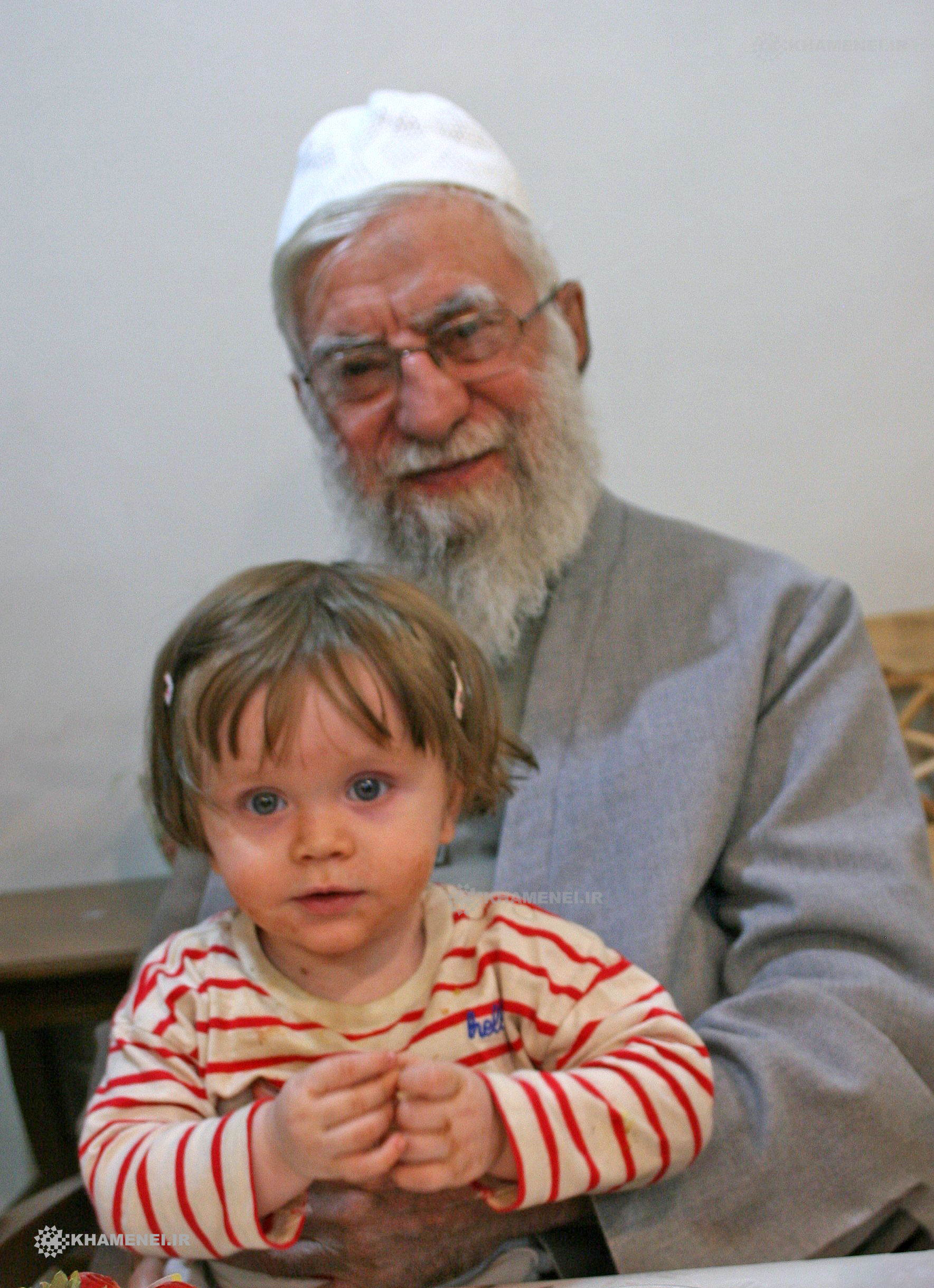
Both were killed in the opening phase of the war that began on February 28, when the United States and ‘Israel’ conducted coordinated airstrikes on targets in Iran, including the Supreme Leader’s residential compound in Tehran.
Zahra, born on December 18, 2024, was 14 months old at the time of her death.
She was the daughter of Khamenei’s daughter Boshra Khamenei and Mohammad Javad Mohammadi Golpayegani.
Her mother was also among those killed in the same strike.
Official Iranian accounts described the release in solemn terms.
“A never-before-published photograph of the martyred Leader of the Islamic Revolution with his little granddaughter, Martyr Zahra Mohammadi Golpayegani. Both were martyred at the outset of the brutal and criminal war waged by the terrorist US government and the illegitimate Zionist regime against the Iranian people,” the English-language site stated.
The official X account associated with the Leader posted the image with a similar caption, noting it was published to mark World Children’s Day.
Separate posts recalled that the child had been at the family home when the missiles struck.
Zahra’s death had already drawn significant attention during Khamenei’s funeral ceremonies in July 2026.
Her small coffin, draped in the Iranian flag and accompanied by a framed photograph, was displayed beside his at Tehran’s Grand Mosalla, an image that was widely circulated in both Iranian and international media.
Iranian diplomatic missions also marked the day by remembering the toddler.
The Iranian embassy in India wrote: “On World Children’s Day, we honour the memory of little Zahra Golpayegani… who was martyred alongside her grandfather in the US-Israeli attack on February 28. May her memory, and the memory of all innocent children who have lost their lives, remain forever in our hearts.”
Previous day
For coverage of the previous day, visit the link below.
Read more: Day 266 | Gulf tensions spiral as Iran threatens retaliation and Houthis strike Riyadh