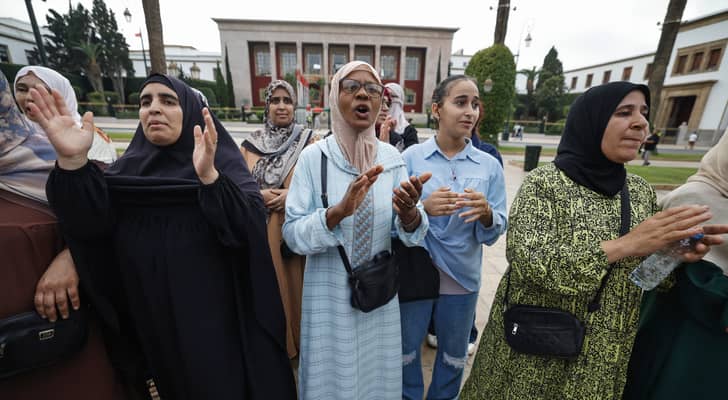
A crowd of protesters gather to block the Garvaghy Road in Portadown, Northern Ireland [Paul Faith/AFP]

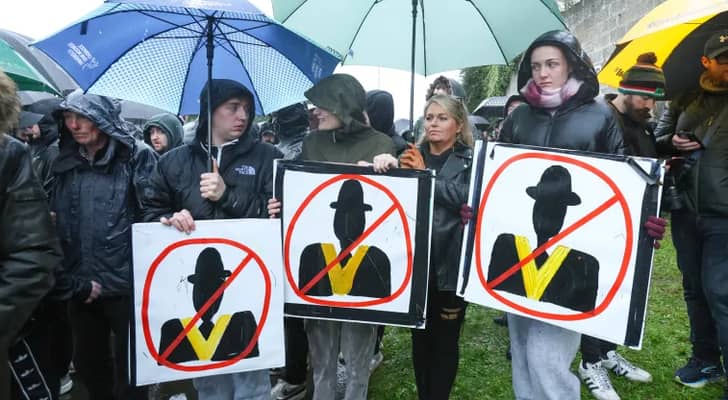
Thousands of N. Irish block Orange Order march in Portadown
Note: AI technology was used to generate this article’s audio.
- Thousands of protesters gathered in Portadown to block an Orange Order march through a predominantly Catholic area.
- Northern Ireland's Court of Appeal permitted the parade for the first time in 28 years, overturning a lower court's temporary injunction.
- Sinn Féin leaders Mary Lou McDonald and First Minister Michelle O’Neill joined protesters urged government intervention.
- Authorities approved the march under strict conditions, capping participants at 35, banning bands and supporters, and setting a 9:30 AM deadline.
Thousands of protesters blocked a key route through a predominantly Catholic neighborhood in Portadown on Sunday, preventing a scheduled march by the Protestant Orange Order organization from passing through the area for the first time in 28 years.
The standoff follows a ruling by Northern Ireland’s High Court that permitted the parade along Garvaghy Road, reviving one of the region's historically contentious marching disputes.
The court decision rejected a final challenge brought by local residents after Northern Ireland’s Court of Appeal overturned a temporary injunction granted a day prior.
Political leaders assemble on the ground
Prominent political figures assembled along Garvaghy Road alongside local residents shortly before the march was scheduled to commence at 8:00 AM (07:00 GMT).
Sinn Féin Leader Mary Lou McDonald and Northern Ireland First Minister Michelle O’Neill joined the crowd in protesting the court's decision, calling on police and the British government to intervene.
"This is madness," McDonald told reporters on site. "This, in fact, is primitive treatment of any community in the year 2026. It is intolerable, and it will not be tolerated. This is a dignified and united community, and they are absolutely determined that they and we will not be drawn back into the past."
First Minister O’Neill confirmed she had engaged directly with Britain’s minister for the region and representatives of the Irish government regarding the situation.
Nearby police vans broadcast recorded warnings stating that participating in the road blockage constituted a criminal offense.
Simultaneously, Democratic Unionist Party (DUP) lawmaker Carla Lockhart posted a photo on X showing a small gathering of Orange Order members wearing traditional silk orange sashes and black bowler hats in another part of town.
Law enforcement call for calm
Responding to the rising tensions, British Prime Minister Andy Burnham called for calm across the region.
"Big gains have been made in Northern Ireland, and we don’t want to see things go backwards," Prime Minister Burnham stated.
Police Service of Northern Ireland (PSNI) Chief Constable Jon Boutcher urged individuals with influence to encourage compliance with the law, noting that no acts of violence or disorder had occurred.
"Police are engaging and working with all parties and will continue to do so," Boutcher stated. "It is incumbent on us all to come together at times like this to do all we can to preserve a peaceful Northern Ireland."
Deputy First Minister Emma Little-Pengelly of the DUP emphasized that threats of violence were unacceptable, stating that "no one in Northern Ireland wants violence or disorder."
The Irish government expressed deep concern, stating its priority was avoiding a return to historical divisions.
Historical context of Drumcree marching dispute
The Orange Order is a Protestant organization closely tied to unionism, the political tradition favoring Northern Ireland remaining part of the United Kingdom.
The procession had received conditional approval from the Parades Commission, an independent body that adjudicates disputed marches.
The commission imposed strict parameters: limiting participation to 35 people, prohibiting musical bands and accompanying supporters, and mandating a hard completion deadline of 9:30 AM (08:30 GMT).
The dispute surrounding the Drumcree parish parade and Garvaghy Road was among the most violent confrontation points during "The Troubles," the conflict over Northern Ireland’s political status that concluded with the 1998 Good Friday Agreement.
Throughout the 1990s, annual attempts by the Orange Order to return from Drumcree Parish Church via Garvaghy Road repeatedly caused massive security operations, severe violent clashes, and widespread civil unrest.