

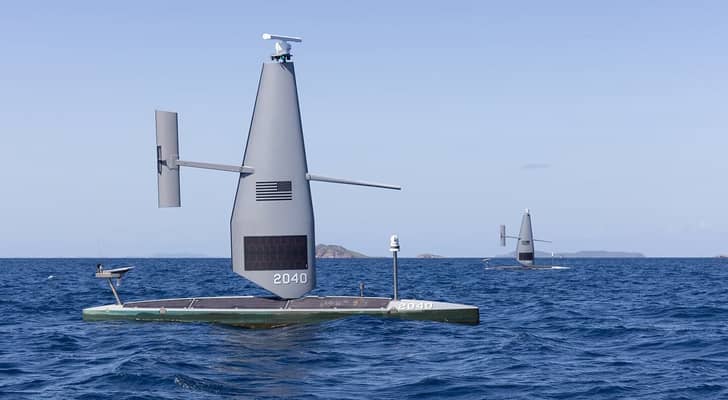
Day 213 | Iran claims seizure of an underwater US drone in Hormuz, US denies the claim
Iran’s Islamic Revolutionary Guard Corps (IRGC) Navy claims to have intercepted a US REMUS 600 underwater vehicle during a reconnaissance mission in the Strait of Hormuz, saying it was seized through a “coordinated intelligence and electronic warfare operation” and handed over to Iranian military experts to retrieve its data. The US military denied the claim, with US CENTCOM spokesman Captain Tim Hawkins telling Al Jazeera that the US maintains “positive control of all of our operational drone assets.”
The REMUS 600 is an autonomous underwater vehicle used by the US Navy and several NATO member states. Equipped with sensors, cameras and sonar systems, it is designed for surveillance, seabed mapping, mine countermeasures and underwater inspections, with an operating depth of up to 600 meters. The latest Iranian claim comes days after the IRGC said it had intercepted another US autonomous underwater vehicle, identified as a Dive-LD, near the entrance to the Strait of Hormuz.
The IRGC Navy also reiterated that the Strait of Hormuz remains closed, warning that its forces would confront unauthorized passage or military activity in the waterway. Iran’s Army Commander-in-Chief, Major General Amir Hatami, reaffirmed Tehran’s control over the strait and called on Gulf countries to push US forces out of the region. He said, “the war is not over,” describing the conflict as being at a “critical and decisive stage” and saying Iran must consolidate what he called its victory.
US President Donald Trump, meanwhile, said oil prices would fall “as soon as Iran gives up” and the war ends, adding that this would happen “soon.” The comments came as Tehran continued to maintain that the Strait of Hormuz would remain closed until what it describes as US economic warfare against Iran comes to an end.
Thread ended
This live thread has ended. Follow our online coverage of day 214 of the war.
Read more: Day 214 | Iran says Trump must choose between war or diplomacy
VIDEO - ‘Israeli’ army claims Hezbollah underground route dismantled
‘Israeli’ soldiers operate in the Mansouri area of southern Lebanon, where the army claims it dismantled an underground route belonging to Hezbollah.
‘Israel’ refers to the area where its troops are operating as a "security zone".
Explosions near Qeshm Island likely linked to warning shots: Iranian media
Iranian media reported earlier sounds described as explosions that were heard from the sea near Iran’s Qeshm Island in the Strait of Hormuz on Monday night.
State TV later said similar sounds have been heard on previous nights and are usually linked to warning shots directed at vessels in the Strait of Hormuz.
“No reports of a strike or explosion on Qeshm Island have been reported so far,” the report added.
Explosion heard near Iran’s Qeshm Island: state media
An explosion was heard near Qeshm Island in southern Iran, the Iranian state-run IRNA news agency reported.
IRNA said the sound appeared to have come from the direction of the sea and that there was no indication that the island itself had been targeted.
The cause of the explosion was not immediately clear. No other Iranian sources had provided further details at the time of the report.
Qeshm Island lies near the Strait of Hormuz, a key shipping route that has been at the center of ongoing tensions between Iran, the United States and other regional parties.
Trump says US will win Iran war “quickly”
US President Donald Trump said Monday that his country will “pretty quickly” win the war with Iran, as Washington and Tehran are participating in mediated talks in New York.
“We're going to win this,” Trump said. “As far as I'm concerned, it's going to be one way or the other, it's going to go pretty quickly.”
“We're going to win that war very soon, that'll be over, and the gas prices will come tumbling down,” he added.
Lebanon says ‘Israeli’ army set off large explosion in south
The ‘Israeli’ military set off a significant explosion in the southern Lebanese village of Mansouri on Monday, Lebanese state media said as ‘Israel’ said it had completed an operation in the area.
"A massive explosion rocked the town of Mansouri in the Tyre district a short while ago. The explosion was carried out by Israeli occupation forces," Lebanon's state-run National News Agency reported.
"The sound of the explosions was heard in the city of Tyre and several surrounding villages," the NNA added.
The ‘Israeli’ military claimed in a statement that it had completed an operation in Mansouri where it dismantled "more than 600 terrorist infrastructure sites" and "eight underground routes".
Lebanese authorities accuse ‘Israel’ of systematically destroying villages in the south, including homes, schools, places of worship and water and electricity infrastructure.
The town of Mansouri, located around nine kilometres (six miles) south of Tyre and 10 kilometres north of ‘Israel’, and its surroundings were subjected to several ‘Israeli’ strikes and to artillery shelling in recent weeks despite a ceasefire that took hold in June.
During the truce, Mansouri's municipality had told residents they could return home but that they should avoid the parts that came under ‘Israel's’ self-proclaimed "security zone".
But last month, the ‘Israeli’ military had ordered Mansouri's residents to evacuate the town before fully occupying it.
It has since regularly carried out demolitions and detonations in the town, which residents in the Tyre region can clearly see, according to correspondents.
Tehran-backed Hezbollah drew Lebanon into the Middle East war in March this year by attacking ‘Israel’ to avenge the killing of Iran's supreme leader in US-‘Israeli’ strikes.
‘Israel’ responded with massive airstrikes and a ground invasion that Lebanon says have killed more than 4,300 people.
Violence has decreased since a fragile ceasefire announced in June after a US-Iran understanding on the broader war, while Lebanon and ‘Israel’ reached a framework agreement later that month.
But ‘Israel’ has kept up attacks and maintains troops in a self-declared "security zone" running around 10 kilometres (six miles) inside south Lebanon, where it has carried out widespread demolitions in villages it occupies.
Iraq leaders back request to exempt Najaf airport from US measures
Iraq’s four top state authorities have backed the government’s request to exempt Najaf International Airport from US measures affecting Iranian flights, according to the Iraqi Presidency.
The four presidencies also stressed that decisions on war and peace must remain under state authority, with weapons held within official state institutions.
They called for addressing the presence of weapons outside state control through constitutional mechanisms and within timelines set by the government.
The statement comes as Baghdad seeks an exemption for Najaf airport from US measures affecting flights operated by Iranian airlines.
Trump reportedly willing to ease Iran sanctions, release frozen funds over nuclear progress
US President Donald Trump is reportedly willing to ease sanctions and release Iran’s frozen funds in exchange for progress on nuclear issues, according to a US official.
Negotiators continue to have "constructive" talks with mediators but there would be no deal unless the nuclear file is addressed, per the anonymous official cited by Al Jazeera.
Washington is skeptical of Tehran after “they broke the last MoU by firing on commercial vessels which stopped the last deal back in July,” the official added.
“Iran has indicated they are flexible on the nuclear issues, but the sides still remain apart on the timing of the commitments and who takes which steps first,” the official said.
'Israel’s' army claims Hamas fighter killed in Gaza
The ‘Israeli’ military said its forces killed a Hamas fighter, identified as Shadi Abu Hasira, in Gaza on Sunday, alleging that he was a “key money exchanger” for the group’s military wing.
Abu Hasira was killed in a drone strike targeting a vehicle in the al-Sinaa area south of Gaza City, according to a source at al-Shifa Hospital cited by Anadolu Agency.
A funeral for Abu Hasira was held in Gaza City on Monday.
Local medical sources said at least four other Palestinians were killed in ‘Israeli’ strikes across the Gaza Strip on Sunday.
Yemeni parliament approves call for ‘general mobilisation’ against Houthis
Yemen’s parliament has approved a general mobilisation declared by Rashad al-Alimi, head of the country’s Presidential Leadership Council, amid renewed fighting with the Houthis.
Al-Alimi announced the mobilisation on Friday, calling on citizens to contribute “in every way possible” and join forces aligned with Yemen’s internationally recognized government to counter Houthi advances.
He also offered amnesty to Houthi fighters who defect and join the government side.
The move comes as Yemen’s internationally recognized authorities seek to strengthen their forces amid continued tensions and military developments across the country.
Lebanese army dismantles ‘Israeli’ spy camera in southern Lebanon
The Lebanese army dismantled an ‘Israeli’ surveillance camera equipped with a solar power system after finding it near Wadi Zibqine in the Tyre district of southern Lebanon, according to the Lebanese army and local reports.
The device was discovered during engineering surveys carried out by the army in southern areas amid continued ‘Israeli’ attacks, according to the army’s Directorate of Guidance. A specialized unit from the army’s Engineering Regiment subsequently dismantled it.
Local reports said the camera had been placed by a drone on the outskirts of Wadi Zibqine. Initial reports had described the object as a possible radar device before the army identified it as a surveillance camera.
Iran files complaint with ICAO over US aviation sanctions
Iran has filed a complaint with the International Civil Aviation Organization (ICAO) over US sanctions targeting its aviation sector, Agence France-Presse reported, citing Iranian state media.
The complaint comes as US sanctions continue to place pressure on Iran’s aviation industry, affecting airlines and related services.
LNG traffic in Hormuz picks up despite US-Iran war
More liquefied natural gas vessels linked to QatarEnergy have transited the Strait of Hormuz over the past week despite the ongoing US-Iran conflict, according to shipping data.
Kpler data showed no visible crossings by Qatar-linked LNG vessels or ships carrying cargo from the Ras Laffan gas terminal in August, amid security concerns and efforts to restrict traffic through the strategic waterway.
Visible LNG tanker movements have begun to increase this month. The latest vessel to reappear outside the strait was the GasLog Skagen, which was tracked off Sri Lanka on Sunday carrying a cargo from Ras Laffan, according to LSEG and Kpler data.
Some vessels may have crossed undetected after switching off their Automatic Identification System transponders, a practice known as “dark transits.”
Before the conflict and blockade, the Strait of Hormuz carried around one-fifth of global crude oil and LNG supplies, making it a critical route for international energy markets.
Iran denies involvement in UK airbase bomb scare
Iran's embassy in London said Monday it "categorically rejects and strongly condemns" speculation that Tehran was involved in a bomb scare near a UK military airbase used by the US.
In an X post, the embassy criticised "the recent unfounded and malicious speculations published by some British individuals and media outlets attempting to link Iran" to the incident early Sunday near the Royal Air Force (RAF) Fairford base.
Five men, all British nationals in their mid-20s, have been arrested and UK counter-terrorism police are leading the probe.
Najaf airport to reopen to Iranian flights within 24 hours
Najaf International Airport is expected to reopen its airspace to Iranian flights within 24 hours, the Iraqi News Agency reported, citing Iraq’s ambassador to Iran.
The move would allow Iranian flights to resume operations at the airport following their suspension.
Mediators expected to hold separate US-Iran talks: Reuters
Mediators are expected to hold separate talks with the United States and Iran today or tomorrow, Reuters reported, citing a source.
The talks are expected to focus on a revised version of a seven-day proposal put forward by Iran, according to the source.
The separate meetings come amid ongoing efforts to reach an understanding between Washington and Tehran.
Iran army official says some neighbors do not want Iran to be strong
- Rear Admiral Habibollah Sayyari said Iran’s adversaries seek to keep the country weak and divided.
- He pointed to countries around the Persian Gulf and Caspian Sea as evidence of support for Iran’s opponents.
- Sayyari said some neighbouring states had allowed foreign forces to use facilities on their territory to launch attacks against Iran.
Iran’s Army Deputy Coordinator Rear Admiral Habibollah Sayyari said some neighboring countries did not want to see a strong Iran, accusing Iran’s adversaries of seeking to weaken and fragment the country.
“The enemy does not wish to see a powerful Iran; it desires a weak and fragmented Iran,” Sayyari said, according to remarks carried by Iranian state media.
He pointed to neighbouring countries along the southern shores of the Persian Gulf and around the Caspian Sea, saying their support for Iran’s adversaries demonstrated their opposition to a stronger Iran.
Sayyari also accused some neighbouring states of allowing foreign forces to use bases or other facilities on their territory to launch attacks against Iran.
He said those countries subsequently asked not to be targeted when Iranian authorities informed them that attacks had been launched from facilities on their soil.
The remarks come amid heightened regional tensions and Iranian concerns over foreign military deployments and attacks launched from neighbouring states.
Sayyari did not identify the countries he was referring to or provide specific details about the facilities or attacks in his remarks.
Read more: Bessent says Iran could have ‘nothing left to trade’ within two weeks
CENTCOM: Iran has no navy because American forces sank it
US Central Command (CENTCOM) has rejected a claim by a senior Islamic Revolutionary Guard Corps commander that Iran has full control over the Strait of Hormuz through its navy.
CENTCOM described the claim as “false,” saying Iran does not control the strategic waterway.
The US command also said Iran has no navy because American forces “sank it,” while pointing to thousands of ships that it said have continued to pass through the strait.
CENTCOM added that more than one billion barrels of oil have passed through the Strait of Hormuz in recent months.
Iran asserts full control over Strait of Hormuz as Trump rejects truce deal
- Trump rejected an Iranian proposal featuring a seven-day ceasefire intended to restore maritime trade through the strait.
- Benchmark Brent crude surged 2.8 percent to $107.26 per barrel, while WTI rose 1.8 percent to $94.07 following news of the impasse.
- Financial analysts noted softer Asian equities and heightened market uncertainty as hopes for an immediate resolution faded.
An Iranian military official declared on Monday that Tehran exercises total military control over the Strait of Hormuz, brushing off international opposition as oil markets surged following Donald Trump's rejection of a proposed reopening plan.
Admiral Habibollah Sayyari, chief of staff of Iran’s army, reaffirmed Tehran's strategic command over the vital maritime bottleneck. "Despite the rhetoric of the enemy, the fact is the Strait of Hormuz is under our complete control," Sayyari stated.
He added that Iranian forces "act decisively in the north of the Oman Sea and east of the Strait of Hormuz and do not allow anyone to cross".
Outlining the military division of responsibilities, Sayyari specified that "the western part of the Strait of Hormuz, the strait itself, and the Persian Gulf are under the full control of the Islamic Revolution Guards Corps (IRGC) Navy, while the eastern part of the Strait of Hormuz and the northern Indian Ocean are under the full control of the Army Navy."
The assertive statements follow Washington's rejection of an Iranian proposal for a seven-day ceasefire aimed at reopening the strategic waterway to commercial shipping, extending a diplomatic standoff over the conflict.
The diplomatic impasse triggered an immediate reaction across global commodities markets, driving crude prices higher. Brent crude rose 2.8 percent to $107.26 per barrel, while US West Texas Intermediate (WTI) gained 1.8 percent to reach $94.07 per barrel.
Market analysts noted that Trump's refusal to accept Tehran's proposal renewed supply concerns. Stephen Innes of Quintex Intel observed that Middle East tensions flared again following the rejection, weakening Asian equities and unwinding a brief rally in global fixed income. Analysts maintain that markets continue to price in the possibility of eventual negotiations, even as both sides maintain firm public postures.
Mojtaba Khamenei says ‘enemy forces’ would soon be driven out of Arabian Sea
Iran’s Supreme Leader Mojtaba Khamenei has said Iranian forces have pushed enemy forces from waters off southern Iran toward the Arabian Sea, warning that they would soon be forced out of the area as well, according to Iranian state media.
“Having suffered painful blows from our valiant combatants and the guardians of the Strait of Hormuz, they [the enemy] dare not venture beyond the Arabian Sea,” Khamenei said in a message marking Sacred Defence Week, which commemorates the Iran-Iraq War.
He added that the time was approaching when the Arabian Sea would also be “cleared of their presence.”
Khamenei’s remarks also coincided with the anniversary of the killing of former Hezbollah leader Hassan Nasrallah in 2024.


