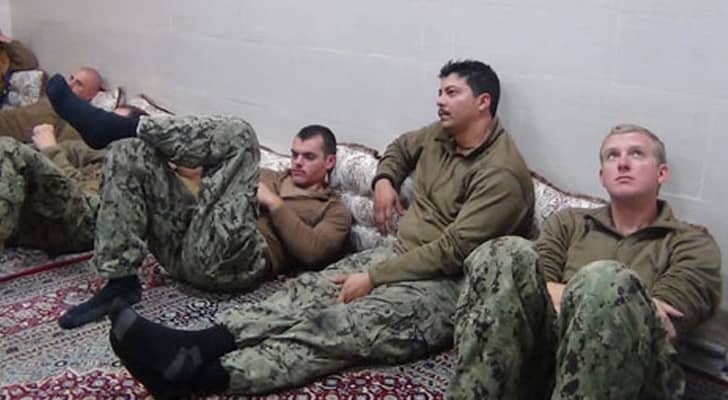
This picture released by the Iranian Revolutionary Guards on Wednesday, Jan. 13, 2016, shows detained American Navy sailors in an undisclosed location in Iran. (Sepahnews via AP)

Eight US sailors fought in Iran war attempted suicide: CNN
Note: AI technology was used to generate this article’s audio.
- Acting Navy Secretary Hung Cao confirmed eight non-fatal suicide attempts among sailors deployed with the USS Abraham Lincoln strike group.
- Official details revealed one sailor was rescued after going overboard in August, while shipmates prevented a second sailor from jumping in March.
- Severe combat tempos, six months without port calls, low morale, and broken basic utilities contributed to extreme stress levels aboard.
Eight US Navy personnel assigned to the USS Abraham Lincoln carrier strike group attempted suicide during a marathon deployment that saw the fleet conduct high-intensity combat operations against Iran, according to a letter from Acting Navy Secretary Hung Cao obtained by CNN.
Written in response to inquiries from Sen. Kirsten Gillibrand (D-NY) regarding the mental health and morale of the strike group’s 6,000 to 7,000 sailors, Cao disclosed figures covering the entire strike group, including personnel on the aircraft carrier, escorting destroyers, carrier air wing, and staff.
"Since the beginning of Lincoln’s deployment, there have been a total of eight suicide attempts across the strike group," Cao wrote to Gillibrand, a member of the Senate Armed Services Committee, in a letter dated Tuesday. "This number includes the Lincoln crew and sailors from the carrier airwing, strike group and destroyer squadron staff, escorting destroyers and all embarked aviation squadrons."
Cao confirmed that no sailors committed suicide during the deployment.
The rate of attempts across the strike group was described as roughly consistent with the active-duty Navy's overall 2024 statistics, which recorded 356 suicide attempts among approximately 337,000 active-duty personnel.
Strain on crew
Military officials noted that eight suicide attempts represents an unusually high figure for a single strike group deployment, where typical deployments see one or two attempts per year.
"Eight attempted suicides is incredibly high," a US military official told CNN. "The strain of combat ops is much higher than normal deployments. No port calls, constant alerts, etc."
The Lincoln carrier was kept out of port for more than six months while conducting continuous operations in the Middle East, preventing sailors from resting or taking on fresh supplies at friendly ports.
In his letter, Cao also confirmed specific overboard incidents that occurred during the mission.
He stated that a sailor assigned to the air wing fell overboard in early August but was "quickly recovered" and treated by medical personnel.
Another sailor attempted to jump overboard in March but was halted by crewmates; that sailor received immediate care and was subsequently sent back to homeport.
The Navy did not respond to requests for comment prior to publication, though it previously stated to CNN that it had "not observed an increase in suicidal ideations or attempts aboard the ship" and treats service member well-being seriously.
Mental health assets onboard
According to Cao's letter, the Navy deployed several mental health resources aboard the Lincoln to support the crew, including five chaplains, one embedded integrated prevention counselor, one psychologist, one clinical social worker, three behavioral health technicians, and an expeditionary facility dog.
Despite these resources, crew members speaking to CNN described deteriorating shipboard conditions and widespread anxiety.
One crew member reported that morale on the carrier was very low, citing frequent reports of suicidal ideation among shipmates alongside persistent failures of basic amenities—including out-of-service toilets, broken water fountains, and a lack of hot water.
"Everyday we wake up and listen to our captain speak, we are desperately hoping and anxious for updates on our return," the crew member said before the carrier received orders to head home.
The ship departed the Middle East in August and is expected to return to its home port in San Diego in the coming weeks.