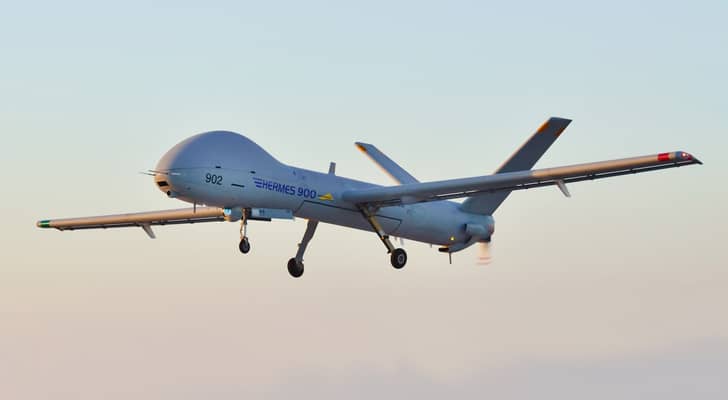
Elbit Hermes 900

Serbia president confirms opening ‘Israeli’ drone factory, plans three more
Note: AI technology was used to generate this article’s audio.
Serbian President Aleksandar Vučić confirmed on Thursday that Serbia has opened a factory to assemble advanced ‘Israeli’-designed combat drones.
In an Instagram post, Vučić said the plant will produce “state-of-the-art” ‘Israeli’-designed drones for the Serbian military and the armed forces of other countries, employing around 100 workers.
He added that the government and its ‘Israeli’ partners “expect to open at least three more factories across the country,” describing the plans as “huge.”
Journalists were barred from the facility due to the “confidentiality of the production process,” with Vučić releasing only limited footage and claiming the public would be impressed by what was being produced there.
The project builds on earlier announcements.
In April, Vučić declared Serbia would jointly manufacture combat drones with ‘Israel’, stating, “We don’t know how to make drones as Israel does… We will do it together, it will be half-half, 50-50,” and predicting “the best drones in this part of the world.”
Investigative reports linked the venture to ‘Israel’s’ Elbit Systems, which is to hold a majority 51% stake alongside Serbia’s state-owned Yugoimport SDPR.
Videos shared by Vučić show him inspecting and briefly operating a drone.
“Now you can see how the drone is used and how it works,” he said.
“They go through the windows and chase the opponent, they are incredibly efficient.”
He also noted that warheads would be produced at Serbia’s Krusik factory and expressed satisfaction at reaching “this level of development.”
The opaque rollout and heavy reliance on foreign technology raise questions about transparency and accountability under Vučić’s populist leadership.
Serbia has pursued aggressive military upgrades—purchasing systems from ‘Israel’, China, and Europe—while maintaining a defense industry that benefits from secretive partnerships.
Critics note that shielding the plant from scrutiny fits a broader pattern of limited public oversight in Belgrade’s arms deals.
‘Israel’s’ role through Elbit Systems, a major defense exporter, further deepens ties that have already seen Serbian arms exports to ‘Israel’ surge dramatically in recent years.
Elbit’s majority control ensures ‘Israeli’ firms retain key leverage over production and know-how, even as Serbia markets the output for export.