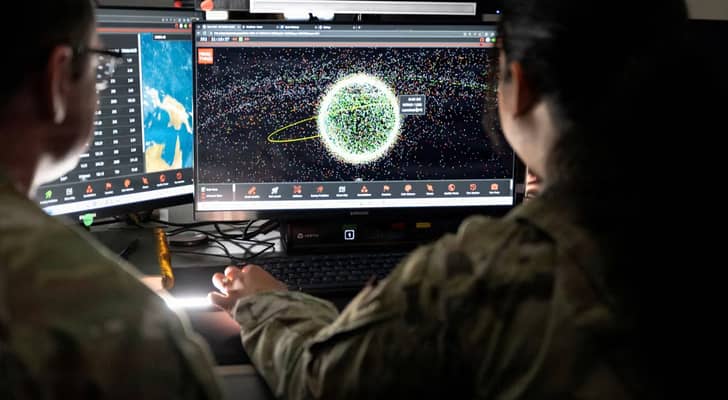
US Space Force Guardians assigned to Space Delta 5 monitor computer workstations at Vandenberg Space Force Base, California, December 18, 2025. US SPACE FORCES/DAVID DOZORETZ / VIA REUTERS.

US confirms orbital deployment of space control weapons
Note: AI technology was used to generate this article’s audio.
- US Space Force defined space control as using kinetic and non-kinetic means for offensive and defensive operations against adversary assets.
- The announcement follows escalating space rivalry with Russia and China, both viewed as threats to US space assets.
The United States Space Force has claimed that the US has weapons deployed in orbit, providing the first official confirmation of operational space-based combat capabilities.
A spokesperson for the service branch stated in an official release:
"The United States has deployed space control weapons in orbit capable of protecting joint US forces from hostile threats."
The statement did not disclose further specifics regarding the exact nature, specifications, or technical parameters of the deployed systems.
The spokesperson explained that the concept of space control encompasses a full range of missions required to compete with adversaries and establish control using both kinetic and non-kinetic means to affect their capabilities.
The spokesperson added that these assets can be employed for both offensive and defensive purposes.
Competition with Beijing and Moscow
The announcement comes against a backdrop of growing space competition between the United States and its principal rivals, Russia and China, both of which Washington views as potential threats to its strategic interests in space.
According to the US Space Force, China is "developing and operating space and counter-space capabilities as part of its strategy to modernize its armed forces."
Meanwhile, the service noted that Russia "views space as a battleground and believes that superiority in space represents a decisive factor in future conflicts."
The militarization of outer space is not a new phenomenon, tracing back to the origins of the space race itself. Following the launch of Sputnik in 1957, the United States and the Soviet Union began studying the military applications of space, including satellite weaponization and anti-satellite (ASAT) technologies.
While early cold war anxieties focused on the potential deployment of nuclear weapons in orbit, major powers and other nations signed the Outer Space Treaty in 1967, which explicitly banned placing weapons of mass destruction in orbit.
Since then, the US, Russia, China, and India have continued to develop space combat capabilities not covered by the treaty—particularly systems capable of targeting satellites critical to military communications, reconnaissance, and navigation.