US Air Force colonel identified by his mission call sign "Bravo", Speaking in his first public interview with American journalist Norah O'Donnell on CBS' 60 Minutes.

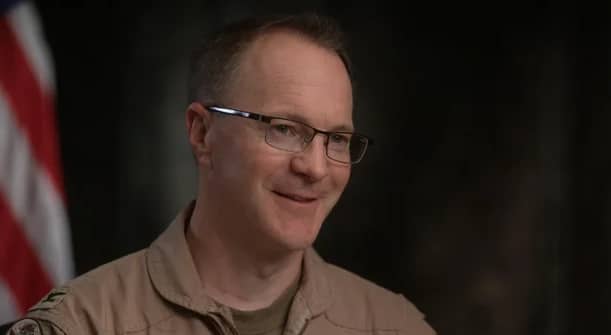
Downed US Air Force officer describes survival ordeal
Note: AI technology was used to generate this article’s audio.
- A US Air Force pilot survived a high-speed ejection over Iran with a damaged parachute, breaking multiple bones before hiding for two days.
- Despite severe injuries, the pilot climbed a 7,000-foot ridge to evade Iranian forces who came within hundreds of meters.
- Over 90 US troops launched a ground operation to rescue him 50 hours later—the first US boots on the ground in Iran in 46 years.
A US Air Force colonel identified by his mission call sign "Bravo" has shared his harrowing story of survival after being shot down over Iran in April.
Speaking in his first public interview with American journalist Norah O'Donnell on CBS' 60 Minutes, the weapons-systems officer described free-falling to the ground with a damaged parachute and evading Iranian search parties for two days before being rescued in a historic special operations mission.
Bravo was the backseater on a two-man F-15E Strike Eagle crew—mission call sign "Dude 44"—piloted by an aviator known as "Alpha".
On the night of April 2, their $30 million aircraft was struck by an Iranian shoulder-fired missile near a mountainous region south of Isfahan while conducting a strike on industrial facilities linked to Iran's drone and missile program.
When the missile struck—a moment Bravo described as "getting hit by a freight train"—the aircraft was critically damaged, forcing both crew members to eject.
The explosion damaged Bravo's parachute, leaving him free-falling toward the mountain desert at an estimated 70 to 100 mph.
"At one point when I looked up and saw no parachute, that was the most terrifying thing I've ever seen," Bravo told Norah O'Donnell on 60 Minutes. "So I paused, right then, and I prayed, 'Lord, your will be done. But if I'm getting through this, I need help.'"
Pilot rescued early
Bravo landed hard roughly five miles away from his pilot, Alpha. The high-speed impact broke Bravo's back, arm, and shoulder, but he immediately moved away from his landing site.
Recognizing that his safest tactic was to gain high ground, he hiked and climbed up a 7,000-foot ridgeline despite his broken bones, quipping: "Never let a lack of motivation put you on Iranian TV."
Back in the US, Defense Secretary Pete Hegseth was woken in the middle of the night and ordered recovery planning, asserting that US forces were going to retrieve the crew regardless of the situation.
Six hours after the crash, US forces successfully extracted Alpha during a risky daytime raid under heavy fire. Alpha, who has since returned to flying duties, declined a 60 Minutes interview for security reasons but expressed deep gratitude to the combat search-and-rescue teams in a statement provided to CBS.
Meanwhile, Bravo remained stranded, hiding on the high ridgeline with almost no food or water in cold mountain desert winds.
Iranian media broadcast footage of the jet's wreckage, and armed search teams closed in, getting to within a few hundred meters of Bravo's location.
Gen. Dan Caine, Chairman of the Joint Chiefs of Staff, noted that Iranian ground forces exhibited "clear intent" to locate the downed airman.
CIA deception
To facilitate the extraction, the CIA launched a multi-pronged deception campaign to confuse Iranian search units while utilizing top-secret technology to pinpoint Bravo's exact coordinates.
US bombers and drones struck nearby Islamic Revolutionary Guard Corps forces to clear a path for the rescue operations.
The complex operation deployed two large search-and-rescue planes onto a makeshift desert airstrip, launching "Little Bird" helicopters to pick up Bravo from the mountain ridge.
Over 90 US service members landed on the ground—marking the first US boots on the ground in Iran in 46 years—supported by several hundred personnel in the air and thousands behind the scenes.
During the extraction, the landing gear of the main rescue aircraft became stuck in deep desert sand, stranding the elite forces until a clandestine Air Force unit arrived to assist.
To protect sensitive technology from being compromised, US forces deliberately destroyed the two stranded aircraft (valued at roughly $100 million each) and the Little Bird helicopters before departing.
Fifty hours after his aircraft was shot down, Bravo was brought to safety as the sun rose on Easter Sunday.
Reflecting on his survival and the massive military effort to rescue him, Bravo told 60 Minutes that the mission stands as an example of America's promise to "leave no man behind."