

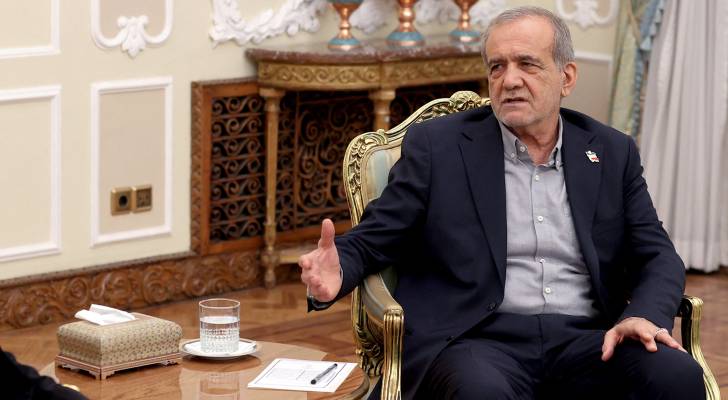
Day 184 | Iran's president admits sanctions impacting economy
Iran’s President Masoud Pezeshkian has admitted that US sanctions on his country are hurting its economy, despite just days ago insisting they would achieve nothing.
“Some say sanctions have no effect at all; to those people, I really don’t know what to say,” Pezeshkian told state TV in an interview late on Friday.
“We are in a war situation, and we must accept these wartime conditions,” he added.
On Monday, US Treasury Secretary Scott Bessent laid out plans for the “economic asphyxiation” of Iran, warning of dire consequences for countries that do not join the American campaign.
The new measures build on a sanctions regime by the US and allies that has been in place since 2018 when President Donald Trump withdrew from an international deal struck with Tehran on its nuclear program.
Pezeshkian said Friday that Iran’s exports and imports had fallen by 25 to 35 percent in recent months as the US maintains a naval blockade of Iranian ports.
The president said the price of petrol should be increased in Iran to account for the fall in trade.
“We should raise the price of the third-tier quota... For example, from 5,000 tomans to 10,000 tomans,” he added.
That quota refers to one of several consumption rates that determine the price an Iranian consumer is charged.
Iran, a major oil producer with some of the world’s cheapest fuel, has for years heavily subsidised petrol, making any changes to pricing politically sensitive.
Vice President Mohammad Jafar Ghaempanah said Wednesday that the US blockade had prevented his country from importing enough petrol to cover a shortfall in domestic production.
But Pezeshkian said that same day that the latest US sanctions “will not achieve anything.”
“We will stand firm against economic pressures, as we have done so far and will continue to do,” Pezeshkian told state media.
Day 185 of the US-‘Israeli’ war on Iran
For further updates - visit the link below.
Read more: Day 185 | US strikes Iranian rocket launchers, marking first attack in a month
Iranian MP warns “retaliation is coming”
Ebrahim Azizi, head of Iran’s parliamentary National Security and Foreign Policy Commission, issued a stark warning on Sunday, writing on X: “Test our will once more, and pay a heavier price. Retaliation is coming; JUST RUN!”
The post came hours after US forces struck two Islamic Revolutionary Guard Corps (IRGC) rocket launchers on Iran’s Larak Island in the Strait of Hormuz.
A US official said the launchers were being prepared to fire missiles carrying naval mines into the vital shipping lane.
Iran’s IRGC confirmed the attack, reporting that several fighters and civilians were killed or wounded, and vowed that the “terrorist act of aggression” would be met with a response and punishment.
Test our will once more, and pay a heavier price.
— ابراهیم عزیزی (@Ebrahimazizi33) August 30, 2026
Retaliation is coming;
JUST RUN!
IRGC says US “will pay” for “fatal mistake” of carrying out strike on Iranian forces
Iran warned on Sunday that the US will “pay the consequences of this miscalculation in both the economic and military arenas,” according to Iran’s Islamic Revolutionary Guards Corps (IRGC).
“This action was a strategic and fatal mistake by the Trump regime during the economic war,” said Sardar Mohebbi, an IRGC spokesman.
“The enemy will pay the consequences of this miscalculation in both the economic and military arenas,” he added.
The US military carried out a strike on Larak Island earlier to prevent Iranian forces from laying mines in the Strait of Hormuz, according to Axios.
US struck Iran to prevent deploying mines in Hormuz: Axios
The US military struck Iranian military targets to prevent the deployment of sea mines in the Strait of Hormuz, according to an anonymous US official cited by Axios.
This is the first US strike in Iran since late July.
Iran’s Islamic Revolutionary Guard Corps (IRGC) confirmed the strike, and vowed retaliation.
“Once again, out of desperation…the American-Zionist enemy…committed an aggressive act by attacking Larak Island,” the IRGC said in a statement cited by Iranian media.
“This action will be answered by the children of Islamic Iran and will result in the punishment of the aggressor,” the statement warned.
Iran vows retaliation for US strike
Iran’s Islamic Revolutionary Guard Corps (IRGC) vowed retaliation for what it said was a US strike on Larak Island earlier today.
“Once again, out of desperation…the American-Zionist enemy…committed an aggressive act by attacking Larak Island,” the IRGC said in a statement cited by Iranian media.
“This action will be answered by the children of Islamic Iran and will result in the punishment of the aggressor,” the statement warned.
Iranian media says US drone struck Larak Island
A US drone struck a target on Larak Island, according to semi-official and IRGC-affiliated Iranian media.
“Preliminary information indicates that a US drone attack targeted a site on Lark Island in Hormozgan province about an hour ago,” Tasnim News Agency said in its report.
“Some initial unofficial reports say two people have been killed and two others injured in the attack,” It added.
US reportedly strikes Iranian missile launchers on Larak Island
US forces are said to have struck on Sunday two Islamic Revolutionary Guard Corps missile launchers on Iran’s Larak Island on Sunday, according to an anonymous US official cited by Al Jazeera.
The launchers were preparing to fire missiles carrying naval mines toward the Strait of Hormuz, according to the official.
The official also said US forces had completed clearing mines from international shipping routes in the strategic waterway.
Bahrain Coast Guard says investigating report of hijacked boat
Bahrain said Sunday its Coast Guard is investigating a report that a Bahraini boat was subjected to a hijacking, according to a statement by the Ministry of Interior on X.
The statement provided no further details.
VIDEO - Houthis footage claiming attacks on “Saudi” military targets in Yemen
Aerial footage released by the Iran-backed Houthi group in Yemen shows what it says are attacks targeting Saudi military gatherings and vehicles using “Rajum” drones on several fronts in Yemen.
Tanker transiting Strait of Hormuz hit by unknown projectile: UKMTO
A tanker transiting the Strait of Hormuz off Oman’s coast has been struck by an “unknown projectile,” according to a report received by the United Kingdom Maritime Trade Operations (UKMTO).
“UKMTO has received a time-late report of an incident 12NM north of Khasab, Oman. A tanker has been struck by an unknown projectile whilst transiting inbound in the Strait of Hormuz,” it said in a statement.
“No casualties or environmental impact are reported at this time,” it added.
‘Israeli’ teens charged with spying for Iran after Telegram recruitment
Two ‘Israeli’ teenagers from Kiryat Motzkin, Haifa, have been charged with carrying out surveillance, vandalism and recruitment tasks for an Iranian intelligence agent after being approached online.
The Haifa District Attorney’s Office filed the indictment on Sunday in the Haifa District Juvenile Court against the minors, aged 14 and 16.
Prosecutors say one of them made initial contact in June 2026 through a Telegram group focused on job postings with a man using the alias “Daniel.”
The agent offered payment for assignments, and the first teen later involved his friend.
Both continued the activity even after suspecting and then confirming the handler’s ties to Iran.
According to the indictment, the pair gathered footage of shopping malls in the Herzliya and Tel Aviv areas and passed on details about entrances and the number of security guards at one site.
They also spray-painted slogans in the Kiryat Motzkin area and attempted to expand the network by forming a Telegram group to recruit other minors willing to take on “high-risk” missions.
One of the teens allegedly posed as a soldier in the ‘Israeli’ military’s elite Unit 8200 intelligence unit in an effort to obtain additional assignments.
They received payments totaling several hundred shekels, partly in cryptocurrency.
Police said the investigation began when one of the suspects was arrested upon arrival at Ben Gurion Airport.
The main defendant faces counts including contact with a foreign agent, providing information for the benefit of the enemy, and property damage; the second is charged with assisting contact with a foreign agent and vandalism.
The court has barred publication of identifying details.
The ‘Israeli’ police stated that the case involves several minors from the Haifa and Krayot area who maintained ongoing contact with a foreign agent working on behalf of Iranian intelligence.
The teenagers were offered money in exchange for executing tasks for an individual who later admitted his connection to Iran.
This indictment forms part of a broader pattern in which Iranian operatives have used Telegram and other platforms to recruit ‘Israelis’, often starting with seemingly minor paid jobs that escalate into full-fledged intelligence-gathering tasks. .
US munition depletion in Iran war raises “soft spots” against Russia & China: report
The heavy expenditure of advanced US munitions in the ongoing war with Iran has left critical gaps in stockpiles needed to deter or respond to threats from China and Russia, according to anonymous US officials cited in a Wall Street Journal report.
Military planners say the rapid transfer of weapons to the Middle East has diminished American firepower elsewhere.
Inventories in Europe of PAC-3 Patriot air-defense interceptors and ATACMS surface-to-surface missiles have fallen to levels described as “beyond critical,” some officials told the Journal.
THAAD interceptors and counter-drone systems have also been redirected, forcing US European Command to adjust operational plans.
By mid-July, the United States had expended roughly 1,700 Patriot interceptors and more than 200 THAAD antimissile interceptors, while Navy ships fired about 150 Standard Missile interceptors against Iranian missiles and drones, according to the report.
Iran had launched more than 1,500 ballistic missiles and 6,000 large drones during the conflict.
Air-defense units shifted from Japan, South Korea, and Germany have created “soft spots” that could take years to refill.
Officials assess that the Pentagon may now be unable to fully execute existing contingency plans to defend Taiwan if China moves against the island in the near term.
While neither a full-scale Russian attack on NATO nor a Chinese invasion of Taiwan is viewed as imminent, the shortages are creating vulnerabilities in Washington’s global posture.
Experts including Tom Karako of the Center for Strategic and International Studies have described the depletion as a “generational annihilation of the means of conventional deterrence,” arguing it is “impossible for that not to have a significant effect on the decision calculus of Russia and China.”
Replenishing the stocks will take years.
Production rates for high-end systems such as Patriots and Tomahawks remain limited, and the defense industrial base is already stretched by prior aid to Ukraine.
Analysts note that pre-war inventories were already insufficient for a high-intensity fight with a peer competitor.
The White House and Pentagon have rejected claims of scarcity.
White House spokeswoman Anna Kelly said the US military “has more than enough munitions, ammo, and stockpiles to serve all of President Trump’s strategic goals and beyond.”
Pentagon spokesman Sean Parnell called reports of shortages “false.”
Allies in Asia and Europe have expressed growing concern that the prolonged Middle East campaign is eroding readiness for potential crises closer to home.
Iran army stopped 30 vessels attempting to pass Hormuz since Aug. 19: Mehr
Iran’s army has stopped 30 “violating vessels” that have attempted to pass through the Strait of Hormuz since August 19, according to IRGC-affiliated Mehr News Agency, citing a source.
“The claims made about minesweeping cannot be confirmed with any data, and the American side has not yet provided any documentation in this regard,” the report added, contradicting US President Donald Trump’s claims that all sea mines were cleared from the Strait of Hormuz.
“The claims made about the amount of oil exports lack a documented basis and appear to be carried out within the framework of the American media war to influence global markets, especially in the energy sector,” it added.
Khamenei urges Muslim leaders to confront “true enemy"
- Khamenei calls US, ‘Israel’ enemies of Islamic unity.
- Iran leader urges Islamic nations to unite against foes.
- Khamenei denounces US, ‘Israel’ during Unity Week.
- Iran’s Khamenei calls for Muslim unity against foreign interference.
Iran's Supreme Leader Mojtaba Khamenei urged leaders of Muslim nations to unite and recognize what he described as their "true enemy," accusing the United States and 'Israel' of orchestrating campaigns to undermine regional cohesion.
In an official address broadcast by Iran's state media (IRIB) to mark "Islamic Unity Week," Khamenei directed his recommendation to regional governments, specifically targeting decision-makers in West Asia and the Persian Gulf.
"My emphatic and repeated recommendation to the rulers of Islamic countries, particularly those in West Asia and along the Gulf, is to identify your true enemy, understand its plan and confront it," Khamenei stated.
"Sworn enemies" of pan-Islamic solidarity
During his message, Khamenei emphasized that solidarity across the Islamic world is vital for establishing regional independence and resisting external military and political pressures.
He claimed that Washington and Tel Aviv are actively plotting to exploit theological, political, and economic divisions among Muslim nations to maintain influence across the Middle East.
"The criminal rulers of America and the fake Zionist regime are sworn enemies of this unity and friendship," Khamenei claimed. He added that U.S. and 'Israeli' policies are not aimed solely at the Islamic Republic or its regional allies, but represent hostility toward the "entire Muslim Ummah."
Remarks follow six months of war
The Supreme Leader's address comes amid unstable regional dynamics following joint U.S.-'Israeli' military strikes against Iranian targets earlier in the year, which prompted retaliatory actions across the region.
A temporary ceasefire reached in April, followed by preliminary diplomatic memorandums in June, subsequently collapsed, leading to renewed military exchanges between Tehran and Washington before a recent halt in bombardments.
US sailor who jumped from aircraft carrier faces disciplinary action
A 19-year-old US Navy sailor who jumped from the aircraft carrier USS Abraham Lincoln earlier this month is facing non-judicial punishment, according to charging documents and his wife’s account reported by MS NOW.
The sailor went overboard on August 3 in what his wife has described as a suicide attempt amid the ship’s record-length deployment.
He spent about an hour in the water before a search-and-rescue helicopter recovered him.
He was treated aboard the carrier, medically evacuated, and returned to San Diego on August 13.
There he spent five days at Naval Medical Center San Diego (Balboa).
His wife said he saw neither a psychiatrist nor a therapist during that stay and was ordered to report back to work immediately upon release.
His first therapy appointment did not occur until August 26.
Charging documents reviewed by MS NOW accuse the sailor of violating Article 83 of the Uniform Code of Military Justice for “malingering”—defined as intentionally faking an illness or inflicting self-injury to avoid work, duty, or service—and Article 86 for absence without leave.
The case is being handled through non-judicial punishment, commonly known as a captain’s mast, rather than a court-martial.
Documents indicate he could forfeit up to half his normal pay.
The sailor and his wife, both 19, have a 3½-year-old son and a daughter born in February while he was deployed.
His wife said he repeatedly requested paternity leave and was denied each time.
She also said he had sought help for his mental health from his chain of command and the ship’s medical team before the incident but felt dismissed.
In a July 21 text to his wife, he wrote that “the boat is finally getting to me” and expressed doubt he could finish the deployment.
“I think they’re insane for doing this to people who need mental help,” the wife told MS NOW.
“Instead of giving them help, this is just another huge stressor.”
She spoke on condition of anonymity because of the sensitive nature of the disciplinary process.
The USS Abraham Lincoln has been at sea for more than 250 consecutive days without a port call while supporting operations related to the war with Iran, according to multiple reports.
Families and some media accounts have raised concerns about morale, living conditions, and mental health aboard the roughly 5,000-person ship.
A Navy official has stated there has not been an increase in suicidal ideations or attempts aboard the vessel and noted that one sailor went overboard, was recovered, treated, and transferred for further care.
A Navy spokesperson told MS NOW the service is “fully committed to the health and wellbeing of every Sailor,” that mental health resources are available 24/7, and that “asking for help is a sign of strength.”
Previous day
For coverage of the previous day, visit the link below.
Read more: Day 183 | Tehran pledges defense, diplomacy as US blockade persists


