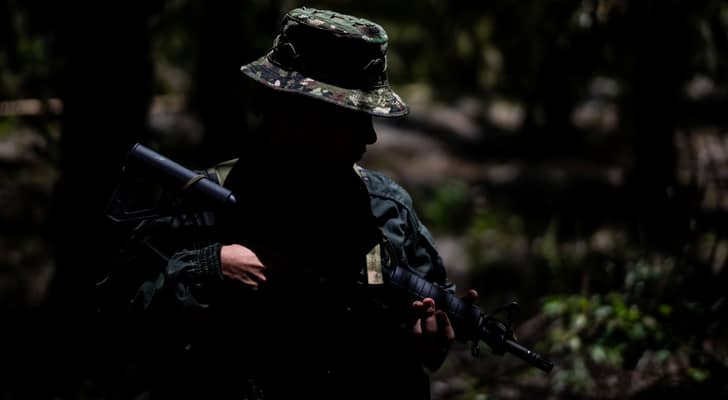
A 17-year-old boy recruited by the 33rd Front of the EMBF, a dissident group of the demobilized FARC, operating in Colombia’s Catatumbo region near the Venezuelan border. © 2026 Federico Ríos Escobar

Armed groups use Facebook, TikTok for child recruitment in Colombia
Note: AI technology was used to generate this article’s audio.
- Colombia armed groups recruit 1,500 children since 2021.
- FARC dissidents drive surge in child recruitment.
- Armed groups lure Colombian children through social media.
- Indigenous children make up nearly half of victims.
- Colombia’s justice system fails to curb child recruitment.
Illegal armed groups across Colombia are recruiting children at an escalating rate while government prevention mechanisms and legal institutions fail to protect vulnerable communities, Human Rights Watch (HRW) warned in a report published Monday, August 24.
The 102-page study, titled “‘I Thought I’d Never See My Mom Again’: Recruitment and Use of Children by Colombian Armed Groups,” details how armed factions exploit poverty, domestic instability, and educational barriers to draw minors into their ranks.
"Armed groups in Colombia are recruiting children with impunity, as protection systems are failing, and social media platforms have become a more effective recruiting ground," stated Juanita Goebertus, Americas director at Human Rights Watch. "Every child recruited is indicative of a government failure."
Algorithms, financial bounties accelerate recruitment
According to data from the Colombian Ombudsperson's Office analyzed by Human Rights Watch, dissident groups originating from the demobilized FARC guerrillas account for the vast majority of reported incidents.
To sustain their forces, these groups rely heavily on digital platforms alongside paid civilian intermediaries.
Researchers examined over 40 posts and 70 accounts on networks including TikTok and Facebook that glorified combatant life, posted fake job offers, and used public chat forums to contact minors.
HRW noted that algorithmic promotion on these platforms often expanded the reach of these recruitment drives.
Both Meta and ByteDance confirmed to HRW that their policies ban violent organizations and stated that flagged accounts were removed.
In physical recruitment operations, intermediary networks receive bounties of up to $1,000 per child, frequently operating near rural boarding schools.
Once inducted, children are routinely transferred to distant regions to erase family ties. In addition to combat roles, minors are forced to gather intelligence, act as messengers, guard hostages, and handle drug shipments, while recruited girls face severe risks of sexual violence.
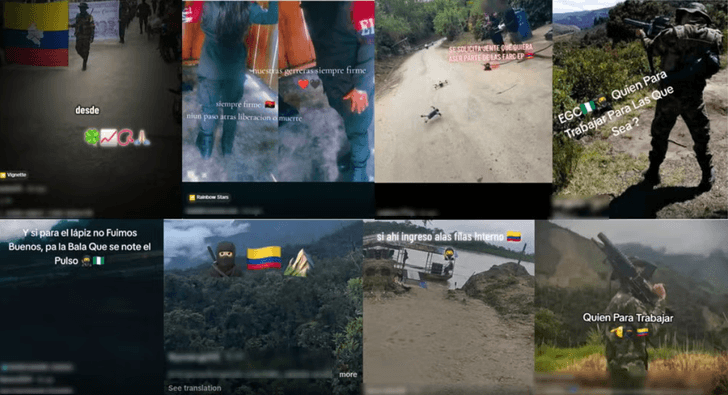
Screenshots from videos posted to TikTok in July 2026 showing the use of emojis to signal affiliation and explicitly seek new combatants for armed groups.
Policy gaps, unequal treatment, and judicial impunity
The report criticizes the Colombian government’s institutional response, pointing out that the primary framework—the National Public Policy on Prevention—has not been updated since 2018 and lacks a clear action plan or dedicated budget.
Furthermore, the state body responsible for coordinating protection, the Intersectoral Commission for the Prevention of the Recruitment and Use of Children (CIPRUNNA), lacks the resources and authority to enforce policies locally.
Human Rights Watch also noted structural inequalities in how released children are treated.
Minors who escape non-political organized crime gangs are denied access to specialized victim protection and reparation programs, leaving them vulnerable to criminal prosecution or standard, underfunded social programs.
With state support largely absent, local community organizations—such as unarmed Indigenous guards—have attempted to rescue children from armed encampments at extreme personal risk, leading to retaliatory assassinations of community leaders.
HRW called on the administration of President Abelardo de la Espriella to adopt a comprehensive security and judicial framework, overhaul municipal child protection agencies, and collaborate directly with Indigenous and community authorities to stop child recruitment.