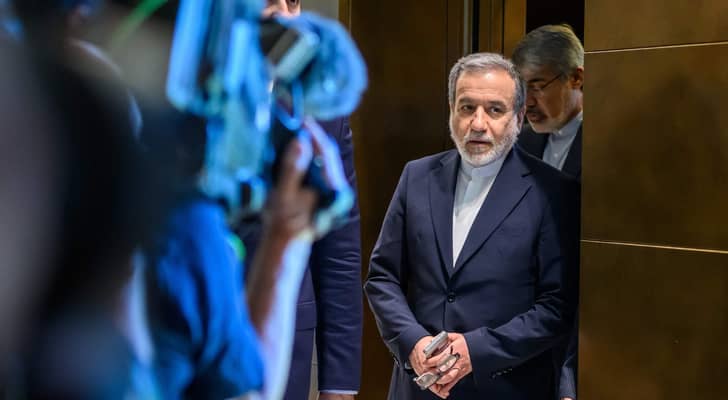
Iran’s Ghalibaf: ‘We stay out of Iraq’s affairs’
Note: AI technology was used to generate this article’s audio.
- Iranian Parliament Speaker Mohammad Bagher Ghalibaf said Tehran does not interfere in Iraq’s internal affairs and will support any agreement between armed factions and the Iraqi government.
- Baghdad has set a September 30 deadline for paramilitary groups to integrate into state security structures and surrender independent arsenals.
Iranian Parliament Speaker and chief negotiator Mohammad Bagher Ghalibaf said Tehran does not interfere in Iraq’s internal affairs and would support any agreement reached between Iraqi factions and the government.
“Iran does not interfere in Iraq’s internal affairs,” Ghalibaf said in a statement, adding that Tehran would support any agreement reached between the factions and Baghdad.
The remarks come as Iraq moves to bring armed groups under state control, with the government setting a September 30 deadline for paramilitary factions to integrate into formal security structures and give up independent weapons stockpiles.
The campaign to centralize weapons accelerated following joint US-Saudi air attacks in Iraq in July.
The strikes targeted militia headquarters across the country in response to drone attacks that were alleged to have been launched from Iraq against Saudi oil infrastructure and US forces.
Most of the factions affected by the government’s disarmament drive are Shia armed groups, several of which maintain close ties with Iran.
Some groups have already signaled their willingness to bring their forces under official state command.
Saraya al-Salam, Asaib Ahl al-Haq and Kataib al-Imam Ali have publicly indicated agreements or positions supporting a transition toward formal state structures.
Other groups have rejected Baghdad’s demand for complete disarmament.
Kataib Hezbollah and Harakat al-Nujaba have explicitly opposed surrendering their weapons, arguing that their arsenals remain necessary for what they describe as resistance against potential foreign attacks.
The dispute presents a major challenge for the Iraqi government as the September 30 deadline approaches, with Baghdad seeking to consolidate control over all weapons while several powerful armed factions remain opposed to fully relinquishing their military capabilities.