
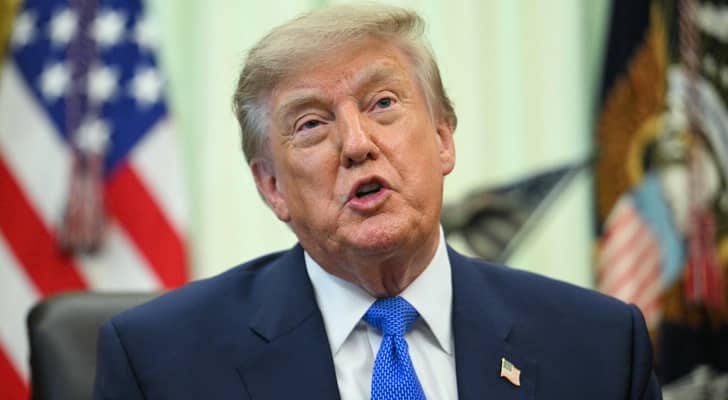
US President Donald Trump speaks in the Oval Office of the White House in Washington, DC.

Day 165 | Trump extends shipping waiver, with limits, to aid energy flow
President Donald Trump on Monday again extended a waiver that allows foreign ships to carry oil and other commodities between US ports, as the war on Iran continues to disrupt energy flows and elevate costs.
The 90-day extension of relief from the Jones Act -- which requires cargo between US ports to move on US vessels -- comes shortly before an earlier waiver was due to expire in mid-August.
But the scope covered is narrower this time, focusing more on the transport of energy, a White House official confirmed Monday.
"Today, the Trump Administration issued a 90-day extension to the Jones Act waiver to ensure our military and key industries maintain uninterrupted access to critical resources," said White House spokeswoman Taylor Rogers.
"Data shows the waiver has driven a significant increase in domestic deliveries of essential products such as gasoline, diesel, and jet fuel," she added.
The relief this time also calls for reviews on the availability of US vessels before determining if the waiver applies to individual voyages.
The Cato Institute's Colin Grabow and Scott Lincicome estimate that more than 54 million barrels of energy products have moved between US ports on over 200 voyages since March, when an earlier waiver was introduced.
"The waiver has unleashed domestic commerce that the Jones Act previously prevented," Grabow and Lincicome said.
"In most cases, these voyages took place on vessels with no connection to US adversaries like China and supplied American companies with American energy products that would've otherwise been imported at a much higher cost," they added.
Oil prices have surged after US and ‘Israeli’ strikes targeting Iran from late February sparked a war that has since engulfed the Middle East.
Tehran retaliated by virtually closing off the Strait of Hormuz, a critical waterway for global energy transit.
Gasoline prices in the United States have since jumped, straining household budgets as the key midterm elections draw close.
Under the 1920 Jones Act, cargo moved by water between US ports has to be transported on vessels that are US-built, US-owned and registered under the US flag. The aim was to promote American shipbuilding.
The Trump administration in March granted a 60-day waiver to temporarily lift this requirement, and extended relief in late April as economic fallout from the conflict persisted.
For now, negotiations on ending the war and reopening the Strait of Hormuz have stalled.
Thread ended
This live thread has ended. Follow our online coverage of day 166 of the war.
Read more: Day 166 | US helicopter fired on ship that tried to break Iran ports blockade
Iran ties Hormuz reopening to ceasefire in Gaza, Lebanon
- Iran ties Hormuz reopening to US concessions.
- Rezaee demands an end to war and blockade.
- Iran seeks release of frozen assets.
- Tehran calls for a region-wide ceasefire, including Gaza and Lebanon.
Mohsen Rezaee, Secretary of the Supreme National Security Council of Iran, issued a firm statement regarding maritime access through the Strait of Hormuz, declaring that the waterway will remain closed until the United States meets a series of Iranian conditions.
Writing in a post on X, Rezaee outlined Tehran's official stance regarding the strategic maritime chokepoint amid ongoing military and diplomatic confrontations.
"IRAN’s message is clear: the Strait of Hormuz will not reopen until the U.S. ends the war and blockade, releases Iran’s frozen assets, and agrees to a region-wide ceasefire, including in Lebanon and Gaza. Until all conditions are met, the Strait will remain closed," Rezaee stated.
IRAN’s message is clear: the Strait of Hormuz will not reopen until the U.S. ends the war and blockade, releases Iran’s frozen assets, and agrees to a region-wide ceasefire, including in Lebanon and Gaza. Until all conditions are met, the Strait will remain closed.
— محسن رضایی (@ir_rezaee) August 11, 2026
Tehran maintains firm stance
Rezaee's declaration underscores Iran's position linking the reopening of the vital transit route to broad political, financial, and military resolutions.
By explicitly naming Lebanon and Gaza alongside the demand for an end to the US blockade and war, the Supreme National Security Council secretary signaled that Tehran views the closure of the Strait as directly connected to regional conflicts across the Middle East.
IRGC warns US power grids face risk if threats resume
Iran's Islamic Revolutionary Guard Corps (IRGC) has issued a direct warning stating that any renewed threats against the country will put hundreds of thousands of miles of American energy lines and power plants at risk.
The military branch asserted that its targeted counter-threat capabilities extend directly to critical US power infrastructure should regional tensions escalate further.
Four sailors killed, four injured in Houthi attack on ship
- Three Pakistani and one Indonesian sailor killed.
A Houthi attack targeting a commercial vessel in the Bab al-Mandab Strait has left four sailors dead and four others wounded, according to Yemen's Ministry of Transport.
Ministry confirms nationalities of victims
In a subsequent statement detailing the casualties, Yemen's Ministry of Transport confirmed the identities of those killed during the maritime strike.
The fatalities resulting from the attack on the ship in Bab al-Mandab are three Pakistani sailors and one Indonesian sailor, the Ministry of Transport stated.
The incident marks another escalation in attacks against commercial shipping navigating through the strategic choke point of the Bab al-Mandab Strait.
US strikes Panamanian ship tried to defy Iran blockade: WSJ
- US helicopter strikes Panama-flagged ship.
- Vessel hit while allegedly defying Iran blockade.
- Strike sparks fire; 17 crew members safe.
- Crew reportedly attempts transfer to another vessel.
A US military helicopter fired at the rudder of a Panama-flagged container ship after the vessel's crew ignored explicit warnings from US personnel enforcing a naval blockade on Iranian ports, The Wall Street Journal reported on Tuesday, citing a US official with knowledge of the matter.
The vessel, identified as the Vela Nova, was sailing westbound through the Gulf of Oman when the engagement took place.
Crew transfer attempt
According to initial assessments from British maritime risk management group Vanguard and a maritime security source, the Vela Nova was struck by a helicopter-launched missile approximately 71 nautical miles off the coast of Pakistan.
Vanguard reported that the missile impact triggered a fire on board the container ship, which was subsequently extinguished.
"The missile struck the vessel, causing a fire that was subsequently extinguished," Vanguard stated in its initial report, confirming that all 17 crew members were accounted for.
There were no immediate reports of casualties resulting from the strike.
Following the engagement, the Vela Nova appeared to be attempting to transfer its crew to another civilian vessel operating in the area.
Pakistan says US, Iran nearing peace deal
Pakistan’s Defense Minister said the United States and Iran are moving closer to reaching an agreement that could lead to lasting peace, Bloomberg reported.
He said recent developments over the past several days indicate that Washington and Tehran are approaching a potential peace agreement.
Two injured in rocket attack near Erbil
Two people were injured in a three-rocket attack targeting a site belonging to the Iranian Kurdish opposition group Kurdistan Toilers Party northeast of Erbil, the group said.
Houthi attack on ship kills 3, says Yemeni government
Yemen’s internationally recognized government says at least three people were killed in a Houthi attack on an unidentified commercial vessel in the Bab al-Mandeb Strait.
The government did not provide further details about the vessel or the circumstances of the attack.
There was no immediate comment from the Houthis.
Cargo vessel hit by projectile off Yemen, casualties reported: UKMTO
A cargo vessel in the southern Red Sea was struck by an unknown projectile off the coast of al-Makha (Mocha), Yemen, the United Kingdom Maritime Trade Operations (UKMTO) said.
UKMTO said the vessel was hit by an unknown projectile, resulting in casualties. Authorities are investigating the incident.
It advised vessels transiting the area to exercise caution and report any suspicious activity to UKMTO.
Pakistan’s interior minister arrives in Tehran
Pakistan’s Interior Minister Mohsin Naqvi has arrived in Tehran for talks with Iranian officials, Iran’s Mehr News Agency reported.
Qatar says Iran-Oman talks on Hormuz reached 'advanced stage'
Qatar’s Foreign Ministry spokesperson said talks between Oman and Iran have reached an advanced stage, describing the negotiations as being at a “critical juncture.”
The spokesperson said Qatar supports all efforts to reduce tensions and wants the Strait of Hormuz reopened as soon as possible.
Qatar said it has received positive feedback from both Oman and Iran and supports any arrangement that guarantees the security of the Strait of Hormuz and freedom of navigation.
The spokesperson said negotiations between Oman and Iran over the strait are still ongoing, adding that regional security is a collective responsibility requiring joint regional coordination.
Iran to restore 95 million cubic meters of daily gas output
Iran plans to restore 95 million cubic meters of natural gas production capacity per day by the end of September, the Oil Ministry said Tuesday.
The recovery effort is part of Tehran’s plans to repair energy infrastructure damaged during the war with ‘Israel’ and the United States.
Oil Minister Mohsen Paknejad said 95 million cubic meters per day of lost production capacity would be restored following damage to gas-processing facilities in Asaluyeh.
The ministry said reconstruction of four damaged processing plants is progressing rapidly after debris was cleared, rebuilding plans were prepared and contractors began work.
A senior Iranian official said in July that the country expected to restore around 100 million cubic meters per day of natural gas production capacity “in the coming months.”
Airstrikes had knocked around 230 million cubic meters of daily production capacity offline since the war began in late February, according to Iranian officials.
Tanker, military forces involved in incident in Gulf of Oman: UKMTO
The United Kingdom Maritime Trade Operations (UKMTO) says it received a report of an incident involving a tanker and military forces in the Gulf of Oman.
UKMTO provided no further details but said authorities are aware of the incident and relevant investigations are ongoing.
Araghchi: Iranian forces defeated 'world’s largest army'
Iranian Foreign Minister Abbas Araghchi said the recent war demonstrated Iran’s military resilience, claiming that its armed forces defeated the world’s largest army.
According to Tasnim News Agency, Araghchi said the war proved Iran was a “hard power” that could not be defeated.
He added that few had expected Iran to withstand the United States, which he described as being backed by the ‘Israeli’ regime, to such an extent.
'Israel's' Smotrich says he’s proud of West Bank settlement expansion
Far-right ‘Israeli’ Finance Minister Bezalel Smotrich has praised the government’s expansion of illegal settlements in the occupied West Bank and its steps toward annexation.
Responding to a report by settlement watchdog Peace Now, Smotrich said his government was reversing policies pursued over the past 30 years.
Smotrich said he was proud of the settlement expansion carried out under his oversight, adding that the measures were intended to prevent the establishment of a Palestinian state.
He said the changes underway in the occupied West Bank were only the beginning.
Smotrich rejected Peace Now’s description of the policies as annexation, instead portraying them as an effort by ‘Israel’ to establish what he called a necessary security zone.
Trump says US has three strategies for dealing with Iran
US President Donald Trump said the US is engaged in negotiations with Iran while accusing Iranian officials of using deceptive tactics during talks.
Speaking to Real America’s Voice, Trump said Iranian negotiators are “very cunning” and claimed they sometimes agree to terms before publicly denying they did so.
Trump said the US has three strategies for dealing with Iran. The first is closely monitoring the country and assessing its condition, while the second involves “hitting them very hard.”
The third strategy, he said, is economic pressure, which he said the US is pursuing regardless.
Trump also claimed Iran is facing inflation of 300%, that its currency is “almost worthless,” and that the government is unable to pay its soldiers.
He said the US controls a significant amount of Iranian money and assets.
Trump reiterated that Iran will not be allowed to obtain a nuclear weapon.
He also criticized the nuclear agreement reached under former President Barack Obama, calling it “disastrous” and claiming Iran would have acquired a nuclear weapon within five years had he not withdrawn from the deal.
Iran condemns ‘Israeli’ attacks in southern Lebanon
Iran’s Foreign Ministry spokesperson strongly condemned what he described as ‘Israeli’ attacks and crimes in Lebanon, particularly in the country’s south.
The spokesperson said the international community’s silence, especially that of the UN Security Council, had contributed to what he called the continued “arrogance” and aggression of ‘Israel’.
He also accused the US administration of being a “complicit partner” in ‘Israeli’ crimes in Lebanon, occupied Palestine and across the region, citing Washington’s comprehensive support for ‘Israel’.
The Iranian official praised what he called the “heroic resistance” and resilience of the Lebanese people in the face of ‘Israeli’ aggression and occupation.
Strait of Hormuz shipping traffic drops to six as US-Iran peace deal hopes fade
Shipping traffic through the Strait of Hormuz fell sharply on Monday as hopes for a peace deal between the US and Iran faded, Reuters reported.
Citing data from ship-tracking company Kpler, Reuters said six vessels transited the waterway, compared with a 10-day average of about 11. Four commodity vessels entered the strait, including two empty oil product tankers, while two vessels exited.
Before the war, about 130–140 ships typically passed through the strait each day.
Bab al-Mandeb remains stable
Traffic through the Bab al-Mandeb Strait remained largely unchanged. Kpler data showed 25 vessels crossed the strategic waterway linking the Gulf of Aden with the Red Sea on Monday, compared with a 10-day average of nearly 24 vessels.
The contrasting traffic levels highlight the continued disruption to shipping through the Strait of Hormuz, a key global energy route.
Iranian assassination threat forced Trump to fly secretly from Turkey: report
An Iranian assassination threat against President Donald Trump prompted an extraordinary secret operation last month, in which he flew from Turkey on a smaller military aircraft while the White House publicly stated he was aboard Air Force One, according to The Washington Post.
The operation occurred on July 8 as Trump departed a NATO summit in Ankara amid heightened US-Iran tensions following the collapse of negotiations and resumed American strikes.
Trump had arrived on a newer Boeing 747-8 donated by Qatar.
Due to a credible threat from Iranian proxy forces—reportedly involving a possible missile attack on his plane—he publicly boarded the older legacy Air Force One in view of cameras, only to be secretly transferred minutes later.
He was moved via an airport catering truck, typically used for loading meals and supplies, from the opposite side of the aircraft to a nearby Air Force C-32A, a modified Boeing 757.
Journalists and some White House staff boarded the legacy plane believing the president was with them; they were instructed to lower window shades. The older jet served as a decoy.
Defense Secretary Pete Hegseth also boarded the C-32A separately.
US officials described the threat as credible, with earlier reporting from The New York Times and CBS News confirming intelligence of Iranian proxies targeting Trump and whatever aircraft he used.
‘Israeli’ intelligence had previously shared warnings of plots against him.
The Qatar-gifted jet lacked the advanced defensive systems of the older Air Force One fleet.
At the time, Trump publicly downplayed the switch, saying he chose the older plane “for old time’s sake.”
He also repeatedly acknowledged the danger: “They want to take out the US leader – me,” he said. “I’m on every list. I saw this morning, I’m on every single one of their lists. And so far, I guess I’ve been a little bit lucky, but that maybe doesn’t last very long.”
He has called himself “No. 1 on the list for killing.”
The White House had maintained for weeks that Trump flew the former Air Force One from Turkey after the Qatari jet departed separately.
The Post’s reporting, based on an unnamed US official, revealed the elaborate ruse contradicted those statements.
Trump arrived at RAF Mildenhall in Britain on the C-32A shortly before the decoy plane.
The report notes that it is not clear how Trump was transported from the C-32A to the legacy Air Force One after landing in the UK; as he appeared on video descending from the stairs of the older Air Force One plane.
Trump has publicly warned of severe retaliation, stating on Truth Social that “1,000 missiles are Locked and Loaded” if Iran acts on threats against him, with orders already given for a potential year-long campaign to “completely decimate and destroy all areas of Iran.”
VIDEO - Ships in Strait of Hormuz seen from Iran's Bandar Abbas
Images of ships in the Strait of Hormuz, seen from Iran's Bandar Abbas, as US President Donald Trump again extended a waiver that allows foreign ships to carry oil and other commodities between US ports, as the war on Iran continues disrupting energy flows and keeping costs elevated.


