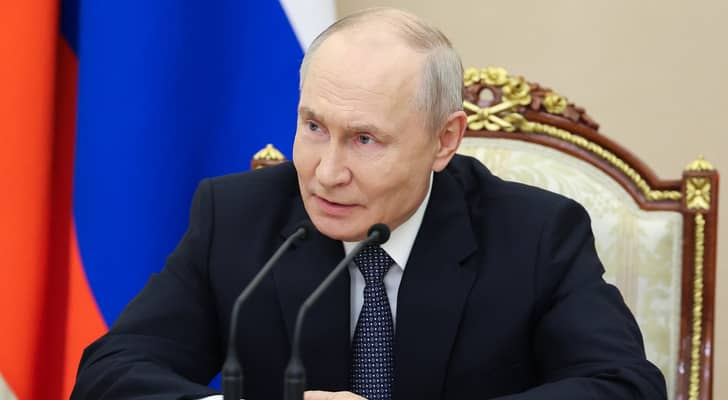
Russia's President Vladimir Putin meets with the Russian Defence Ministry leadership in Moscow.

New US intel assesses Putin may test NATO with limited attack on member state: report
Note: AI technology was used to generate this article’s audio.
New US intelligence assessments indicate that Russian President Vladimir Putin could attempt to test NATO’s resolve with a limited assault on an allied country in the coming years, according to a report by The Wall Street Journal.
The reports, described by US officials, outline possible scenarios ranging from cyberattacks to the deployment of unmarked armed groups or a small-scale land incursion on the alliance’s eastern flank.
Previously, US assessments held that Putin would avoid provoking a NATO country while still fighting in Ukraine.
That view shifted earlier this year as Russia faces mounting pressure.
Ukrainian drones are causing increasing damage to Russian forces and the oil industry, while Russian troops make only limited gains amid heavy casualties.
Officials assess that Putin, squeezed on the battlefield and under domestic pressure to deliver a victory, may become more dangerous when backed into a corner.
Putin’s potential goal in any such action, even while the war in Ukraine continues, would be to fracture the NATO alliance, according to the US officials.
Heather Conley, a senior fellow at the American Enterprise Institute, noted: “The question mark is how the United States would respond in that case. It has always been a goal [of Russia’s] to challenge the credibility of NATO and to separate the United States from its allies.”
Recent probing actions have already raised alarms.
Russian cruise missiles have landed in Poland, and drones have entered Romanian airspace, including one that struck an apartment building.
The intelligence assessments place the possible timeframe for any Russian move between this fall and 2029.
The likelihood of a limited land incursion remains low but increases over time, officials said.
Such a step has long been viewed as extremely unlikely because it would trigger NATO’s Article 5 mutual defense clause, though the alliance’s response to cyber or hybrid threats is less clearly defined.
Conley highlighted the longstanding difficulty: “This has always been NATO’s challenge to respond to a sub-Article Five attack, and it’s been very true that to this point, NATO allies have preferred not to escalate.”
A NATO spokesman, Col. Martin O’Donnell, stated: “We are always thinking through and preparing for any number of scenarios. NATO is watching and we are ready to deter and defend as necessary, which we continue to demonstrate.”
The assessments come as US officials also express concern over depleted stockpiles of critical munitions, including Precision Strike Missiles, Army Tactical Missile Systems, Stinger missiles, and various air-defense interceptors, depleted by transfers to Ukraine and operations related to Iran.
Pentagon and White House spokespeople rejected claims of shortages, with Chief Pentagon spokesman Sean Parnell saying the US maintains “a deep, ready arsenal” and that any adversary mistaking media reports for weakness “will discover the truth the hard way.”