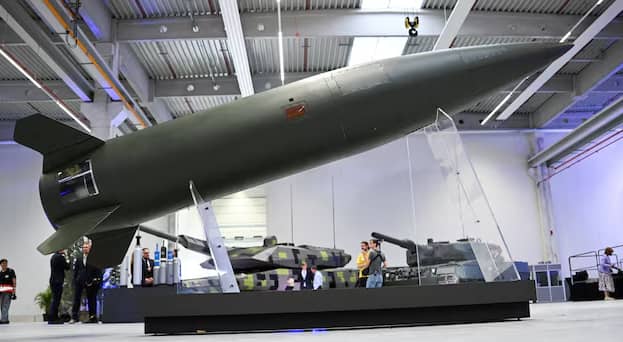
An Army Tactical Missile System (ATACMS) is displayed during the inauguration of a new artillery plant of ammunition maker Rheinmetall, in Unterluess, Germany August 27, 2025. REUTERS/Annegret Hilse/File Photo Purchase Licensing Rights

US consumes 'virtually all' long-range precision missiles in 5-month Iran war: Reuters
Note: AI technology was used to generate this article’s audio.
- Long-range strikes may require riskier tactics.
- Patriot, THAAD, and Tomahawk inventories also reduced.
- White House says US military remains fully capable.
The US Army has used up much of its global stockpile of highly accurate long-range missiles during its five-month war with Iran, Reuters reported on Tuesday, citing three people familiar with the data.
The extensive usage has triggered widespread concern within the federal government regarding America's readiness for potential future conflicts with major adversaries, including Russia and China.
The primary weapons depleted are the US Army's surface-to-surface missiles: the Army Tactical Missile System (ATACMS) and the next-generation Precision Strike Missile (PrSM).
Two sources told Reuters that the military has fired "virtually all" of these precision munitions, which cost over $1 million per unit and allow US forces to strike targets from standoff distances without exposing piloted aircraft to enemy air defenses.
While US-supplied ATACMS played a pivotal role in Ukraine enabling strikes inside Russia, PrSM inventories were already relatively low at the start of the conflict because the system is newer. Production is currently shifting toward PrSM as ATACMS are phased out.
Dwindling stockpiles spark internal debates
The figures have circulated among federal officials over the past week during intense administration discussions regarding how long the US can sustain strikes on Iran without dropping inventories below levels needed to respond to global crises.
A fourth source familiar with the data noted that while US Central Command (CENTCOM) nearly exhausted its localized Middle East supplies, it has been able to reload by transferring land-based missiles from US military stockpiles around the world.
Beyond offensive surface-to-surface missiles, defensive interceptor supplies have fallen sharply. A Center for Strategic and International Studies (CSIS) report cited by Reuters estimated that between February and July.
The US expended roughly 65% of its Patriot interceptors and reduced its inventory of THAAD ballistic missile interceptors by at least 38%. Two sources confirmed to Reuters that these estimates align with internal US data.
Additionally, one source stated that the US Navy has burned through slightly less than half of its global inventory of Tomahawk cruise missiles.
Trump administration rejects readiness concerns
In response to inquiries regarding the stockpile data, the White House released a statement from President Donald Trump dismissing concerns over inventory constraints:
"The United States has far more munitions than anyone in the world and far more than we need," President Trump said. "Our defense companies are, at this moment, making more munitions than they have ever made before, in addition to expanding their plants and equipment at record levels."
Pentagon chief spokesperson Sean Parnell backed the White House stance, stating:
"America’s military is the most powerful in the world and has everything it needs to execute at the time and place of the President’s choosing. We have executed multiple successful operations across combatant commands while ensuring the US military possesses a deep arsenal of capabilities to protect our people and our interests."
While defense analysts agree that production for items like artillery and specialized missiles is at record highs, they caution that manufacturing capacities may still fall short during a prolonged high-intensity conflict.
Manufacturers Lockheed Martin (maker of ATACMS, PrSM, and THAAD) and Raytheon (maker of Tomahawks and Patriots) did not immediately respond to requests for comment, though Raytheon has reached a tentative multi-year agreement with the Pentagon to expand Tomahawk output.
The conflict -launched jointly with 'Israel' in February- continues to spark debate regarding executive authority, as President Trump has prosecuted hostilities without requesting an Authorization for Use of Military Force (AUMF) or formal declaration of war from Congress.