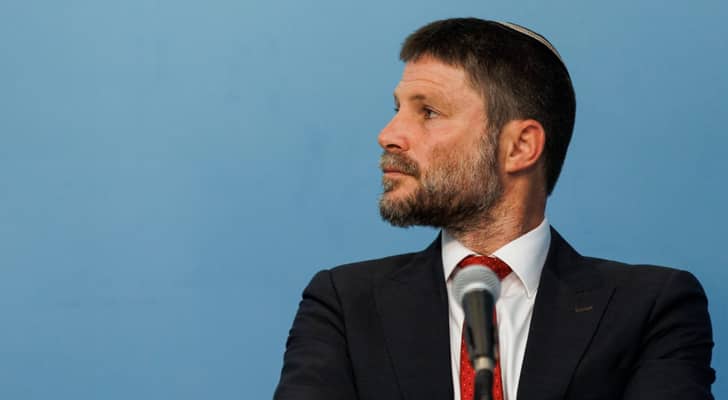
Smotrich admits he seeks 'Promised Land' borders for 'Israel'
Note: AI technology was used to generate this article’s audio.
- Smotrich calls for 'Israeli' control of West Bank and Gaza.
- Backs buffer zones in Lebanon and Syria.
- Says military presence must come before civilians.
- Reaffirms broader religious territorial ambitions.
'Israeli' Finance Minister Bezalel Smotrich revealed his practical and religious vision for the State of 'Israel’s' borders during a domestic podcast interview, asserting that immediate policy must focus on securing the West Bank, the Gaza Strip, and establishing deep military buffer zones in Lebanon and Syria.
Asked by the interviewer to define where 'Israel's' borders lie, Smotrich drew a clear distinction between his personal 'religious' faith regarding biblical boundaries and his immediate administrative work plan as a government minister.
Targets: Gaza, West Bank, and northern buffer zones
Addressing his immediate priorities in government, Smotrich stated that his focus remains centered on consolidating state presence across the West Bank and the Gaza Strip.
Regarding 'Israel's' northern and eastern frontiers, Smotrich emphasized the necessity of a prolonged military presence deep inside Lebanese and Syrian territory to insulate border communities from future attacks.
"In my capacity as a minister in the State of 'Israel', I am establishing the State of 'Israel' and its hold on the West Bank and the Gaza Strip," Smotrich said during the podcast. "I am definitely remaining very deep in a security zone in Lebanon and Syria, with the intention that the enemy must be pushed back and removed far from our borders."
Smotrich also emphasized a fundamental shift in defense doctrine following the October 7 events, maintaining that armed forces must be stationed ahead of civilian communities along all front lines.
"Always, always, always military first and then civilians. Not like what happened on October 7th, where civilians were first and the military was behind them—that's how it was in the north and in the south," Smotrich stated.
'Balancing' governance with religious aspirations
When pressed on whether his immediate policy goals represent the full scope of his long-term ambitions, the minister affirmed that his religious beliefs regarding the 'historic Land of Israel' remain intact while pursuing practical statecraft.
"Does this mean I am abandoning my ambitions for... even more than that? I am not abandoning them," Smotrich concluded, noting that fulfilling broader religious hopes relies on divine providence while ministers focus on pragmatic actions on the ground.