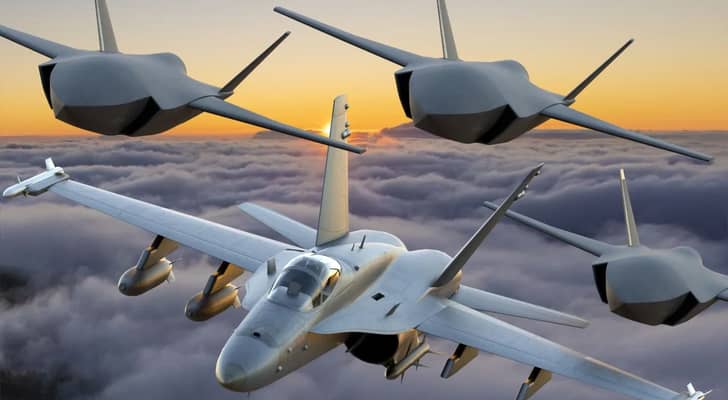
Loyal Wingman drone from Boeing supporting fighters in 3D illustration.

'Israel' plans domestic stealth jets; reduce reliance on US
Note: AI technology was used to generate this article’s audio.
- AI-powered drones to operate alongside fighter jets.
- Plan expands domestic defense production.
'Israel' aims to produce its own stealth fighter aircraft and autonomous unmanned combat aerial vehicles (UCAVs) over the next ten years as part of a strategic push to diminish dependence on American military assistance, according to statements by a senior 'Israeli' official telling the Jerusalem Post.
Speaking to JP, the senior official outlined a long-term vision to build primary aerial combat platforms domestically to ensure operational continuity in the event of external supply disruptions.
"I can envision 'Israel' producing its own stealth fighter aircraft," the official stated. "If the assessment is that one day others may stop supplying these systems, then we should begin producing them ourselves. The goal is ten years from now."
Autonomous CCA key to force design
Alongside piloted stealth aircraft, the planned expansion focuses heavily on Collaborative Combat Aircraft (CCA).
Designed to operate in close coordination with manned fighters, these high-tech UCAVs rely on advanced artificial intelligence to execute autonomous or semi-autonomous missions in contested environments.
Their operational roles span intelligence, surveillance, and reconnaissance (ISR), electronic warfare, and direct combat engagements.
By absorbing enemy fire, scouting hostile areas, and executing high-risk maneuvers, CCA platforms are designed to expand airpower reach and lethality while mitigating risks to human pilots.
The technological focus aligns with broader international developments, including the US Air Force's program targeting procurement of over 150 CCA units by fiscal year 2031 to complement platforms like the F-35 and Next Generation Air Dominance (NGAD) systems.
Independent manufacturing
The initiative builds on 'Israeli' Prime Minister Benjamin Netanyahu's policy to strengthen 'Israel's' local defense industry, which has historically focused on artillery, missile technology, cyber systems, and uncrewed reconnaissance drones rather than primary fighter jets.
While 'Israel' Aerospace Industries (IAI) previously developed the Kfir and the advanced Lavi fighter jet in the 1980s -a project canceled in 1987 due to budgetary constraints and political pressure from the US- 'Israel' has relied primarily on American-supplied manned aircraft for several decades.
Addressing future readiness, Col. Yishai Cohen, head of the Integration Department at the Defense Ministry's Directorate of Defense, Research, & Development (MAFAT), noted that establishing independent manufacturing at scale is now a top directive.
"There is a huge race in all countries to achieve those capabilities," Cohen stated regarding domestic platform production and CCA systems. "For my colleagues and me, that is a main lesson learned - we need to not only be in charge of development, but then scale and produce it independently in 'Israel' for the needs of the IDF."