

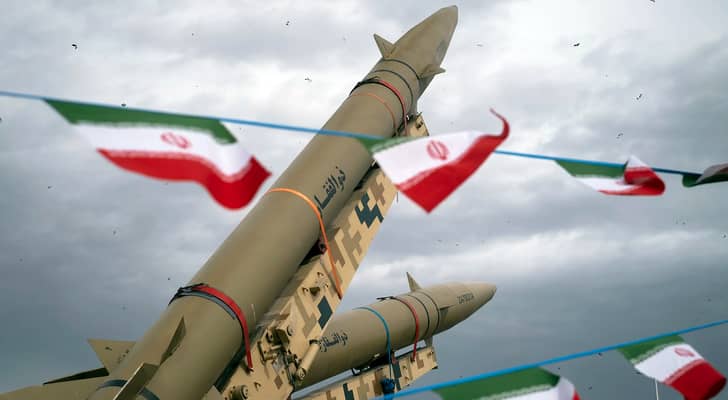
Day 154 | Iran targets US bases across Middle East; deadly strikes escalate tensions
Latest updates:
- The IRGC says it targeted US military bases across the Middle East after US forces bombed a building on Iran’s Qeshm Island, killing a couple and their two-year-old child.
- Explosions from US attacks were also reported on Kish Island, in Bushehr province, and at four locations across Khuzestan province.
- Kuwait says one worker was killed in an Iranian attack on a building belonging to a Chinese company in the country's north.
- Iran says three IRGC members were killed in a US missile strike on Zanjan province.
- Iran's Foreign Ministry says talks with Omani officials are ongoing in Tehran over the Strait of Hormuz.
- The Iraqi military says there is no evidence that recent regional attacks were launched from Iraqi territory, following joint US-Saudi strikes on Iran-aligned groups in the country.
CENTCOM says allowed nearly 30 ships to pass Iran blockade for “humanitarian aid”
The United States Central Command (CENTCOM) said Saturday that it permitted nearly 30 ships to “pass through the blockade for humanitarian aid”.
“As of July 31, CENTCOM has redirected 30 commercial vessels, disabled 2, and boarded 2 to ensure full compliance,” it said on X.
“The U.S. military has also permitted nearly 30 ships to pass through the blockade for humanitarian aid,” it added.
Trump says Iran makes him “angry” over nuclear talks
US President Donald Trump voiced his frustration with Iran during a cabinet meeting in Camp David, accusing Tehran’s negotiators of repeatedly breaking their word and denying that nuclear topics were discussed during hours-long meetings.
"All they do is make me angry," Trump said, describing how Iranian officials publicly contradict what takes place behind closed doors.
"You know, it just makes me angry."
"We'll be in there talking about nuclear for seven hours... And I'll say, 'They discussed nuclear.' And they'll go out and they'll say, 'We never discussed nuclear.'"
"They break their word so often,” Trump said.
"We have the best people... they'll make a deal,” Trump also said, adding that the talks are carried out by Secretary of State Marco Rubio, Vice President JD Vance, and envoys Jared Kushner and Steve Witkoff.
Lebanon president says ‘Israeli’ detonations “direct threat” to framework deal
Lebanese President Joseph Aoun said Friday that ‘Israeli’ army detonations near the UNESCO-listed Beaufort castle in southern Lebanon overnight were a "direct threat" to a recent framework deal agreed with ‘Israel’.
Aoun said the explosions "are an extremely dangerous escalation", according to a statement from his office, adding that they "represent a direct threat to the process which was launched as part of the framework agreement".
He noted that their timing ahead of another round of talks with ‘Israel’ in Rome next week "sends negative messages".
Trump says Iran war “going well”
US President Donald Trump said Friday that the Iran war is “going well”, as Tehran and Washington continue trading blows over a dispute on the Strait of Hormuz.
“It's going well. All you can do is keep winning, then eventually something will happen. But we're hitting them hard, knocking them out for a loop, and we just keep winning,” Trump told Fox News.
“Eventually they'll have no choice but to go home,” Trump adds.
'Israeli' says it will join attack on Iran if requested by Trump
'Israeli' Defense Minister Israel Katz stated that 'Israel' is prepared to join a military strike against Iran if requested by US President Donald Trump.
Kuwait intercept hostile drones targeting vital facilities
The Kuwait Armed Forces detected, engaged, and destroyed multiple hostile drones that breached Kuwaiti airspace at dawn, according to Statement No. 81 issued by the official spokesperson for the Ministry of Defense, Staff Colonel Saud Abdulaziz Al-Atwan.
The Ministry of Defense reported that the Iranian aggression targeted a number of vital and military installations within the country.
Material damage, no casualties
Military forces engaged and neutralized the incoming targets upon detection. Staff Colonel Al-Atwan confirmed that while the falling shrapnel from the destroyed drones resulted in material damage, no human casualties were recorded.
Concluding the official statement, the Kuwait Armed Forces emphasized that they continue to perform their duties and operational tasks with high efficiency, maintaining constant state of readiness and taking all necessary measures to safeguard the nation's sovereignty, security, and stability in coordination with competent authorities to ensure the safety of citizens and residents.
IRGC says it struck two oil tankers following US transit routes
- IRGC says two oil tankers struck and halted.
- Claims vessels ignored warnings under US escort.
- Four other tankers changed course and retreated.
- IRGC warns shipping firms against US statements.
The Islamic Revolutionary Guard Corps (IRGC) claimed on Friday that its naval forces struck and halted two non-compliant oil tankers navigating an undeclared route under US military air escort.
According to a statement issued by the IRGC Public Relations department, the two vessels attempted to transit what the IRGC described as an unsafe and illegal route in the early hours of the morning, disregarding explicit warnings from Iranian forces.
Four accompanying tankers turn back
The IRGC statement added that four other tankers traveling in the area immediately changed course and returned to their points of departure following the strikes on the two non-compliant vessels.
Addressing shipping companies and maritime insurers, the IRGC referenced messages issued the previous evening rejecting statements from US Central Command (CENTCOM).
The IRGC advised vessel owners and insurance providers to ignore CENTCOM's guidance, suggesting they consult maritime actors involved in recent incidents regarding the security situation.
Concluding its announcement, the IRGC Navy issued a warning that illegal interventions and directives by the U.S. military to vessels operating in the region would not remain unanswered.
'Israel' arrests ambulance driver over Iran espionage
- Suspect accused of passing sensitive intelligence.
- Allegedly tracked senior 'Israeli' officials and key sites.
- Prosecutors say he received payment for espionage.
'Israeli' security forces submitted an indictment Thursday morning in the Haifa District Court against 34-year-old 'Israeli' citizen Amir Hisham Muhammad Titi, charging him with conducting intelligence operations on behalf of Iran following his arrest several weeks prior.
Titi, who worked as an ambulance driver, faces nine alleged counts in total: one count of assisting the enemy during wartime, two counts of transmitting information to the enemy with intent to harm state security, and six counts of transmitting information liable to benefit Iran and its proxies.
Collection of hospital emergency intelligence
During interrogation, Titi admitted to maintaining contact with hostile parties linked to Iran or Hezbollah since October 2024.
The initial contact occurred when Titi messaged an Instagram account purporting to belong to National Security Minister Itamar Ben-Gvir to request assistance in obtaining a firearm license.
Titi noted that while operating, he suspected his contacts were enemy agents rather than the minister.
Although Titi claimed in his final interrogation before the indictment that he did not know his contact was Iranian -a marked shift from his earlier accounts- prosecutors detailed an extensive series of intelligence operations.
Initially tasked with photographing 'Israeli' site impacts from Iranian ballistic missiles to identify weaknesses in the Iron Dome air defense system, Titi was unable to reach those locations.
His handlers then redirected him to gather intelligence accessible through his job, obtaining emergency protocols from various 'Israeli' hospitals along with dozens of photographs and written reports.
Surveillance of political leadership
The indictment revealed that Titi provided real-time reports to his handlers when President Isaac Herzog and Finance Minister Bezalel Smotrich visited the Galilee Medical Center in Nahariya.
Titi transmitted a photo of President Herzog alongside his security detail during the visit.
His operations extended beyond medical facilities into public and high-security locations:
- Hostages square (Tel Aviv): Documented the area and, in August 2025, printed and distributed dozens of photographs of 'Israeli' hostages at a protest under instructions from his handlers for NIS 3,600.
- Amikam: Photographed locations across the town where former Defense Minister Yoav Gallant resides.
- Haifa: Photographed Horev Mall and was assigned to map the security camera system at the Haifa Museum of Art.
Financial compensation
'Israel' Police stated that Titi received tens of thousands of shekels for his intelligence work, funneled through his family members' bank accounts and a digital cryptocurrency wallet.
The prosecution noted that Titi also provided some intelligence without financial compensation solely to harm 'Israel'.
His highest-paid assignment yielded NIS 10,000 for transmitting data regarding the number of individuals killed and wounded during the conflict in March and April 2026.
As recently as May 2026, Titi's handler offered him NIS 50,000 to "find and hit" a specific target to be identified later; while Titi expressed willingness to carry out the task, the operation was never executed.
'Israel' plans domestic stealth jets; reduce reliance on US
- AI-powered drones to operate alongside fighter jets.
- Plan expands domestic defense production.
'Israel' aims to produce its own stealth fighter aircraft and autonomous unmanned combat aerial vehicles (UCAVs) over the next ten years as part of a strategic push to diminish dependence on American military assistance, according to statements by a senior 'Israeli' official telling the Jerusalem Post.
Speaking to JP, the senior official outlined a long-term vision to build primary aerial combat platforms domestically to ensure operational continuity in the event of external supply disruptions.
"I can envision 'Israel' producing its own stealth fighter aircraft," the official stated. "If the assessment is that one day others may stop supplying these systems, then we should begin producing them ourselves. The goal is ten years from now."
Autonomous CCA key to force design
Alongside piloted stealth aircraft, the planned expansion focuses heavily on Collaborative Combat Aircraft (CCA).
Designed to operate in close coordination with manned fighters, these high-tech UCAVs rely on advanced artificial intelligence to execute autonomous or semi-autonomous missions in contested environments.
Their operational roles span intelligence, surveillance, and reconnaissance (ISR), electronic warfare, and direct combat engagements.
By absorbing enemy fire, scouting hostile areas, and executing high-risk maneuvers, CCA platforms are designed to expand airpower reach and lethality while mitigating risks to human pilots.
The technological focus aligns with broader international developments, including the US Air Force's program targeting procurement of over 150 CCA units by fiscal year 2031 to complement platforms like the F-35 and Next Generation Air Dominance (NGAD) systems.
Independent manufacturing
The initiative builds on 'Israeli' Prime Minister Benjamin Netanyahu's policy to strengthen 'Israel's' local defense industry, which has historically focused on artillery, missile technology, cyber systems, and uncrewed reconnaissance drones rather than primary fighter jets.
While 'Israel' Aerospace Industries (IAI) previously developed the Kfir and the advanced Lavi fighter jet in the 1980s -a project canceled in 1987 due to budgetary constraints and political pressure from the US- 'Israel' has relied primarily on American-supplied manned aircraft for several decades.
Addressing future readiness, Col. Yishai Cohen, head of the Integration Department at the Defense Ministry's Directorate of Defense, Research, & Development (MAFAT), noted that establishing independent manufacturing at scale is now a top directive.
"There is a huge race in all countries to achieve those capabilities," Cohen stated regarding domestic platform production and CCA systems. "For my colleagues and me, that is a main lesson learned - we need to not only be in charge of development, but then scale and produce it independently in 'Israel' for the needs of the IDF."
Iran parliament speaker says US will 'pay the price' after Qeshm killings
Iranian Parliament Speaker Mohammad Bagher Ghalibaf has warned that the United States will "pay the price" following the deaths of a couple and their two-year-old child in a strike on Iran's Qeshm Island.
In a post on X, Ghalibaf described the incident as a "continuation of the atrocities in Minab and Lamerd," referring to earlier attacks that he blamed on the US and "Israel."
According to Iranian authorities, at least 170 people were killed when a US-'Israeli' strike hit a primary school in the southern city of Minab on the first day of the war. A sports hall in the southwestern city of Lamerd was also struck the same day, killing at least 24 people.
Ghalibaf accused Washington of responding to setbacks on the battlefield by targeting civilians.
"The US has grown accustomed to making up for the slaps they receive on the battlefield by spilling the blood of the innocent," he wrote, adding: "They will pay the price."
The United States has not immediately commented on Ghalibaf's latest remarks.
Previous day
For coverage of the previous day, visit the link below.
Read more: Day 153 | Trump vows retaliation after Iran targets US bases; US-Saudi strikes hit Iraq


