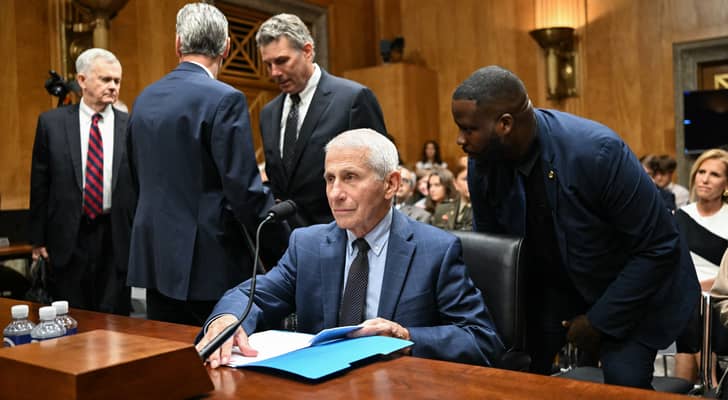
Dr. Anthony Fauci arrives for a Senate Homeland Security and Governmental Affairs committee hearing on Capitol Hill in Washington, DC.

Why did Anthony Fauci plead the Fifth more than 100 times at Senate COVID hearing?
Note: AI technology was used to generate this article’s audio.
Dr. Anthony Fauci invoked his Fifth Amendment right against self-incrimination more than 100 times during a contentious Senate hearing on Wednesday, refusing to answer questions about the origins of COVID-19 and the US government’s pandemic response.
The 85-year-old former director of the National Institute of Allergy and Infectious Diseases appeared under subpoena before the Senate Homeland Security and Governmental Affairs Committee, chaired by longtime critic Sen. Rand Paul (R-Ky.).
The hearing focused on COVID origins, gain-of-function research, and Fauci’s past statements and advice on lockdowns, masks, and other measures.
In his opening statement, Fauci accused Paul of an “unhinged obsession” aimed at seeing him imprisoned.
No answers, just the same script... 111 times.
— Fox News (@FoxNews) July 29, 2026
Dr. Anthony Fauci stonewalled the Senate Homeland Security & Governmental Affairs Committee by repeatedly invoking the Fifth Amendment during today's hearing on COVID-19 and the former NIAID director's conduct throughout the… pic.twitter.com/LyeR4hBta8
“The only conclusion I can reach is that the sole reason he is calling me before this committee is to get me to say something — anything — that could vindicate his repeated public pledges that I end up, in his words — quote — ‘behind bars,’” Fauci said.
“Any reasonable person who has followed his unhinged obsession with me would readily come to the same conclusion.”
He explained that, on the advice of his attorneys, he would invoke the Fifth Amendment. “Although it pains me to do so because of the respect I have for the legislative branch of government and my decadeslong record of cooperating with Congress, under the advice of my attorneys, I will invoke my right under the Fifth Amendment of the Constitution to refrain from answering your questions,” Fauci stated.
Throughout the hours-long session, Fauci responded to nearly every question—regardless of topic—with the identical phrase:
“On the advice of counsel, I respectfully decline to answer based upon my rights under the Fifth Amendment of the Constitution.”
This included even basic queries from Sen. Josh Hawley (R-Mo.) about the day of the week or the colors of his tie and the carpet.
Fauci’s legal team cited concerns that Republicans might use any new testimony to pursue perjury charges.
Former President Joe Biden had issued a preemptive pardon to Fauci in the final days of his administration in January 2025, intended to protect against what Biden called “unjustified and politically motivated prosecutions.”
The pardon does not cover statements made after its issuance.
Paul rejected the validity of the Fifth Amendment claim in this context, arguing that a 19th-century Supreme Court precedent and federal law required testimony and that the Biden pardon would not shield new false statements.
“There’s no risk to perjury if you tell the truth,” Paul said ahead of the hearing.
At the close, he warned of “repercussions” and announced a committee vote next week on holding Fauci in contempt of Congress.
Paul’s lawyer, David Schertler, was ordered removed from the hearing room after attempting to interject.
Schertler later called Paul’s actions “outrageous” and described the senator’s pursuit as “an intense and seemingly pathological course of retribution, revenge, and obsession.”
He maintained that Fauci “has a valid Fifth Amendment privilege.”
Democrats on the committee defended Fauci and criticized the proceedings.
Ranking member Sen. Gary Peters (D-Mich.) said the hearing “does real damage” and risked deterring scientific experts from public service.
Sen. Richard Blumenthal (D-Conn.) compared it to McCarthy-era tactics and called it a “show trial” designed as a “perjury trap.”
The hearing produced no new substantive revelations on COVID origins, which remain debated among US intelligence agencies.
Paul has long accused Fauci of misleading Congress about NIH funding of research at the Wuhan Institute of Virology; Fauci has repeatedly denied the claims.
Paul recently released more than 1,100 pages of Fauci’s pandemic-era personal diary entries.
Separately, Florida officials indicated plans for a state-level probe into Fauci’s actions, which would not be affected by the federal pardon.
Gov. Ron DeSantis described Fauci as “the most destructive bureaucrat in US history.” The contempt vote and related political fallout are expected to continue in the coming days.