


Day 138 | US launches new strikes on Iran as Trump reverses tariff plan
Latest updates:
- US expands military campaign: US Central Command (CENTCOM) says it has launched an additional round of strikes against Iran aimed at degrading capabilities used to target commercial shipping in the Strait of Hormuz.
- Naval presence increases: CENTCOM says more than 20 US Navy warships and hundreds of military aircraft are now operating across the Middle East as the US resumes its naval blockade of Iranian ports.
- Iran claims retaliatory attacks: Tehran says it struck US sites in Kuwait, Bahrain and Jordan, and targeted two oil supertankers in the Strait of Hormuz.
- UAE vessels hit: The UAE says two of its national vessels were struck by Iranian cruise missiles.
- Indian crew member killed: India has summoned an Iranian official after an Indian crew member was killed and others were wounded in the attacks.
- Trump reverses tariff move: President Donald Trump has backtracked on his previously announced 20% tariff plan in a social media post.
Thread ended
This live thread has ended. Follow our online coverage of day 139 of the war.
Read more: Day 139 | US launches fresh strikes on Iran as Tehran vows retaliation
Fresh explosion reported in Ahvaz, southwestern Iran: Mehr
A new explosion was heard in the southwestern city of Ahvaz, Iran's Mehr News Agency reported on Wednesday night, marking a continued escalation following earlier waves of military strikes in the region.
Multiple explosions rock several Iranian cities
Iranian state media reported a series of loud explosions striking the southwestern city of Ahvaz and the southeastern port of Chabahar on Wednesday, while authorities in Hormozgan province confirmed that an American military projectile landed near the strategic port city of Bandar Abbas.
US launches second wave of strikes against Iran
Acting under the direct orders of the Commander in Chief Donald Trump, US forces launched a second wave of airstrikes against Iran at 3 p.m. Eastern Time on Wednesday, heavily targeting military capabilities used by Tehran to threaten commercial vessels transiting the vital Strait of Hormuz shipping lane.
Multiple explosions rattle Erbil near US Consulate
A series of loud explosions detoured through Erbil on Wednesday, with eyewitnesses and journalists reporting that automated air defense systems were actively triggered near the United States Consulate General, says AFP.
The diplomatic complex, situated in the capital of Iraq’s northern Kurdistan region, has been a frequent target of drone and rocket strikes amid ongoing regional hostilities.
While local anti-terror and security forces have not immediately released a casualty report, visual documentation from the ground indicates that defense batteries successfully intercepted multiple incoming projectiles over the city.
Trump prefers Sharaa dealing with Hezbollah over Netanyahu
- Trump said Syrian President Ahmed al-Sharaa will address Hezbollah using a different approach.
- He claimed al-Sharaa's strategy would be more targeted and avoid widespread destruction.
- Trump suggested Israel should redeploy its forces in Lebanon.
- He said Iran remains the primary regional challenge.
In an interview with Fox News, US President Donald Trump stated that Syrian President Ahmed al-Sharaa will take charge of dealing with Hezbollah, promising a starkly different and more precise approach than the one currently employed by 'Israel'.
The comments signal a potential shift in how the US envisions the security architecture of the region, emphasizing a primary role for Damascus in managing the armed group.
Precision without demolition
According to US President Trump, al-Sharaa's intervention will mark a departure from the heavy destruction seen in recent military campaigns. Trump emphasized that the Syrian leader "will not demolish buildings" as part of his strategy.
"Al-Sharaa will be more precise than the Israelis in dealing with Hezbollah," Trump told Fox News, adding, "and I know he wants to do this."
Freeing up 'Israel' to focus on Iran
Alongside his praise for al-Sharaa's willingness to act, Trump suggested that a change in the security landscape would allow 'Israel' to adjust its military posture.
The US President remarked that "it would be good" for Israel to execute a redeployment in Lebanon. This strategic shift, Trump argued, would allow the Israeli military to refocus its attention and resources on the larger geopolitical challenge in the region: Iran.
US Treasury vows to target Iran war funding networks
The US Treasury Department said it will continue targeting illicit procurement networks that finance Iran's military and weapons programs.
US Treasury Secretary said Washington remains committed to disrupting the financial and logistical networks used to support Iran's military capabilities.
No plans for talks with US right now: Iran’s Foreign Ministry spokesperson
Iran has ruled out negotiations with the US, saying its priority remains defending the country amid the ongoing escalation.
Foreign Ministry spokesperson Esmail Baghaei told reporters that Tehran has no plans to engage in talks with Washington and said Iran would honor its international commitments only if the US fulfills its own obligations.
"Our commitments remain in effect only as long as the other side fulfills its pledges," Baghaei said.
He added that Iran stopped implementing its obligations under the memorandum of understanding after the US, according to Tehran, failed to uphold its commitments under the temporary agreement.
"After the other party violated its obligations, we also refrained from implementing ours in any area where it was required," Baghaei said.
US denies Iranian claims of striking civilian wheat silo
- CENTCOM said its operations targeted only military infrastructure.
- Officials said July 14 strikes focused on degrading Iran's maritime threat capabilities.
- Washington accused Tehran of attacking civilian shipping and neighboring Gulf states.
US Central Command has rejected accusations from Tehran that American forces struck a civilian grain depot, calling the allegations "false" and releasing a list of the actual Iranian military positions targeted in a major wave of operations on July 14.
The official denial comes after Iranian state media and Khuzestan provincial officials claimed a US projectile hit a civilian wheat storage facility in Hoveyzeh County late Tuesday night, accusing Washington of deliberately targeting vital infrastructure.
Flat denial of civilian targeting
In a direct public pushback, US defense officials clarified that American combat aircraft and naval assets have focused exclusively on neutralizing Iran's offensive military capabilities.
CENTCOM flatly denied hitting the Hoveyzeh facility, framing the reports as an attempt by Tehran to deflect from its own regional actions.
"On July 14, US forces hit Iranian military targets in Bandar Abbas, Khormuj, Ahvaz, Qeshm, Tunb, Bushehr, and Kuh-e Stak," CENTCOM stated, listing the seven specific locations where weapons systems and command nodes were engaged.
According to the CENTCOM, these coordinates are active hubs used by the Islamic Revolutionary Guard Corps (IRGC) to coordinate attacks on international commercial vessels transiting the Strait of Hormuz.
CLAIM: Iranian state media claims that U.S. forces struck a civilian wheat storage facility in Hoveyzeh on July 14. This is FALSE.
— U.S. Central Command (@CENTCOM) July 15, 2026
TRUTH: On July 14, U.S. forces hit Iranian military targets in Bandar Abbas, Khormuj, Ahvaz, Qeshm, Tunb, Bushehr, and Kuh-e Stak to degrade… pic.twitter.com/n7Njez05lE
Escalating Gulf tensions
The dispute over the targets underscores the highly volatile nature of the current conflict, which has seen the US Navy reinstate a strict maritime blockade against Iranian ports while executing pre-emptive strikes to protect international shipping lanes.
While Tehran continues to decry the strikes as violations of national sovereignty, Washington has turned the focus back onto Iranian actions.
CENTCOM pointed out that while US forces are targeting active military systems, Iran and its regional proxies have systematically targeted civilian commercial tankers, as well as launching hostile drone and missile barrages toward neighboring Gulf nations.
Iran’s Hengam Island struck by US projectiles: Mehr
The Hormozgan Governorate confirmed that a location on Hengam Island in the Persian Gulf was struck by US military projectiles on Wednesday, with provincial authorities currently conducting initial field assessments to determine the full extent of the damage before releasing a detailed report, according to Iran's Mehr News Agency.
Tehran: MoU valid only if Iran's interests are met
- Iran reaffirmed a "commitment for commitment" approach to implementing the agreement.
- Tehran accused US, 'Israel' of violating the accord.
- Iranian officials said Tehran has suspended obligations in areas where it alleges the agreement has been breached.
Iran will not unilaterally adhere to the Islamabad Memorandum of Understanding (MoU) unless the agreement consistently serves its national interests and national security, Iranian Foreign Ministry Spokesperson Esmaeil Baghaei warned during a press briefing.
Baghaei firmly restated Tehran's reciprocal approach to international diplomacy, stressing that the operational core of the agreement remains "commitment for commitment."
The declaration signals a highly transactional stance by Iranian leadership as the fragile U.S.-Iran diplomatic framework faces severe regional strain and threats of total collapse.
Doctrine of reciprocal commitment
Baghaei made it clear that Tehran's patience with unilateral demands has run out, framing the policy of proportional response as a foundational principle of Iranian foreign policy.
"A memorandum of understanding only holds value for us as long as it secures our national interests and national security," Baghaei stated. "With this outlook, we have said from the very beginning: commitment for commitment."
He explained that Iran's compliance is directly tethered to the actions of the United States and its allies.
According to the spokesperson, whenever the opposing side has violated a clause of the agreement, Iran has immediately and systematically withheld its own compliance in corresponding areas.
Deal in crisis
The Islamabad MoU, digitally signed in mid-June 2026, was designed as a temporary framework to halt hostilities and establish a pathway toward a final, comprehensive treaty.
It outlined steps such as the lifting of the US naval blockade, the reopening of the Strait of Hormuz, and a cessation of regional military operations.
However, the agreement has rapidly entered a critical crisis phase. Baghaei's comments highlight growing frustration in Tehran over what it views as a persistent failure by the Trump administration and its allies to implement key commitments, particularly regarding the promised ceasefire in Lebanon and the lifting of maritime restrictions.
By declaring that Iran has already suspended several of its obligations in retaliation to these perceived violations, Baghaei warned that the future of the entire diplomatic track remains highly volatile and entirely dependent on immediate, verifiable compliance from Washington.
13 more people injured in US strike on Iranian army base
Iran said a US strike on an army ground forces barracks in the southern city of Bampur killed 7 military personnel and injured 13 others.
According to the Iranian Army, the attack involved 13 US missiles targeting the barracks early Wednesday. The military warned it would deliver a "decisive response" to the strike.
Iran's Health Ministry said more than 260 people were wounded in the latest wave of US attacks across the country but did not provide an updated death toll for civilians or military personnel.
US-mediated 'Israeli', Lebanese talks in Rome concluded
- Negotiators agreed on the framework for launching pilot zones in southern Lebanon.
- Technical talks will continue to implement the broader trilateral framework.
- The long-term objective is a comprehensive peace agreement and a stable border.
Diplomatic talks between delegations from 'Israel' and Lebanon concluded in the Italian capital following two days of highly productive and positive discussions, the US Embassy in Beirut announced.
Hosted at the United States Embassy in Rome, the high-level meeting focused entirely on establishing a concrete roadmap to implement the historic framework agreement signed by the two countries in Washington.
Structuring southern pilot zones
The primary achievement of the two-day summit was a formal consensus on the operational structure and practical guidelines governing the "pilot zones" in southern Lebanon.
Under this US-backed initiative, 'Israeli' forces will gradually withdraw from designated border areas as the Lebanese Armed Forces (LAF) deploy to assume total security control and ensure the disarmament of non-state actors.
According to the statement released by the US Embassy in Beirut, the practical guidelines for these initial zones will be fully finalized and put into action over the coming days.
Transitioning to technical negotiations
With the groundwork for the pilot zones established, diplomatic teams are moving immediately into a broader, more detailed phase of the peace process.
"We will now transition to expanded technical talks that will focus on the implementation of all clauses of the trilateral framework," the US Embassy statement read, highlighting the ultimate objective of brokering a comprehensive, long-term agreement between 'Israel' and Lebanon.
The upcoming technical discussions are expected to tackle highly sensitive logistics, including the exact coordinate boundaries of the security sectors, specific timetables for troop movements, and independent verification mechanisms to ensure all parties remain in full compliance.
Despite the complex security environment, US mediators expressed strong optimism that the successful conclusion of the Rome round represents a vital, concrete step toward stabilizing the volatile border region.
US intercepts two vessels attempting to breach Iran blockade
- The interceptions occurred within the first 17 hours after the blockade was reinstated.
- CENTCOM said it remains fully prepared to enforce the blockade.
- The operations followed US airstrikes targeting Iranian military capabilities.
US Central Command announced that American naval forces intercepted and redirected two commercial vessels attempting to violate the newly resumed blockade on Iranian ports.
The maritime encounters took place within 17 hours of the blockade going into effect.
The strict enforcement measures represent the latest escalation in a rapidly expanding confrontation between Washington and Tehran over shipping security in the Middle East.
Enforcing compliance
Military authorities did not disclose the identities, cargo, or flags of the redirected ships.
However, US Central Command made it clear that any maritime traffic transiting to or from Iranian coastal zones will face immediate intervention by American forces.
"The U.S. military remains vigilant and prepared to ensure full compliance," the command stated in its official release, reinforcing that the blockade applies to all maritime transit routes linked to the Islamic Republic.
Since restarting the naval blockade against Iranian ports 17 hours ago, U.S. forces have redirected 2 commercial vessels attempting to run the blockade. The U.S. military remains vigilant and prepared to ensure full compliance. pic.twitter.com/E00JAlmBua
— U.S. Central Command (@CENTCOM) July 15, 2026
Heavily fortified chokepoint
The blockade went into effect at four p.m. Eastern Time on Tuesday, preceded by an intense round of pre-emptive American airstrikes.
Those strikes targeted Iranian military assets and defense installations used to threaten commercial shipping lanes in the Strait of Hormuz.
The Pentagon has heavily fortified its presence in the region to back up the economic chokehold.
More than 20 US Navy warships and hundreds of military aircraft are operating across the Middle East.
Pentagon officials warned that American forces remain alert and fully capable of neutralizing any hostile response from Iranian regional forces or proxy groups.
No ships used southern passage in Strait of Hormuz yesterday, Iranian state media says
No ships passed through the US-led southern route of the Strait of Hormuz on Tuesday, Iranian state media reported.
The Fars news agency, citing data from maritime tracking firm Kpler, said 21 vessels crossed the waterway during the day, but none used the passage along the Omani coast.
Fars also reported that the number of seafarer deaths in the Sea of Oman had reached 17, with 56 confirmed incidents recorded. The figures have not been independently reported by other organizations, including the UK Maritime Trade Operations Centre.
The Strait of Hormuz remains a key global shipping route, with disruptions in the area raising concerns over commercial traffic and energy supplies.
Iran’s Araghchi on way to Doha to offer condolences over passing of former emir
Iran’s Foreign Minister left for Doha on Wednesday to meet Qatari officials and express condolences following the death of Qatar’s former emir, Sheikh Hamad bin Khalifa Al Thani.
According to a statement on the minister’s Telegram channel, the visit is focused on offering condolences after Sheikh Hamad’s death on Sunday, which was followed by a four-day mourning period in Qatar.
The trip comes as Qatar continues to play a mediation role between Iran and the US amid rising tensions. Tehran has recently carried out attacks on what it described as US targets in Qatar, including a strike reported on Sunday.
US military completes 90-minute wave of Iran strikes
US Central Command (CENTCOM) said its latest round of strikes on Iran has ended after a 90-minute operation.
The strikes began at 6am US Eastern Time (11am UK time) and concluded at 7:30am Eastern Time, according to a statement posted by CENTCOM on X.
The US military said the operation targeted coastal defense systems, along with cruise missile storage and launch sites on Iran’s Greater Tunb Island.
CENTCOM said the strikes were aimed at further reducing Iran’s ability to attack commercial shipping in the Strait of Hormuz, a key global maritime route.
Anti-Trump billboard displayed in Tehran
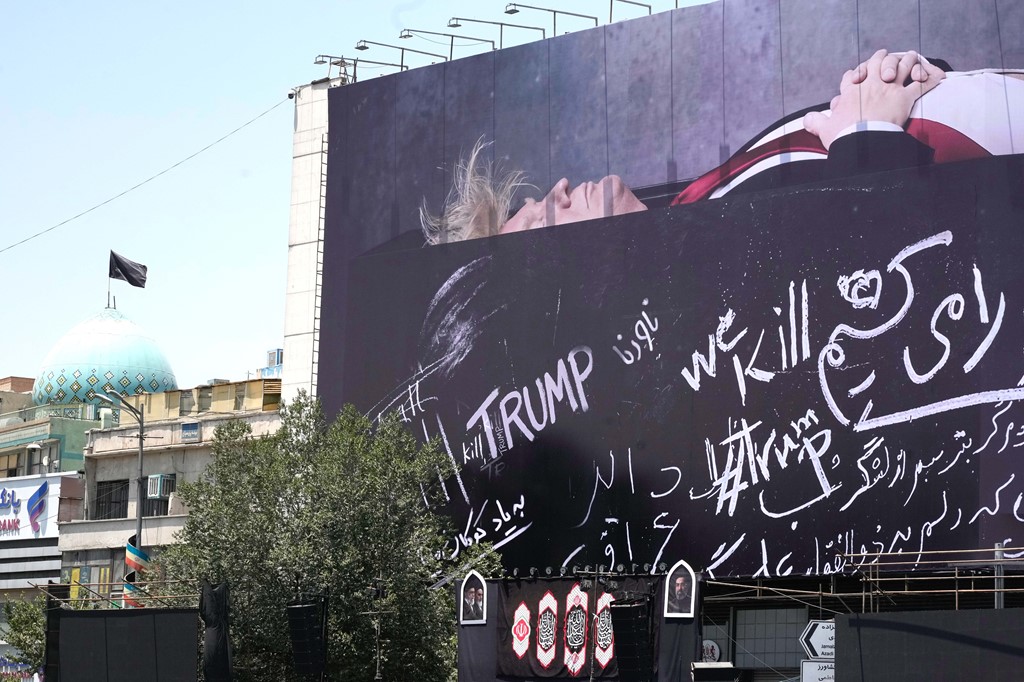
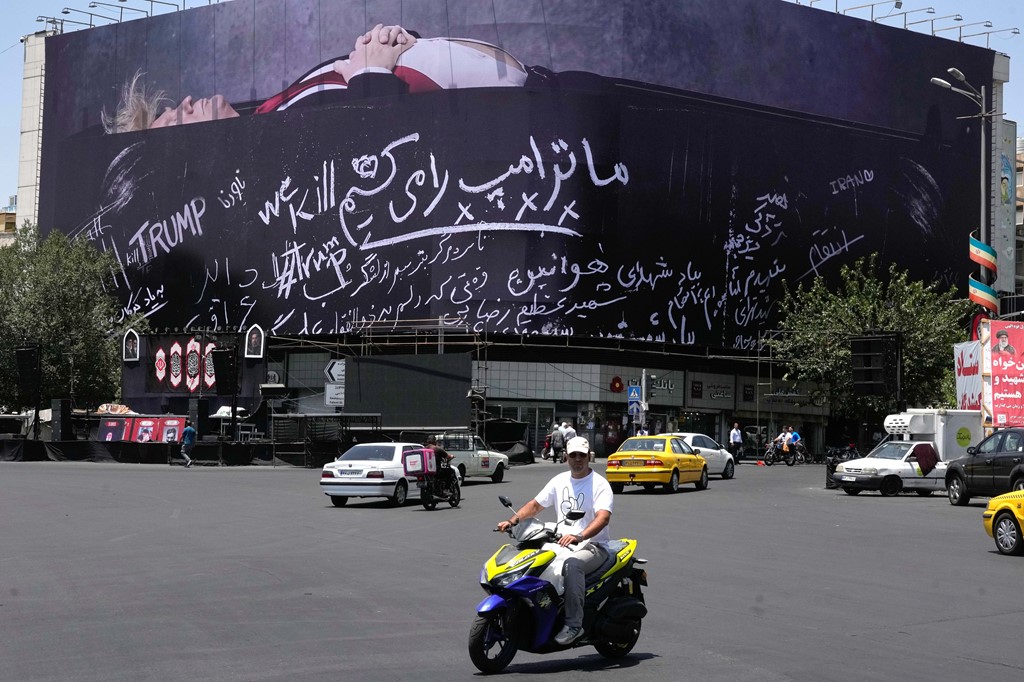
Images from Tehran show a new billboard featuring US President Donald Trump displayed in the Iranian capital on Wednesday.
The billboard shows Trump lying on his back on top of a black box in Islamic Revolution Square, with messages written mostly in Persian and one message in English issuing a direct threat toward the US president.
Trump has previously said he could be a target for Tehran, telling reporters during a NATO summit in Turkey last week that he was "number one on the kill list" of Iran.
Europe raises threat level for Middle East airlines
The European Union Aviation Safety Agency has raised its threat level assessment for airlines operating in the Middle East, Bloomberg reported.
The decision reflects growing concerns over risks facing commercial aviation in the region amid escalating tensions and military activity.
US carries out new strikes against Iran: CENTCOM
The United States Central Command (CENTCOM) said Wednesday morning that it carried out a new wave of strikes against Iran.
“At 6 a.m. ET today, U.S. Central Command forces began launching a wave of strikes against Iranm” CENTCOM said on X.
“The strikes are designed to further degrade military capabilities Iranian forces have used to attack commercial shipping in the Strait of Hormuz,” it added.


