

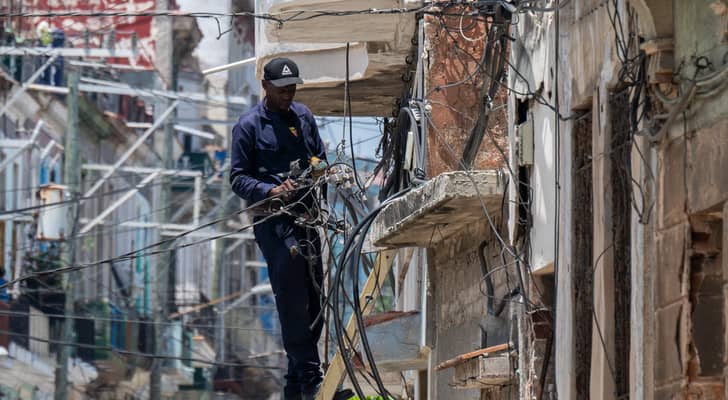
Cuba's power grid in total collapse; authorities investigate
Note: AI technology was used to generate this article’s audio.
- Cuba suffered its third nationwide power grid collapse in six months, leaving the island without electricity.
- State utility UNE reported a total disconnection from the national power system and is investigating the cause.
- The blackout comes amid severe fuel shortages following US sanctions imposed earlier this year.
- The United Nations has warned the worsening power crisis is deepening shortages of food, drinking water, and medicine.
Cuba suffered its third total nationwide power outage in six months on Monday, paralyzing the island as its brittle energy infrastructure buckled under the weight of severe fuel shortages and tightening international pressure.
The state-run electricity utility, Unión Eléctrica (UNE), confirmed the systemic failure on Monday afternoon.
“There has been a total disconnection from the national electricity generation system,” UNE announced in a brief statement on X, adding that technical teams are actively investigating the precise trigger behind the collapse.
#AHORA || Ocurre una desconexión total del Sistema Electroenergético Nacional. Se investigan las causas.
— Unión Eléctrica de Cuba (@OSDE_UNE) July 6, 2026
Se continuará informando al respecto. pic.twitter.com/F7ksTBTakO
Blockade accelerates infrastructure collapse
The island of 9.6 million people was already struggling with an electricity generation system composed primarily of aging, Soviet-era thermal plants that have fallen into deep disrepair.
However, the pace of the blackouts has accelerated sharply since January 2026, when US President Donald Trump imposed a strict oil blockade alongside a flurry of fresh sanctions targeting the Cuban state and foreign companies conducting business with Havana.
The blockade has successfully choked off the maritime fuel supply chains required to run the supplementary generators that prop up the creaking national grid.
According to shipping data, Washington has permitted only a single oil tanker, arriving from Russia, to successfully dock and discharge fuel in Cuba over the last six months.
To cope with the fuel depletion, authorities have spent months enforcing increasingly draconian rolling blackouts. Power cuts routinely exceed 24 consecutive hours in parts of the capital, Havana, and have topped 70 continuous hours in several vulnerable rural provinces.
UN warning
The latest grid failure marks the eighth total nationwide blackout to hit the island since late 2024.
Observers note that the compounding impact of the power outages and economic restrictions has pushed the country closer to a broader systemic collapse.
With water pumping stations, refrigeration units, and medical facilities heavily reliant on a stable electrical grid, basic necessities have become scarce.
The prolonged lack of electricity has led to acute shortages of food, clean drinking water, and essential medicines, prompting the United Nations to officially warn that Cuba is facing an imminent humanitarian emergency.
While Havana has pivoted heavily toward expanding renewable infrastructure, government data shows that solar power still only accounts for roughly 10% of Cuba's total energy mix, leaving the population overwhelmingly vulnerable to the ongoing fuel paralysis.







