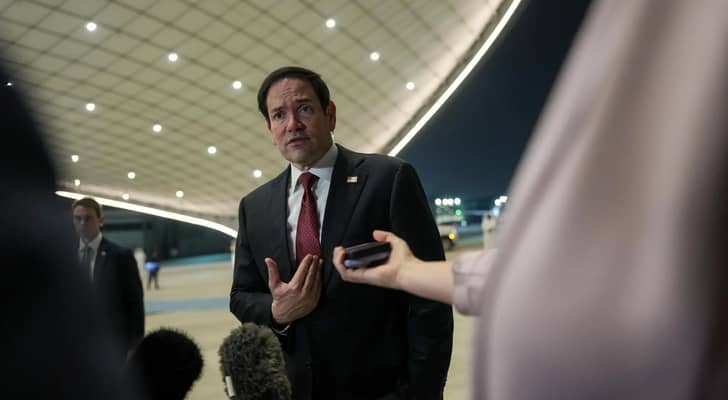
US Secretary of State Marco Rubio

Rubio: 'Israel' remains in Lebanon because of Hezbollah's attacks
Note: AI technology was used to generate this article’s audio.
- Rubio warns sanctions will return if Iran violates the interim agreement.
- Reaffirms opposition to any transit fees in the Strait of Hormuz.
- Says 'Israel' is fully informed, while Lebanon-'Israel' border talks remain a separate track.
Launching a critical diplomatic tour of the Gulf, US Secretary of State Marco Rubio revealed that specialized technical committees will return to Switzerland on June 29 to resume high-stakes negotiations with Iran.
The working-level talks will focus tightly on hammering out the granular nuclear verification and sanctions-relief mechanisms embedded in the newly signed bilateral Memorandum of Understanding (MoU).
Rubio confirmed that the landmark Swiss accord has initiated a rigid 60-day implementation clock.
However, he heavily conditioned the durability of the deal, issuing an explicit warning from the Trump administration that Washington is prepared to pivot back to aggressive economic containment at a moment's notice.
"President Trump expects Iran to remain fully committed to the talks, and he wants a clear, solid deal," Rubio told reporters in Abu Dhabi. "Iran must abide by the Memorandum of Understanding. If they do not, the President has numerous options at his disposal, chief among them an immediate return to maximum-pressure sanctions."
Hormuz free of tolls
A primary objective of Rubio's Gulf tour is assuring close partners -including the UAE, Saudi Arabia, and Kuwait- that the White House has not compromised their security or economic interests to secure the temporary truce with Tehran.
Addressing recent rhetoric from Iranian state hardliners suggesting that Tehran could seek to monetize or restrict maritime traffic in the Persian Gulf once the 60-day window closes, Rubio drew an uncompromising line.
"We demand that navigation through the Strait of Hormuz return to being completely free, a stance backed by the entire international community," Rubio asserted. "Let me be entirely clear: there will be absolutely no fees or transit tolls imposed in the Strait of Hormuz."
Coordinating 'Israeli' red lines
Rubio also addressed the geopolitical friction points surrounding Washington's closest regional ally, clarifying the level of intelligence sharing between the White House and Tel Aviv.
He dismissed speculation that the US had sidelined 'Israeli' defense interests to push through the interim agreement with Tehran.
"'Israel' is fully aware of everything we are doing regarding the Memorandum of Understanding," Rubio stated. "They are completely in the loop, and they are intimately aware of the specific red lines that President Trump has established."
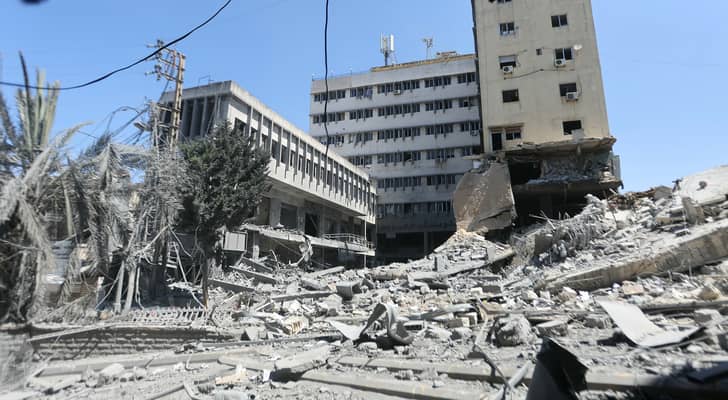
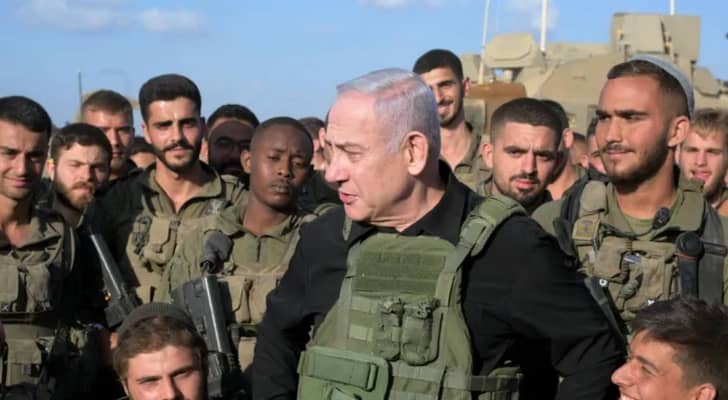
The Secretary of State explicitly defended the strategic rationale behind 'Israel's' current military footprint in the Levant, noting that "Israel is present in Lebanon because Hezbollah systematically targets it with rocket fire."
Independent Lebanon track
Crucially, Rubio signaled that the United States is treating the stabilization of Lebanon as an entirely separate diplomatic track, isolating it from the broader nuclear portfolio being negotiated with Iran.
"Today we are pursuing a second track, which consists of direct negotiations between the government of Lebanon and 'Israel,' and we are hopeful it will succeed," Rubio announced.
In a direct effort to diminish Tehran’s historic proxy leverage over Beirut through Hezbollah, Rubio vowed that Washington would deal exclusively with the sovereign state apparatus to restore order along the southern border.
"We will directly assist the Lebanese government in extending its legitimate authority and sovereignty over the entirety of its territory, completely free from any external foreign interference," Rubio concluded.