

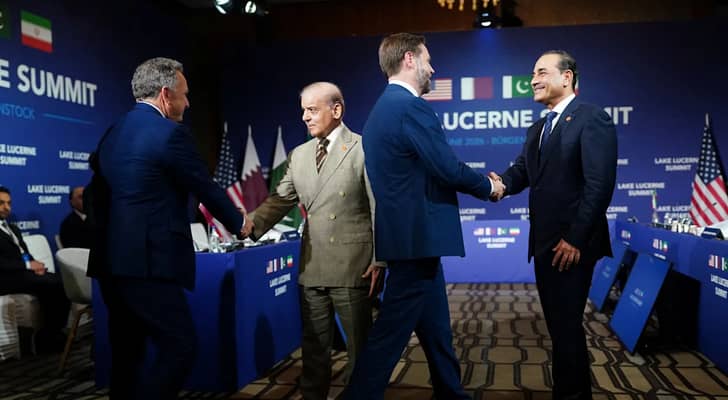
Day 115 | First round of US–Iran Swiss talks concludes
The opening round of high-stakes, direct negotiations between the United States and Iran has officially concluded in Switzerland.
Facilitated through the joint mediation of Pakistan and a Gulf nation, the diplomatic track marks the first major bilateral push to establish regional stability after months of severe military escalation.
Hussein Gurbanzadeh, a senior member of the Iranian negotiating delegation, told state television that the initial day of talks centered on fundamental economic concessions.
Specifically, the delegations reviewed mechanisms for releasing frozen Iranian financial assets and evaluated detailed proposals regarding oil sanctions relief.
The Lebanon Impasse: Continued warfare between 'Israel' and the Iran-backed group Hezbollah stands as a major roadblock to peace. Tehran has made it a strict precondition that fatal 'Israeli' strikes across Lebanon must cease entirely before any meaningful diplomatic progress can be made.
Vance’s Strained Mission: While steering the American delegation into the Swiss negotiations, Vice President JD Vance expressed strong optimism regarding the opportunity to "transform" long-standing US ties with Iran. However, this high-stakes diplomatic initiative was rapidly upended by conflicting public remarks from Donald Trump.
Thread ended
This live thread has ended. Follow our online coverage of day 116 of the war.
Read more: Day 116 | Iran clashes with US over Terms of frozen funds
Qalibaf says 'Israel' oppose negotiations because they see them as their end
Iranian Parliament Speaker Mohammad Bagher Qalibaf said understandings reached with the United States in Switzerland included mechanisms to safeguard Lebanon’s sovereignty and territorial unity, a coordination channel on any incidents in the Strait of Hormuz, and the temporary lifting of sanctions on Iranian oil and petrochemical sales until a final deal is reached, as well as the release of $12 billion in frozen Iranian assets.
He said meetings with US Vice President JD Vance had been arranged as needed to follow up on the memorandum of understanding and resolve disputes, stressed that diplomacy and military action are complementary, and said 'Israel' opposes the negotiations because it sees them as “its end.”
Trump: Any released Iranian funds will be used solely to buy grain from US farmers
- Trump says Hormuz is fully open and oil shipments have increased.
- Reports progress in Iran talks while warning against future violations.
- Released Iranian assets would be restricted to US food purchases.
- Says oil revenues should support civilians, not military rebuilding.
- Claims his approach helps prevent economic turmoil and addresses regional disputes.
In a series of sweeping statements from the Oval Office, US President Donald Trump announced significant developments regarding international trade, maritime security, and ongoing diplomatic negotiations with Iran.
Striking a balance between optimism and geopolitical pressure, Trump confirmed that global energy transit has stabilized and that negotiators are successfully advancing toward a comprehensive deal.
Hormuz fully open
A primary focus of the President's address was the immediate restoration of critical maritime commerce.
Trump declared a major breakthrough in shipping security, stating that the United States has successfully managed to pass more oil quantities than before.
"The Strait of Hormuz is fully open," Trump announced, adding that "Iran is doing very well with regard to the Strait of Hormuz."
Trump heavily underscored that the current diplomatic economic strategy would prevent international financial instability.
He reassured markets and the public that the specific methodology he is utilizing to handle Iran will not cause a global economic depression.
Good progress in negotiations
Addressing the diplomatic track, Trump stated that Washington is currently making "good progress" in negotiations to secure a final agreement that he described as both "fair and reasonable."
However, the President coupled this diplomatic optimism with an absolute security guarantee, vowing that "Iran will never possess a nuclear weapon."
Despite the positive trajectory of the talks, Trump maintained a firm deterrent posture, issuing a direct warning to Tehran. "If Iran misbehaves, I will do what I have to do," Trump asserted.
Frozen assets for American agriculture
In a major policy directive regarding sanctions relief, Trump detailed a highly restrictive economic mechanism for handling the release of blocked Iranian capital.
The President mandated that any frozen Iranian funds slated for release will not be granted as unrestricted cash. Instead, the money will be tied directly to the American agricultural sector.
"The frozen Iranian funds that will be released will be used exclusively to purchase food from American farmers," Trump stated.
Expanding on this economic framework, Trump outlined clear boundaries for how Tehran must manage its domestic finances moving forward.
He emphasized that oil revenues are intended for humanitarian purposes rather than defense spending.
"Iran is not supposed to use oil revenues to rebuild its army," Trump explained. "Instead, it should use the money to buy food for its people."
Addressing regional friction
Beyond the immediate scope of the US–Iran negotiations, Trump noted that his administration is actively engaged in untangling broader diplomatic complexities in the Middle East.
Without providing specific operational details, the President concluded by affirming his personal involvement in smoothing over leadership friction, stating, "I am working on solving problems, including those related to Netanyahu."
Vance downplays rumored Iranian ‘snub,’ urges media to skeptically view social media rumors
US Vice President JD Vance is downplaying reports of a diplomatic standoff following a viral moment involving Iranian negotiators, urging the public and the press to look past social media speculation.
In a video clip, a reporter asks about an encounter involving Iranian Foreign Minister Abbas Araghchi. According to the reporter, Araghchi entered a meeting room without greeting the American delegation or shaking hands before promptly exiting, sparking speculation of an intentional diplomatic snub.
When asked how he interpreted the interaction and whether it felt like a deliberate slight, Vance dismissed the notion.
"No, I mean, trust me, I’ve spent a lot of time dealing with the Iranians over the last few months," Vance responded. "Sometimes I find them extremely confusing as negotiators, but look, we had a little press conference. They obviously don’t quite have the same First Amendment protections in Iran that we have in the United States of America."
Vance explained that despite the brief, awkward encounter and subsequent reports that the Iranian delegation was preparing to walk out, the two sides ultimately engaged in lengthy, substantive discussions.
"What I did find kind of funny is that after that initial meeting, there was this sort of social media firestorm where everybody said the Iranians are going to leave, and then we proceeded to talk to them for like the next nine hours," he noted.
Arguing that the digital narrative did not reflect the reality behind closed doors, Vance issued a caution to media outlets covering the high-stakes talks.
"I would just encourage the media, mistrust a little bit what you see coming out of Iranian social media," Vance concluded. "They can be confusing negotiators, but we feel like we’re making progress."
Ghalibaf, Araghchi arrive in Muscat for talks over Hormuz
Following intense diplomatic negotiations in Switzerland, Iranian Parliament Speaker Mohammad Bagher Ghalibaf and Foreign Minister Abbas Araghchi arrived in Muscat on Monday for high-level consultations regarding new management arrangements for the strategic Strait of Hormuz.
According to Iranian state television, the sudden visit is aimed at finalizing a collaborative coordination framework for the vital maritime choke point.
The Omani News Agency confirmed that both the Sultanate of Oman and Iran have heavily emphasized the critical importance of utilizing proactive diplomacy to preserve regional security and guarantee unhindered navigation through the Strait.
The diplomatic shift follows an official announcement from Washington that Tehran has conditionally committed to open transit within the waterway as part of broader peace tracks.
Qalibaf says Iran will not back down until Lebanon fully restores sovereignty
Iranian Parliament Speaker Mohammad Bagher Qalibaf said military action alone, regardless of its success, cannot secure the gains of victory without diplomacy, stressing that negotiations remain an extension of resistance rather than an alternative to it.
Qalibaf said talks between Iran and the United States would ultimately contribute to the goal of enabling Lebanon to exercise sovereignty over all of its territory, adding that Tehran would not retreat until that objective is achieved.
“Negotiations are one of the methods of struggle and a continuation of it,” Qalibaf said, according to remarks reported on Monday.
He added that while military operations may achieve results on the ground, diplomacy is necessary to translate those gains into lasting outcomes.
Trump says Iran will agree to major weapons inspections
Donald Trump says Iran is expected to accept major weapons inspections to ensure “nuclear honesty” in the future.
'Israel' PM says troops have 'full freedom of action' in south Lebanon to prevent threats
'Israeli' Prime Minister Benjamin Netanyahu declared Monday that 'Israeli' forces had been granted "full freedom" to engage any threat encountered in southern Lebanon, reaffirming that troops would remain deployed in the region for as long as deemed necessary.
"My directive, and that of the minister of defence, to the IDF is clear and has not changed: Our fighters in southern Lebanon have full freedom of action to thwart any direct or developing threat to them or to the residents of the North," Netanyahu said in a statement. "The IDF has no restrictions on this matter."
Iran sends top officials to Oman for Strait of Hormuz talks
Iranian negotiators Ghalibaf and Foreign Minister Araghchi are traveling to Oman to discuss management of the Strait of Hormuz, focusing on coordination of Iranian arrangements and bilateral cooperation, according to IRNA and a Telegram post by Ghalibaf.
Iran says it will continue IAEA cooperation
Iran says cooperation with the IAEA will continue under existing procedures and in line with parliamentary approvals and decisions by the Supreme National Security Council.
Qatar’s PM, US VP held call with Lebanese President
- Leaders discussed efforts to reinforce the Lebanon ceasefire.
- Qatar reaffirmed support for Lebanon’s sovereignty and regional peace.
- Aoun praised Qatar’s mediation and diplomatic role.
On the sidelines of the ongoing Lake Lucerne Summit in Switzerland, a coordinated diplomatic push has been launched to shore up the volatile security situation in the Levant.
The Qatari Ministry of Foreign Affairs announced that Qatari Prime Minister and Minister of Foreign Affairs Sheikh Mohammed bin Abdulrahman Al Thani, alongside US Vice President JD Vance and senior American officials conducted a joint high-level telephone call with Lebanese President Joseph Aoun.
The primary purpose of the unprecedented joint call was to directly review ongoing political and diplomatic tracks focused on strengthening adherence to the recently brokered ceasefire in Lebanon.
Both Washington and Doha are seeking to leverage the momentum generated by the broader US–Iran framework to build lasting regional stability and prevent further military escalation.
Qatar reaffirms Lebanese sovereignty
During the discussions, Prime Minister Al Thani explicitly highlighted Qatar’s unyielding commitment to the Republic of Lebanon.
He emphasized Doha’s unwavering position regarding the preservation of Lebanon’s sovereignty, independence, and territorial integrity against external threats.
The Prime Minister further reiterated Qatar's comprehensive support for any regional and international frameworks designed to transition temporary truces into a just, enduring, and sustainable peace across the broader Middle East.
Beirut welcomes mediation
From Baabda Palace, Lebanese President Joseph Aoun expressed his profound gratitude and appreciation for Qatar’s active role.
He praised Doha's continuous diplomatic mediation, tireless troubleshooting, and constructive contributions aimed at cultivating meaningful regional dialogue and securing Lebanon's fragile borderlines.
The call takes on added significance as technical teams at the Swiss summit finalize operational parameters for a proposed "Lebanon deconfliction cell".
This specialized tracking mechanism, overseen by regional partners, is expected to serve as the baseline framework for monitoring ceasefire violations and ensuring compliance on the ground.
Rubio to travel to Gulf amid Iran talks
US Secretary of State Marco Rubio will begin a trip to three Gulf countries on Tuesday amid negotiations with Iran to end the war in the Middle East, his spokesperson said.
Visiting the United Arab Emirates, Kuwait and Bahrain, Rubio will discuss "the memorandum of understanding with Iran, efforts to secure full and free safe transit through the Strait of Hormuz, and the importance of peace and stability in the region," State Department spokesman Tommy Pigott said in a statement.
Pakistani PM stunned as Iranian delegation quits Switzerland talks
It was supposed to be the crowning achievement of months of quiet, backchannel diplomacy.
Instead, the opening minutes of the high-stakes Lake Lucerne Summit in Bürgenstock, Switzerland, delivered a stark reminder of how fragile the newly minted US–Iran peace track truly is.
According to eyewitness accounts and visible cues inside the luxury resort, the carefully orchestrated diplomatic script designed by Pakistani and Qatari mediators fell apart the moment Iranian Foreign Minister Abbas Araghchi walked into the negotiation hall.
As the delegations gathered to implement the newly signed Islamabad Memorandum of Understanding, Pakistani Prime Minister Shehbaz Sharif went in for a warm, cordial embrace with Araghchi, clearly expecting the pre-arranged media schedule to play out smoothly.
However, Araghchi immediately made it clear that Iran was not interested in performing for the cameras or participating in superficial opening speeches.
The physical shift in the room was instantaneous.
Observers noted that the visible confidence drained from the Pakistani delegation.
Sharif and Army Chief Field Marshal Asim Munir -who had spent weeks assuring Washington that every logistical and political detail had been locked down- were suddenly left scrambling in public.
Interior Minister Mohsin Naqvi was quickly dispatched to chase down the Iranian foreign minister to figure out what had triggered the sudden pivot.
A tense, secondary briefing behind closed doors followed, leaving the hosting officials with faces that clearly betrayed the panic of a high-profile diplomatic initiative unraveling in real-time.
Standing quietly at the back of the room, observing the entire spectacle, was US Vice President JD Vance.
After the frantic sidebar negotiations concluded, Sharif and Munir walked over to Vance to brief him on the sudden change in Iranian posture.
By all accounts, the exchange was deeply apologetic on the part of the hosts.
Only after this quiet intervention were the delegates able to salvage the timeline and proceed with the delayed formal speeches.
The sudden friction underscores the massive pressure bearing down on the Swiss summit.
Pakistan and Qatar have invested enormous diplomatic capital to position themselves as the indispensable mediators capable of bringing Washington and Tehran to the same table.
They successfully secured the luxury venue, gathered the rival parties, and captured the initial symbolic visuals.
Yet, as Araghchi's abrupt pushback demonstrated, a single external variable -most notably a recent, hardline public threat from Donald Trump questioning the deal's parameters- can instantly disrupt months of meticulous planning, proving that the road to a final US,Iran treaty remains a geopolitical minefield.
US says suspending sanctions on Iranian oil until August 21
The US Treasury said Monday it is temporarily lifting sanctions on Iran to allow the Islamic Republic to produce, sell and deliver crude oil and related products through August 21.
"All transactions" that were previously prohibited involving the production, sale, and transport of Iranian-origin crude oil "are authorized through 12:01 am eastern daylight time, August 21, 2026," according to a license published by the Treasury Department, which administers US economic sanctions.
US Treasury Secretary Scott Bessent cited Tehran's commitment in ongoing negotiations to "free and open transit" in the Strait of Hormuz and permission for International Atomic Energy Agency inspectors to enter their country as a reason for pausing the sanctions.
Netanyahu says 'Israel' committed to staying in south Lebanon security zone
'Israeli' Prime Minister Benjamin Netanyahu said 'Israel' would remain in the security zone in southern Lebanon for as long as necessary, claiming the move was needed to protect residents of the north.
WATCH: California protesters raise Lion and Sun flag before Iran match
Protesters in California raised the historic Lion and Sun flag ahead of Iran’s World Cup match, drawing attention from fans and media gathered near the stadium.
Vance to depart Switzerland, leaving Iran talks to technical teams
Vice President JD Vance said he is departing Switzerland after a day of high-level negotiations to end the war with Iran.
“As much as this place is very beautiful, I can’t stay here for the next 60 days,” the vice president said during a brief news conference.
“I’m about to go back home to the United States, but the technical teams are going to be working with proper oversight to make sure that we’re accomplishing the objectives that matter for everybody,” he added.
Vance said the negotiating teams made “a lot of good progress” during the talks, staying at the table past 1 a.m. today.
Iran's Pezeshkian to visit Pakistan on Tuesday
The office of Iranian President Masoud Pezeshkian announced that he will visit Pakistan on Tuesday, according to Iran's Tasnim News Agency.
The visit comes amid ongoing diplomatic activity involving Tehran and regional partners, following recent negotiations and discussions on a range of political and economic issues.
Pezeshkian says Iran entered talks without concessions
Iranian President Masoud Pezeshkian said that Tehran entered negotiations without making any concessions, emphasizing the country’s firm stance in ongoing diplomatic talks.
His remarks come amid continued discussions involving Iran and other parties over regional and bilateral issues.
Pezeshkian said Iran did not offer concessions during the talks, while claiming that the other side made some concessions as a result of Iran’s position.
He added that “positive breakthroughs” had been observed in certain areas of the negotiations, without providing further details.
15 ships cross Strait of Hormuz, Kepler data shows
Marine analytics data from Kpler indicates that 15 vessels have crossed the Strait of Hormuz since Monday morning, suggesting continued maritime traffic through one of the world’s most strategic shipping routes.
The figures come amid conflicting statements regarding the status of the waterway, which connects the Gulf to the Arabian Sea.
Background on closure claims
The Iranian Revolutionary Guard Corps said on Sunday that the Strait of Hormuz remained closed, following earlier reports of a shutdown linked to escalating tensions related to the war involving Israel and Lebanon.
However, the latest vessel tracking data appears to indicate that maritime movement has continued despite those claims.


