Trump reveals details of Qasem Soleimani’s killing
Note: AI technology was used to generate this article’s audio.
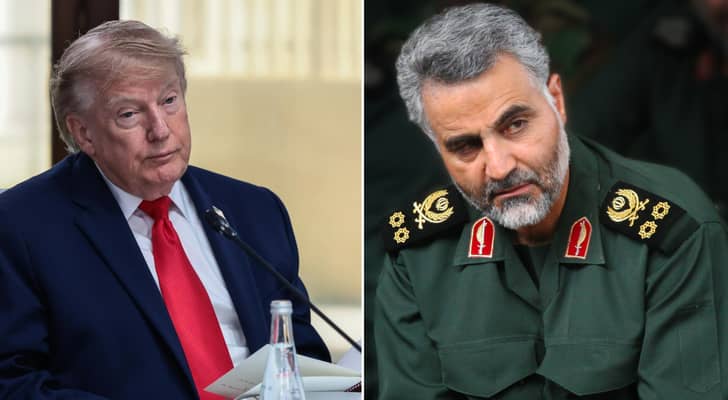
US President Donald Trump detailed his account of the 2020 operation that killed Iranian General Qasem Soleimani, asserting that ‘Israel’ had committed to a joint effort but withdrew at the final stage.
According to Trump, the United States and ‘Israel’ had collaborated on the plan for approximately 30 days.
“Israel, at the last moment, backed out when I killed him. That was supposed to be done with Israel. It was a joint thing,” Trump said.
Trump described Soleimani’s cautious travel habits, noting that the Iranian commander typically flew on commercial airliners surrounded by civilians, aware that such platforms would deter a strike, according to statements made to Axios.
“We worked on it for 30 days. He only travels in commercial airliners with lots of people because he knows we're not going to shoot him down. You know, a military plane is different.”
The operation proceeded after ‘Israel’ informed the US a day before the scheduled action that it would not participate, citing concerns about the potential repercussions.
“And he got into the plane. Everything was on schedule. But a day before, Israel told us they're not going to do the attack. And I understood that, because it was not so good for them,” Trump continued.
Undeterred, Trump said he consulted senior US military generals—explicitly excluding figures such as Mark Milley, whom he criticized for other decisions.
“But I went to some good guys. I said, ‘What do you guys think?’ They said, ‘Well, we can do it without 'em, we don't need 'em, sir.’”
“I said, ‘Would it be as good?’ They said, ‘Just as good or better.’”
“And it was a flawless attack.”
The strike, conducted via drone at Baghdad International Airport on January 3, 2020, killed Soleimani and several accompanying figures, including Iraqi militia leader Abu Mahdi al-Muhandis.
US officials have previously described the operation as a unilateral American action, with ‘Israeli’ intelligence providing supportive information on Soleimani’s movements, though not direct operational involvement in the strike itself.
‘Israeli’ leaders, including then-Prime Minister Benjamin Netanyahu, publicly praised the US decision at the time.
Tensions with Netanyahu over Iran
Trump also suggested in other recent statements on Wednesday during a press conference on the sidelines of a G7 summit that Netanyahu lacks standing to criticize a recently signed memorandum of understanding between the United States and Iran, citing his withdrawal from the operation to strike Soleimani.
“They’ve been wonderful to me, Israel, but they didn’t want to do that attack,” Trump said.
“They were all set the night before the attack. Then [Israel told] me they didn’t want to do it,” Trump added, claiming that he decided to go ahead with the operation alone.
“For all of those so-called geniuses who want to show me how smart they are, ask them why didn’t they blow up General Soleimani,” Trump said, without mentioning ‘Israel’ directly.
Trump’s comments reflect ongoing friction with Netanyahu, whom he has publicly described in strong terms while also acknowledging their partnership.
The US president has expressed frustration with ‘Israeli’ military actions in Lebanon that he believes risked derailing the Iran negotiations.