

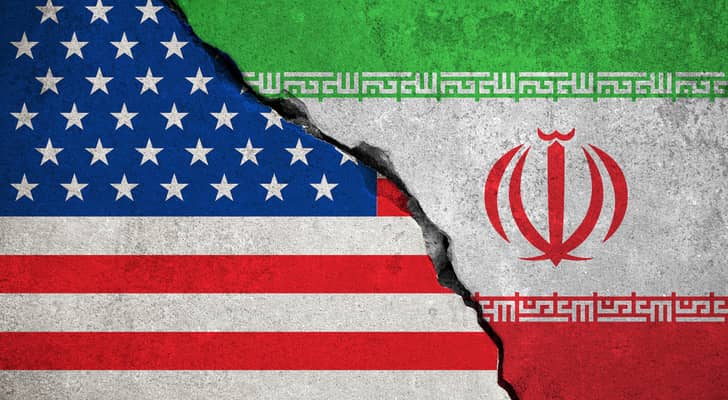
Day 110 | Iran and US to embark on two months of peace talks Friday
The United States and Iran are to launch talks on a final settlement to their conflict on Friday in Switzerland, officials said, as news that the Strait of Hormuz will reopen sent world oil prices tumbling.
Negotiations over a final deal are to start immediately after a signing ceremony and continue during a 60-day window, leading to decisions on the fate of Iran's nuclear programme and a plan for the lifting of international economic sanctions.
Optimism that the war triggered by the February 28 US-‘Israeli’ strikes on Tehran might be coming to an end was dented, however, by fresh ‘Israeli’ strikes on south Lebanon.
Iran's central military command, Khatam al-Anbiya, warned that Israel should "await a harsh response" to the strikes, which Lebanon's state news agency said targeted two vehicles in the town of Mayfadoun and another in nearby Shukeen, near the town of Nabatieh in southern Lebanon, killing four.
Friday's signing ceremony will take place at Switzerland's mountainside Burgenstock resort, perched high above Lake Lucerne, the Swiss foreign ministry said.
According to a senior US official, speaking on condition of anonymity, the framework agreement has already been signed electronically by President Donald Trump, Vice President JD Vance, Iran's deputy foreign minister Majid Takht-Ravanchi and top negotiator Mohammad Bagher Ghalibaf.
Ghalibaf will attend the signing and the US side will be represented by Vance, who said Trump might also attend.
The developments came after Trump said an Iranian blockade on the crucial Hormuz strait oil and gas route would be fully lifted by Friday, in a major boost to the global economy.
Thread ended
This live thread has ended. Follow our online coverage of day 111 of the war.
Read more: Day 111 | Iran, US “remotely” sign deal to end war; now in effect: US media
US, Iran execute digital signing of peace MoU
The United States and Iran have successfully signed a digital memorandum of understanding to officially end the war, according to Axios correspondent, placing the ceasefire and maritime agreements into immediate effect ahead of Friday’s planned diplomatic summit in Switzerland.
Ghalibaf: We achieved in diplomacy more than military action
- Iran was fully prepared to launch a major retaliatory strike
- Tehran warned of a wider regional attack if the enemy responded
- Trump announced a Lebanon ceasefire, enabling mass returns of displaced
Iranian Parliament Speaker Mohammad Bagher Ghalibaf delivered a major address detailing the inner workings of a high-stakes geopolitical standoff, describing diplomacy as an extension of active combat.
Ghalibaf asserted that by treating negotiations as a form of struggle, the Islamic Republic ultimately secured several times more benefits through the diplomatic track than it could have ever achieved via direct military engagement.
Reflecting on the tense final hours before a comprehensive ceasefire was brokered, Ghalibaf revealed that Iran had drawn a strict line in the sand following a military assault on the Dahiyeh suburb of Beirut, Lebanon.
Despite warnings from international actors that a breakthrough agreement was close to finalization and could be upended, Iran rejected calls to withhold its military response.
"When you attacked Dahiyeh in Lebanon, we were going to respond under any circumstances," Ghalibaf stated. "Our friends in the armed forces were ready, they had their orders, and the command's strategy was in place; everything was prepared. No matter how much they told me there not to strike, I said we will definitely strike."
Ultimatum forces ceasefire
The Parliament Speaker detailed the severe warnings he issued to back up Iran's military posture, informing opposing parties that any counter-retaliation would trigger an uncontained regional war.
"You must be careful not to respond," Ghalibaf warned his counterparts during the peak of the crisis. "Because you struck, we will strike; if you respond, we will strike the region."
According to Ghalibaf, this rigid military readiness directly shifted the diplomatic calculations in Washington and forced a rapid escalation of American pressure on 'Israel'.
He noted that the impact of Iran's unyielding position became visible in the early hours of the morning when US President Donald Trump intervened directly to halt the conflict.
"You saw that by two o'clock in the morning, Trump announced a ceasefire, not just in Dahiyeh, but across the entirety of Lebanon, and spoke to Netanyahu using that exact same language," Ghalibaf stated, pointing to the event as definitive proof that negotiation is a powerful method of combat.
Diplomacy returned security
Ghalibaf emphasized that the primary objective of any state strategy must be achieving its core national goals and restoring baseline stability.
He noted that while he was in constant communication with military commanders on the ground to prepare for an imminent strike, the overwhelming success of the diplomatic channel ultimately shifted the outcome, bringing immediate security back to the region.
The tangible success of this diplomatic victory is already visible on the ground in Lebanon.
Ghalibaf highlighted that within the first 24 hours of the announced truce, more than 50 percent of the citizens who had been displaced by the heavy fighting had already successfully returned to their homes.
Concluding his remarks, Ghalibaf credited the professional staff at the Iranian Foreign Ministry for executing the complex diplomatic maneuvers, while emphasizing that his own approach remains rooted in his background as a soldier.
"I have experience in diplomatic work, but diplomacy is not my profession," he concluded. "I am a fighter, but with the spirit and culture of a warrior, I follow the path of diplomacy as well."
Trump says US will have to give Iran's money back
US President Donald Trump said the United States has frozen significant Iranian assets and may ultimately have to return them, arguing that keeping the funds indefinitely could undermine confidence in the US dollar.
Speaking at a news conference in France following the G7 summit, Trump said the money belongs to Iran and was frozen at a specific point in time.
He also addressed a recently signed US-Iran memorandum of understanding, which includes provisions to end military operations, reopen the Strait of Hormuz and launch talks on Iran’s nuclear program alongside a sanctions-relief process.
Trump added that sanctions relief could come "as soon as they behave" and said investment in Iran's reconstruction would depend on the country's conduct, while noting the extensive economic damage Iran has suffered.
Iran details 14-point framework regarding US agreement
- Agreement calls for lifting maritime restrictions and restoring Hormuz shipping
- Framework includes sovereignty guarantees and phased release of Iranian assets
- Tehran says Lebanon ceasefire is essential for talks to proceed
The Iranian Foreign Ministry issued a comprehensive brief on Wednesday, unveiling the explicit structural parameters of the newly brokered 14-point Memorandum of Understanding (MOU).
Spanning just one and a half pages, the strategic framework officially binds both Tehran and Washington to an intensive 60-day negotiation window aimed at securing a final, permanent diplomatic accord, with formal talks scheduled to commence this Friday.
Ministry statement emphasized that the first two foundational clauses of the document are dedicated entirely to establishing the general rules of engagement for the upcoming process.
Under the terms of the baseline text, the United States has formally committed to respecting Iran's sovereign independence and protecting its territorial integrity throughout the lifespan of the peace track.
Sanctions, frozen assets, nuclear roadmap
The upcoming 60-day diplomatic window will focus directly on dismantling the complex architecture of international trade restrictions and addressing Iran's advanced atomic infrastructure.
The Foreign Ministry confirmed that the upcoming rounds will systematically tackle the technical disposition of Iran's enriched nuclear materials, the precise future caps on uranium enrichment levels, and the structural lifting of commercial blockades.
As part of the initial understandings, the US delegation has committed to removing all existing barriers preventing Tehran from reclaiming its frozen financial assets abroad, a matter that has already undergone preliminary technical discussions.
Furthermore, Washington has pledged to execute a comprehensive lifting of all primary and secondary economic sanctions -including multilateral measures previously instituted by the United Nations Security Council- subject to a structured timetable to be finalized during the upcoming sessions.
Concurrently, the agreement mandates an immediate de-escalation of naval hostilities.
The US is required to completely dismantle its maritime blockade and halt all interference with Iranian merchant vessels within a strict 30-day deadline, a directive the ministry noted American forces have already begun actively implementing.
In return, Tehran has agreed to normalize commercial shipping operations.
Over a designated timeframe, Iran will restore standard global traffic patterns through the strategic Strait of Hormuz and clear specific tactical obstacles from the waterway.
The operational administration of the corridor will be managed through a joint partnership between Iran and Oman, with provisions to consult broader regional states as operational necessities arise.
Lebanon, non-negotiable prerequisite
The Foreign Ministry strongly underscored that the stability of the entire diplomatic track rests upon an immediate, verifiable cessation of military hostilites across the Middle East.
The state text notes that Lebanon is explicitly referenced three separate times within the text of the MoU, reflecting its central importance to the regional peace architecture.
"The war must be stopped on all fronts, including Lebanon, for the negotiation phase to begin," the Foreign Ministry statement declared. "One of the specific clauses explicitly confirms that the commencement and continuation of these negotiations remain strictly conditional upon the implementation of reciprocal obligations, foremost among them being a total cessation of the war that includes Lebanon."
Tehran issued a stark warning regarding the continued presence of Israeli forces across the border, asserting that the agreement mandates absolute respect for Lebanese sovereignty.
The ministry stated that any continued 'Israeli' military occupation of Southern Lebanon constitutes a direct, actionable violation of the newly signed MOU, warning that Iran will take all necessary measures to counter ongoing infractions.
Despite the volatile regional backdrop and rising tension over enforcement terms, the Foreign Ministry concluded by confirming that Iran’s diplomatic itinerary remains entirely unchanged.
The state delegation is fully prepared to arrive in Switzerland to commence the first formal session of the 60-day negotiation cycle this coming Friday.
"Here they lost militarily", Trump responds to his own 2020 Iran quote
Fox reporter confronts Donald Trump with his own January 2020 statement: "Iran never won a war, but never lost a negotiation." When pressed to reconcile that logic with the current Iran deal, Trump defends the outcome by asserting, "Here they lost militarily."
Trump says US 'did send a copy' of Iran accord to 'Israel'
US President Donald Trump on Wednesday said Washington "did send a copy" of its accord with Iran to end the Middle East war, following reports of tensions with Prime Minister Benjamin Netanyahu.
Insisting he maintains a good relationship with Netanyahu, Trump reaffirmed his criticism at the G7 summit of 'Israel's' campaign against Hezbollah in Lebanon, saying "they (Israel) could do a much better job".
Hezbollah chief says 'Israel'-Lebanon talks should be limited to mutual security
Hezbollah chief Naim Qassem said Wednesday that Lebanon's negotiations with 'Israel' should be limited to "mutual security", and that the country's main demand should be restoring its sovereignty after 'Israeli' troops invaded the south.
"The ceiling for the negotiations with the Israeli enemy is mutual security... and any proposal under the banner of disarmament will not pass, as this is an Israeli recipe for taking everything and wrecking the country," Qassem said in a televised address.
"Everything linked to organising our domestic situation, whether the issue of weapons or the economy, or the national security strategy or defence strategy... it all must be completely outside the negotiations. This we discuss internally. Therefore in any negotiation, the main demand must be Lebanon's sovereignty," he added.
Trump says Iran accord to be signed 'shortly', 'maybe' Thursday or Friday
US President Donald Trump on Wednesday said he expected the accord with Iran ending the Middle East war to be signed "shortly" but added uncertainty over the date.
"The deal we reached with Iran on Sunday will be signed shortly, tomorrow (Thursday), maybe the next day (Friday)," Trump said at the G7 summit, after previous announcements that it would be signed Friday in Switzerland.
"We are going to most likely sign a deal," he added.
Trump: ‘You don’t have to knock down buildings in Beirut’ on 'Israel’s' campaign in Lebanon
Speaking of 'Israel’s' ongoing campaign in Lebanon, Trump has said “they could do better with respect to Hezbollah”.
“I’m not saying they shouldn’t protect themselves,” the president said, but added: “You don’t have to knock down buildings in Beirut. They could behave better.”
Trump admits row with Netanyahu, told him to 'tread lightly'
Trump acknowledges rift with Netanyahu over Lebanon operations, urging 'Israeli' PM to show restraint
“If it doesn’t get done in 60 days, that’s all right, we go back to bombing,” Trump said
The US president says he’s prepared to “go back to bombing” Iran if the next stage of negotiations does not pan out the way he wants.
“If it doesn’t get done in 60 days, that’s all right, we go back to bombing,” Trump said. “But we might have to, because we’re never going to let them have a nuclear weapon.”
Trump: Continued warfare would have sealed off Hormuz
Speaking from the sidelines of the G7 Summit in the French Alps, US President Donald Trump issued an aggressive defense of his administration’s newly brokered peace framework with Iran.
Trump asserted that his decisive use of military force successfully dismantled Iran’s strategic defenses, forcing Tehran to capitulate and accept terms that completely prevent the Islamic Republic from obtaining a nuclear weapon.
Trump underscored that the deal directly averted a devastating global economic crisis by permanently unlocking the blockaded Strait of Hormuz.
In a series of breaking remarks to reporters, the President made it clear that Western coalition forces were prepared to wage an indefinite war if Tehran had refused the administration's final terms.
"If we had continued fighting, the Strait of Hormuz would never have opened at all," Trump stated, emphasizing the strategic necessity of the diplomatic pivot. "The agreement with Iran achieves everything we wanted, from preventing it from possessing a nuclear weapon to opening the Strait of Hormuz."
Second-night bombing threat
The President pulled back the curtain on the final hours of the intense, closed-door negotiations that preceded Sunday's announcement, revealing that the US utilized an unyielding military ultimatum to break the diplomatic deadlock.
"The past two days were extremely difficult," Trump disclosed. "We informed the Iranians that we would return to bombing them for a second night if we did not reach an agreement."
Trump noted that previous operations had already achieved devastating tactical objectives, effectively crippling Iran's conventional defense capabilities and removing its top command structure.
"We eliminated Iran’s leaders and its navy," Trump said, adding that his primary motivation for shifting from active combat to a negotiated settlement was to insulate the global market from a catastrophic disruption. "I struck a deal because I did not want to see an economic disaster."
"If we had not made this deal, the opening of the Strait of Hormuz would not have been achieved, and bombs would still be falling constantly," Trump added.
G7 leaders endorse deal
The diplomatic breakthrough has yielded immediate dividends for the global economy. Following months of commercial gridlock that saw energy shipping volumes through the Persian Gulf dry up entirely, energy markets reacted dynamically to the peace framework.
Trump confirmed that global oil prices have plummeted to unprecedentedly low levels in the immediate aftermath of the announcement, providing crucial breathing room for inflation-weary consumers.
The details of the memorandum of understanding (MOU) -which transitions into a intensive 60-day negotiation window following a formal signing ceremony in Geneva this Friday- were a primary focus of the Group of Seven meetings in Évian.
Trump noted that he personally briefed his international counterparts on the exact mechanics of the deal, reporting an overwhelmingly positive reception from allies who had previously expressed deep reservations over the rapid outbreak of hostilities.
"I discussed the details of the Iran agreement with the leaders at the G7 summit, and they are very happy that we concluded a deal," Trump concluded. Expressing deep confidence in the durability of the truce, he added, "I believe that the Iranian leadership will behave completely differently now."
US, Iran and mediators discuss accelerating MoU signing timeline, Axios reports
The United States, Iran, and mediators are discussing shifting the signing of a memorandum of understanding to a remote format as early as Wednesday instead of an in-person ceremony on Friday, according to Axios, citing a diplomat from a mediating country and a second source familiar with the talks.
Axios reported that the move could allow the agreement to be signed electronically, potentially accelerating the implementation of provisions related to the Strait of Hormuz and leading to the earlier release of the deal’s text. A diplomatic source said both sides are aligned on opening the strait and that talks aim to speed up the timeline.
A source familiar with the discussions told Axios that Iran had requested the text not be published before formal signing, while denying the White House was responding to political pressure. The White House declined to comment.
Despite the possible change, meetings between U.S. and Iranian delegations led by Vice President JD Vance and Iranian parliamentary speaker Mohammad-Bagher Ghalibaf are still expected to take place Friday in Switzerland to discuss launching nuclear talks.
Axios also reported conflicting accounts over whether the agreement was already signed electronically on Sunday, with one official saying it was, while other sources disputed that claim.
As of Wednesday morning, no final decision had been made on changing the signing schedule.
China tells Iran 'all parties' must adhere to deal to end war
China's top diplomat told his Iranian counterpart on Wednesday it was "key" for all sides to "genuinely implement" their commitments after Tehran and Washington reached a memorandum of understanding to end their war, Beijing's foreign ministry said.
"The dawn of peace has already emerged, the key part of the next step is for all parties to genuinely implement their commitments and eliminate interference from various sides," Wang Yi told Abbas Araghchi in a phone call.
"China has consistently supported Iran's reasonable and legitimate claims and Iran's efforts in safeguarding its own sovereignty and security," Wang added.
Macron says G7 summit 'moment of unity' after months of 'disagreements'
French President Emmanuel Macron on Wednesday hailed the G7 summit as a "moment of unity" after months of "disagreements", as the three-day meeting in France came to a close.
The summit was a "success" after months "characterised more by fragmentation, divisions and disagreements", Macron said at a press conference, calling it a moment of "unity, of meaningful discussion and of genuine cooperation amongst the leaders gathered here".
The French president also hailed the "remobilisation" of the G7 group of world leaders to ramp up pressure on Russia to broker peace with Ukraine.
Trump says he'll address media from France as he highlights Iran outcome
US President Donald Trump said in a Truth Social post that discussions during his trip to France centered on preventing Iran from obtaining a nuclear weapon and reopening the Strait of Hormuz.
He also highlighted what he described as strong economic indicators in the United States, including investment, jobs, stock market gains and lower oil prices.
Iranian channel claims 3 tankers, 2 cargo ships broke naval blockade
Iran’s Press TV reported that three oil tankers and two cargo vessels carrying Iranian goods successfully breached the naval blockade imposed on Iran, claiming that the process of lifting the US maritime blockade has begun.
'Israeli' military claims it killed Hamas, Islamic Jihad commanders
The 'Israeli' military claimed it killed two Palestinian fighters in separate strikes across the Gaza Strip over the weekend, claiming they were involved in the October 7, 2023 attack on Kibbutz Be’eri.
The military identified the two men as Hamas commander Mohammed Saeed Ahmed Nimroti and Muawiya Sulaiman Zakar Aydi, a commander in Palestinian Islamic Jihad’s central camps battalion.
There was no immediate response from Hamas or Palestinian Islamic Jihad regarding the statements.
Somaliland denies 'Israel' in talks to open military base
Somaliland’s Defence Minister Mohamed Yusef Ali has dismissed media reports suggesting that 'Israel' is in negotiations to establish a military base in the territory.
Speaking on the sidelines of a conference in Tel Aviv, Ali told Reuters that while 'Israel' is involved in training Somaliland’s military and police forces, claims about a planned military base are "rumours".
The comments come amid expanding ties between the two sides. 'Israel' recognised Somaliland as an independent state in December, a move rejected by Somalia, which described it as a "deliberate attack" on its sovereignty.
Earlier this week, Somaliland President Abdirahman Mohamed Abdullahi visited 'Israel' and inaugurated an embassy in Jerusalem, marking a further step in developing bilateral relations.


