

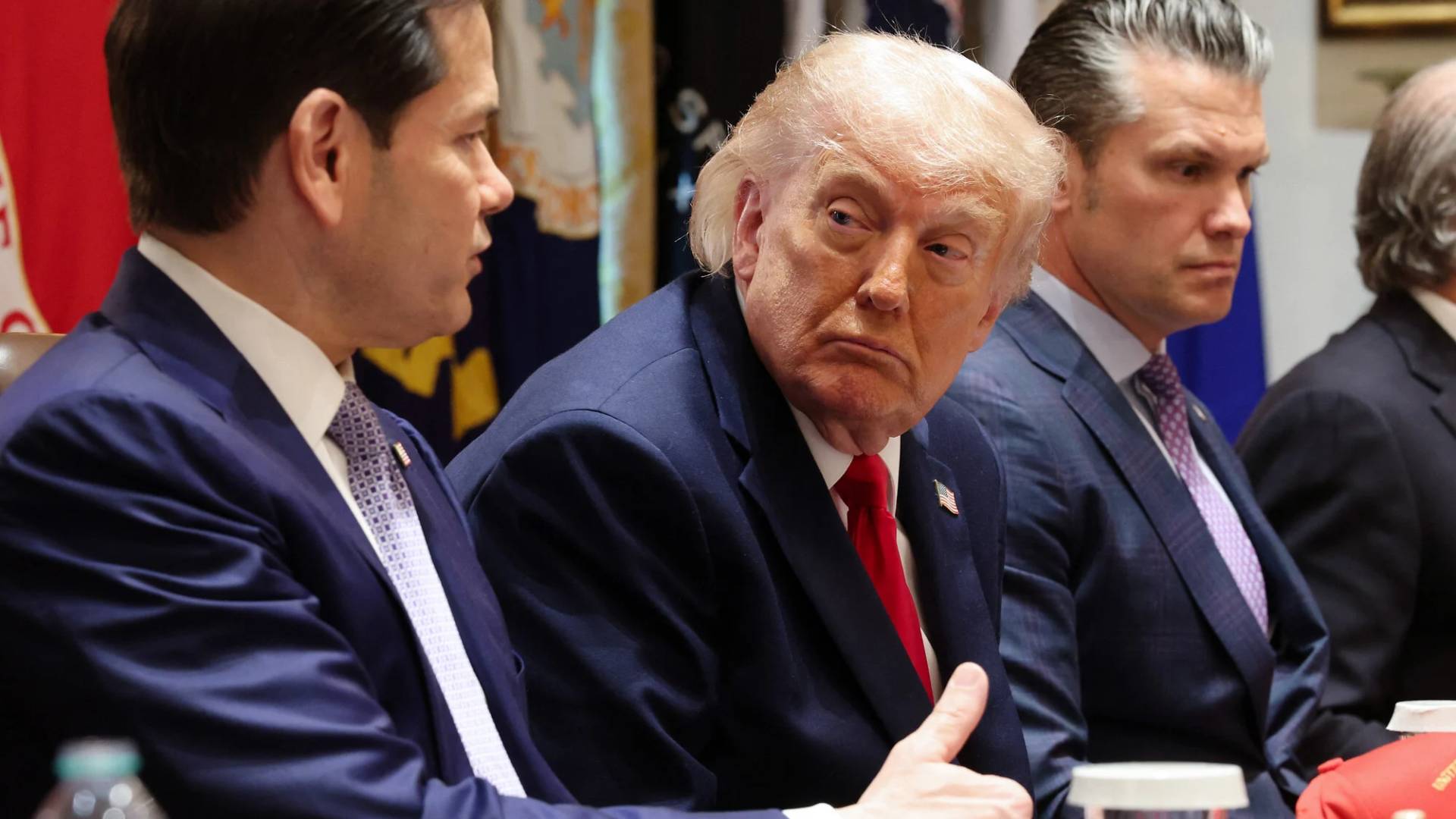
Day 92 | Trump concludes Situation Room meeting on Iran without announcing a decision
US President Donald Trump met with advisers in the White House Situation Room for about two hours on Friday as he considers a tentative agreement with Iran that could reopen the Strait of Hormuz and launch nuclear negotiations. Trump said before the meeting he was preparing to make a “final determination,” though it remains unclear whether he has officially approved the proposal.
Meanwhile, Iran’s Foreign Ministry said a memorandum of understanding between Tehran and Washington has not yet been finalized. Iranian officials also said there has been no definitive confirmation that Supreme Leader Mojtaba Khamenei approved the proposed document.
At the same time, Iran’s Islamic Revolutionary Guard Corps navy announced it fired warning shots at four vessels near the Strait of Hormuz. According to a statement published on an affiliated Telegram channel, the ships were allegedly attempting to pass through the waterway “without prior coordination or authorization.”
Day 93 of the US-‘Israeli’ war on Iran
For further updates - visit the link below.
‘Israel’ closes schools near border with Lebanon after massive Hezbollah attacks
‘Israel’ today announced it will force schools to close in areas in the north along the border with Lebanon, following Hezbollah’s massive rocket and drone barrages today.
The ‘Israeli’ Home Front Command said no educational activities will take place in settlements along the Lebanon border, including Kiryat Shmona, as well as Meron, Bar Yohai, Or HaGanuz, Safsufa, Yesud HaMa’ala, Kisra-Sumei, Beit Jann, and Sde Eliezer.
In the Upper Galilee and northern Golan, education will only be permitted inside a building or in an area where a shelter can be reached in time.
The directives will stay in effect until Monday at 9 PM, when the ‘Israeli’ Home Front Command will conduct another assessment.
War in Lebanon
Lebanon's prime minister accused ‘Israel’ on Saturday of pursuing a "scorched-earth policy" in his country's south, urging a halt to the fighting as ‘Israel’ carried out fresh airstrikes and issued evacuation warnings for more than a dozen locations.
A day after ‘Israeli’ Prime Minister Benjamin Netanyahu said his forces had advanced deeper into Lebanon, his counterpart Nawaf Salam warned the country was facing a "dangerous" escalation, and called for “a swift and real ceasefire”.
In a televised address, Salam accused ‘Israel’ of "pursuing a scorched-earth policy and collective punishment" by "destroying towns and villages, and forcing their inhabitants into exile".
This will bring "neither security nor stability" to ‘Israel’, he said.
Still, he defended his government's engagement with its southern neighbour, after military delegations from both sides held security talks in Washington on Friday, with more US-brokered negotiations planned next week.
Salam said the outcome of the negotiations was "not guaranteed", but called them "the least costly path for our country and our people".
A truce to halt the fighting between ‘Israel’ and Tehran-backed Hezbollah officially took effect on April 17, but has never been observed.
Both ‘Israel’ and Hezbollah accuse each other of violating the ceasefire and justify their attacks by the other's alleged breaches.
A US statement issued after Friday's ‘Israel’-Lebanon talks made no mention of the truce, but said the "productive military-to-military discussions" would inform next week's political meeting.
Hezbollah vehemently opposes the direct talks.
Lebanon PM defends direct negotiations with ‘Israel’
Lebanese Prime Minister Nawaf Salam denounced on Saturday what he called a dangerous ‘Israeli’ escalation in the south, urging an immediate ceasefire and insisting that a "scorched-earth policy" would not ensure ‘Israel's’ security.
In a televised address, Salam also defended his government's direct negotiations with ‘Israel’ -- which Iran-backed Hezbollah opposes -- saying that the talks were the "least costly path" for Lebanon.
"In light of the dangerous and unprecedented Israeli escalation over the past few days, it is necessary to step up political and diplomatic efforts to achieve a swift and real ceasefire," Salam said.
He accused ‘Israel’ of "pursuing a scorched-earth policy and collective punishment" by "destroying towns and villages, and forcing their inhabitants into exile".
This will bring "neither security nor stability" to Israel, he said.
Salam's broadcast came after ‘Israel's’ military issued new evacuation warnings for residents of more south Lebanon villages, and a day after military delegations from both countries held landmark security talks in Washington.
Those talks took place ahead of US-brokered negotiations early next week -- the fourth round since the latest ‘Israel’-Hezbollah conflict erupted in March.
Salam said the outcome of the direct negotiations with ‘Israel’ was "not guaranteed", but that they "are the least costly path for our country and our people".
A US statement after Friday's talks made no mention of a ceasefire, and ‘Israel’ has recently intensified its air and ground operations against Hezbollah.
A truce to halt the fighting officially took effect on April 17, but has never been observed.
VIDEO - ‘Israelis’ at Nahariya beach flee from Hezbollah rockets
Footage of ‘Israelis’ at the beach running to shelters after Hezbollah rockets fell into the sea off the coast of Nahariya in northern ‘Israel’, according to Hebrew media.
Several rocket salvos were launched from Lebanon, and this one marks the first time in three weeks that rockets have been launched towards Nahariya.
Lebanon army says “targeted” strike wounds two soldiers
Lebanon's military said on Saturday that a "targeted" ‘Israeli’ strike wounded two soldiers in southern Lebanon, a day after military delegations from the two countries met in Washington.
In a statement, the Lebanese army said "two soldiers were seriously wounded as a result of being targeted inside a vehicle by a hostile Israeli drone" near the southern city of Nabatieh.
UKMTO says Iran Port Blockade Still Active, warns of 'destructive fire'
The United Kingdom Maritime Trade Operations (UKMTO) issued an urgent, high-level maritime advisory on Saturday, confirming that the military blockade of Iranian ports remains in full effect across the Arabian Gulf, Gulf of Oman, North Arabian Sea, and the strategic Strait of Hormuz.
The maritime tracking agency warned that the blockade strictly restricts all inbound and outbound shipping traffic from Iranian ports.
The mandate extends to any neutral vessels attempting ship-to-ship transfers with blockade-runners, classifying those actions as a direct violation of the quarantine.
According to the directive, US forces are authorized to use rapid, escalatory measures against any vessel failing to demonstrate immediate compliance upon being hailed.
While the UKMTO noted that the designated maritime warning zone is not legally intended to halt neutral or standard merchant shipping, transiting vessels must explicitly communicate their intentions and prove they are not routing to or from an Iranian port.
Due to the volatility of active military operations, the US Navy warned it cannot guarantee the safety of neutral shipping within the theater.
All commercial aircraft and vessels currently navigating the region have been strongly advised to stay clear of the designated zone entirely, maintain a 30-nautical-mile standoff distance from US military units to prevent misidentification, and keep a continuous listening watch on VHF Channel 16.
Oman maritime alerts floating naval mine suspected in Hormuz
Oman’s Maritime Security Centre (MSC) issued an emergency advisory on Saturday warning all seafarers, commercial vessels, and local fishermen to exercise extreme caution following the sighting of a suspected floating naval mine within Omani territorial waters in the strategic Strait of Hormuz.
According to the official statement released via X, the unconfirmed floating explosive was detected just west of the Inshore Traffic Zone, a vital maritime corridor for global shipping.
#Alert
— مركز الأمن البحري| MARITIME SECURITY CENTRE (@OMAN_MSC) May 30, 2026
Due to the sighting of a floating object suspected to be a naval mine west of the Inshore Traffic Zone in the Strait of Hormuz within Omani territorial sea, the Maritime Security Centre urges all seafarers, fishermen, and vessels to exercise the utmost caution while… pic.twitter.com/avlGMKvqrX
The MSC has instructed all maritime traffic to maintain a safe distance from any suspicious objects and to report any unusual sightings immediately to regional naval authorities.
The alert comes amid hyper-extended regional tensions in the waterway, which acts as a primary choke point for international energy shipments.
Omani security forces are reportedly monitoring the zone, though no commercial disruptions have yet been declared.
Two Lebanese soldiers wounded by 'Israeli' drone strike on military vehicle in Nabatieh
The Lebanese Army confirmed on Saturday that two of its soldiers were seriously injured when a hostile 'Israeli' drone directly targeted their vehicle on a public road in the town of Aabba, located in the southern Nabatieh district.
The wounded troops have been evacuated to a nearby hospital for emergency medical treatment.
إصابة عسكريين في الجيش بجروح بليغة نتيجة استهدافهما داخل سيارة بمسيرة إسرائيلية معادية على طريق عام عبا (النبطية)، وجرى نقلهما إلى أحد المستشفيات للمعالجة.#الجيش_اللبناني #LebaneseArmy pic.twitter.com/ymA5c3URM3
— الجيش اللبناني (@LebarmyOfficial) May 30, 2026
Smoke rises in Western Galilee after apparent strike, reports
'Israel'’s Channel 12 reported on Saturday that thick columns of smoke were seen rising from a targeted site in the Western Galilee region following an apparent rocket or drone strike.
This is a developing story.
Drone sighting halts Munich Airport operations
- Over 20 flights diverted during shutdown
- Police search fails to find drone operator
- Incident follows previous drone-related disruptions
A suspected drone sighting forced a temporary shutdown at Munich Airport on Saturday morning, halting all flight operations at the southern German aviation hub for approximately one hour and triggering widespread travel disruptions.
The security freeze was lifted after local authorities and police determined that active threats to air traffic could be safely ruled out.
Dual pilot reports
The incident began at approximately 9:00 a.m. local time (0700 GMT) when two separate commercial pilots, stationed in different aircraft on the tarmac, reported spotting a drone flying over the airport grounds.
Adhering to strict safety protocols, airport authorities immediately ordered a complete halt to all takeoffs and landings.
The sudden airspace closure caused immediate logistical challenges for incoming aircraft.
An airport spokesperson confirmed that during the hour-long freeze, more than 20 commercial flights scheduled to land at Munich had to be aborted and diverted to alternative airports across the region.
Police search yields no results
Law enforcement immediately launched a security response to locate the unauthorized craft and identify its operator.
"Extensive police operations, including a search of the affected area by police helicopter, yielded no results." - Statement from a Munich police spokesperson.
Following the unsuccessful search, authorities concluded that there was no lingering danger to commercial aviation.
The operational shutdown was officially lifted at 10:05 a.m., allowing normal flight schedules to resume.
Police confirmed that a formal investigation has been opened to definitively determine the nature of the sighting and identify whoever was behind the flight path intrusion.
Recurring threat to aviation
Saturday's incident highlights an ongoing security challenge for the major German transport hub.
Drone sightings at Munich Airport previously caused even greater operational chaos in October of last year, when a series of rogue drone incursions forced several security shutdowns in quick succession.
Aoun, Salam meet at Baabda over southern escalation
- Lebanon holds emergency security meeting at Presidential Palace
- Leaders condemn 'Israeli' strikes in south Lebanon
- Officials reiterate priority of full ceasefire
- Lebanon prepares for June 2–3 negotiations
Lebanese President General Joseph Aoun received Prime Minister Dr. Nawaf Salam at Baabda Palace on Saturday afternoon for high-level talks focused on the country's worsening security landscape and the humanitarian crisis stemming from ongoing military actions.
According to an official statement released by the Lebanese Presidency, the two leaders conducted a comprehensive review of the overall situation in the country, with primary focus dedicated to the expanding footprint of 'Israeli' operations across southern Lebanon.
Condemning Tyre, Nabatieh destruction
The deliberations centered heavily on the security developments unfolding in southern cities and villages, particularly within the heavily impacted Tyre and Nabatieh districts.
President Aoun and Prime Minister Salam sharply rebuked what they termed condemned 'Israeli' practices, documenting a systematic campaign of house demolitions, widespread land bulldozing, and the deliberate destruction of Lebanon's historic landmarks.
The executive leadership also addressed the severe psychological and economic toll being inflicted on civilian populations, pointing directly to ongoing military threats and repeated evacuation orders forcing citizens to abandon their homes and livelihoods.
In response, Aoun and Salam agreed to immediately intensify domestic and international communications to force an end to the actions.
Washington talks review
A critical portion of the Baabda Palace meeting was dedicated to evaluating the recent tripartite military summit held in Washington, which brought together Lebanese, American, and 'Israeli' military delegations.
During their assessment of those deliberations, the two presidents affirmed that the Lebanese delegation successfully maintained its core diplomatic mandate: prioritizing an immediate and unconditional ceasefire above all other operational terms.
This strategic review serves as the baseline for Lebanon's diplomatic strategy moving forward.
The presidency noted that Aoun and Salam extensively mapped out the ongoing preparations and structural parameters for the next formal round of negotiations, which are officially scheduled to take place on June 2 and 3.
Managing displacement crisis
Beyond the international diplomatic track, the meeting addressed pressing internal security and humanitarian obligations.
The leaders reviewed the general domestic security situation and analyzed the daily logistical updates regarding the care, housing, and tracking of the thousands of Lebanese citizens who have been forcibly displaced from their properties and hometowns due to the conflict.
Tasnim: US naval blockade remains in force despite Trump's statements
- Iran says US naval blockade remains in force
- Iranian ships reportedly turned back by US warships
- CENTCOM continues enforcing blockade restrictions
- Situation contradicts Trump’s blockade-lift claim
Iran's maritime commercial sector has refuted claims that the United States has eased its naval restrictions, confirming to the Tasnim News Agency that the hostile American blockade remains fully functional despite contradictory statements issued by Washington.
While a social media post by US President Donald Trump led to widespread misinterpretations that the naval siege had been terminated, Iranian sailors on the water told Tasnim that US military forces are actively enforcing the line with threats of kinetic violence.
Warnings of gunfire
According to field reports obtained by Tasnim, the naval blockade continues to operate as an active act of war.
Iranian mariners who contacted Tasnim stated that following Trump's public claim that the blockade was ending, several Iranian commercial vessels attempted to cross the established enforcement lines.
These ships were immediately intercepted by American warships patrolling the zone.
US Navy personnel issued stern warnings to the merchant vessels, ordering them to retreat immediately and remain behind the blockade perimeter. The mariners noted that US forces explicitly threatened to open fire on any vessel that refused to comply with the order to turn back.
Centcom continues halting shipping
The operational reality on the water indicates that US Central Command (Centcom) has not altered its mission parameters.
Centcom naval assets are continuously issuing halting advisories along the blockade boundary, working systematically to prevent any Iranian ships from exiting the restricted maritime zone.
The ongoing interceptions highlight a sharp disconnect between the messaging coming out of the White House and the tactical execution of the blockade by US military commanders in the region.
confusion triggered
The maritime confusion began after President Trump published a statement on his platform, Truth Social, claiming a breakthrough regarding the stranded vessels.
"Ships that are stuck in the Strait due to our amazing and unprecedented Navy blockade (which will now be lifted) can begin the process of 'heading home'!" — US President Donald Trump posted on Truth Social.
Despite the explicit phrasing from the American president that the naval quarantine "will now be lifted," shipping data and direct testimonies from Iranian crews to Tasnim confirm that no operational shift has occurred.
The economic and military encirclement of Iranian shipping lanes remains strictly enforced by the United States military.
Pentagon says US troops targeted using location data
- CENTCOM warns troops targeted via location data
- Lawmakers label adtech a national security threat
- Data brokers may expose troop movements to adversaries
- Congress urges stricter device security measures
In the first official confirmation of its kind, the United States military has acknowledged that American forces deployed to active war zones have been targeted by adversaries utilizing commercially available smartphone location data.
The revelation, detailed in a newly disclosed Pentagon letter, underscores the growing national security risks posed by the global surveillance economy and the loosely regulated digital advertising trade.
Centcom confirms 'in-theater' threat
According to an internal April 14 communication from US Central Command (Centcom) shared with Reuters by Senator Ron Wyden (D-Oregon), military officials have fielded "multiple threat reports concerning adversary exploitation of commercial location data to target or surveil US personnel in theater."
While Centcom did not provide specific coordinates or list casualties resulting from the data leaks, its area of responsibility includes the highly volatile Gulf region, where American forces routinely face off against the Iranian military over the strategic Strait of Hormuz.
A bipartisan coalition of lawmakers sent a follow-up letter to the Pentagon on Thursday, stating that this is the first explicit confirmation that commercial data networks are actively weaponizing the battlefields where US troops are stationed.
"Commercial location data can be used to identify where US troops congregate and their pattern of life, which can be exploited by adversaries to target attacks such as missiles, drones, and roadside bombs, as well as for counterintelligence purposes." -Extract from bipartisan congressional letter to the Pentagon.
Senator Wyden was more blunt in his assessment of the tech sector, stating that the time has come to "start treating the adtech industry as a national security threat."
Adtech pipeline exposes military
The data in question is generated constantly by standard digital advertising frameworks.
Apps and digital service providers harvest highly precise coordinates from smartphones, which are then sold to data brokers.
These brokers collate, package, and resell the detailed day-to-day movements of individuals through complex networks of corporate intermediaries.
While consumer privacy advocates have long criticized this open-market trade, the national security vulnerabilities have compounded dramatically in recent years:
- In 2016: A US defense contractor successfully used commercial data to track American special operations forces entirely from their domestic bases to a sensitive staging outpost in Syria.
- Recently: Investigative journalists in Germany and at Wired mapped billions of coordinates bought from a data broker to expose the highly granular, daily comings and goings of personnel stationed across 11 US military and intelligence sites in Germany.
The Interactive Advertising Bureau and the Association of National Advertisers -two powerful groups representing digital advertisers- did not return emails seeking comment on the matter.
Demands to dump Google Chrome
Lawmakers argue that the Pentagon has known about these structural leaks for years and should have acted far more aggressively to shield field personnel.
Congress is now demanding the military implement immediate defensive protocols, including disabling unique advertising IDs on all military-issued devices, forcing automatic location-sharing shutdowns in combat zones, and banning Google's Chrome web browser from state equipment.
Representative Pat Harrigan (R-North Carolina), a co-signer of the letter and a former US Army Special Forces officer, leveled harsh criticism at standard tech infrastructure.
Harrigan stated that web browsers like Chrome "are built from the ground up to collect and share user data," adding that every day they remain on official government devices "is another day we are handing our adversaries a weapon against our own troops."
In response to the congressional pushback, Alphabet's Google issued a brief defense, claiming that Chrome features "industry leading security." The tech giant added that it has "long advocated for stronger rules and safeguards against data brokers."
The Pentagon stated in an email that it intends to respond directly to the lawmakers' inquiries but declined to elaborate on what measures are currently being taken to protect troops from commercial surveillance.
Lawmakers noted that their prior attempts to extract further operational details from military officials regarding the reported targeting had been entirely unsuccessful.
Pakistan will not normalize relations with 'Israel': DPM
- Pakistan ties 'Israel' stance to Palestinian statehood
- US praises Pakistan’s Iran mediation efforts
- Rubio accepts invitation to visit Pakistan
Pakistan has firmly reiterated its long-standing foreign policy regarding 'Israel' and the Palestinian territories, declaring that it will not normalize relations with Tel Aviv absent concrete progress toward an independent Palestinian state.
The diplomatic bottom line was delivered on Friday by Pakistani Deputy Prime Minister and Foreign Minister Ishaq Dar following a high-level bilateral meeting with US Secretary of State Marco Rubio in Washington.
Speaking to reporters at the Pakistani Embassy, Dar confirmed that Islamabad remains resolutely committed to its foundational policy regarding Palestine and the ongoing crisis in the Gaza Strip, a position he noted was also formally re-stated during UN engagements earlier in the week.
Response to Trump's push towards Abraham
Dar’s public remarks arrived as a direct response to a recent push by US President Donald Trump, who publicly called on several Muslim-majority nations to consider signing on to the Abraham Accords normalization framework.
The foreign minister effectively closed the door on any near-term policy shift, clarifying that any alteration of Pakistan's diplomatic stance toward Israel is entirely contingent upon the formal creation of a sovereign Palestinian state.
US commends Pakistan's mediation
Beyond the 'Israel'-Palestine impasse, the Washington talks yielded significant progress regarding broader Middle East stability.
Dar revealed that the United States government explicitly appreciated Pakistan’s quiet diplomatic role in trying to reduce volatile tensions between Washington and Tehran.
While both sides confirmed that Dar and Rubio engaged in substantive discussions regarding regional security, counter-terrorism, trade, and investment, the foreign minister strictly declined to share specific details regarding Pakistan's active mediation between the US and Iran.
"Pakistan remains hopeful that its role could help support broader peace efforts in the region." Stated the Foreign Minister Ishaq Dar, citing confidentiality rules governing Islamabad's role as a mediator.
Strategic partnership
Despite holding opposing views on the Abraham Accords, the meeting concluded with a mutual agreement to significantly upgrade bilateral relations.
According to Dar, Secretary Rubio accepted a formal Pakistani proposal to launch deeper, structured discussions aimed at building a more comprehensive strategic partnership.
To formalize this track, Rubio has agreed to conduct an official state visit to Pakistan later this year.
Pentagon hosts Lebanese and ‘Israeli’ delegations for security talks
The US Department of Defense said it hosted Lebanese and ‘Israeli’ delegations as part of a new security track aimed at supporting ongoing discussions between the two countries.
According to the Pentagon, the talks were led by the Under Secretary of Defense for Policy and involved what it described as productive military discussions focused on developing frameworks for regional security and stability.
The department said the outcomes of the meetings would support the broader political track being led by the US State Department.
Washington also reiterated its support for Lebanon’s sovereignty, territorial integrity, and efforts to ensure that armed groups operate only under state authority.
The meetings come amid continued US diplomatic efforts to reduce tensions along the Lebanese-'Israeli' border and strengthen regional stability.
US military says forces ‘remain present and vigilant’ in the Middle East
The United States Central Command said US forces remain present and vigilant across the Middle East amid ongoing regional tensions.
In a post on X, CENTCOM stated that “US forces remain present and vigilant across the region,” reaffirming Washington’s military posture in the area.
The command also shared a photograph of an F-16 fighter jet, saying the aircraft was flying “over the Middle East during a patrol.”
CENTCOM oversees US military operations across several regions, including the Middle East, and has recently highlighted the readiness of American forces as tensions continue involving Iran and other regional flashpoints.
Hegesth says US committed to blocking Iran from getting a ‘nuclear weapon’
US Secretary of Defense Pete Hegseth said Washington remains firmly committed to its global security obligations, including preventing Iran from acquiring a nuclear weapon.
Speaking at the Shangri-La Dialogue security summit in Singapore, Hegseth stated that the United States “still has global obligations to ensure that, say, Iran doesn’t get a nuclear weapon.”
The annual summit brings together defence officials and security leaders from across the Indo-Pacific to discuss regional and global security challenges.
Hegseth’s remarks come amid heightened tensions involving Iran and ongoing US-led efforts to pressure Tehran over its nuclear programme.
He did not provide further details on specific policy measures but reiterated the US position that Iran must be prevented from developing nuclear weapons capability.
Rocket falls in 'Israel's' Kiryat Shmona after launches from Lebanon
The ‘Israeli’ military said it detected rocket launches from Lebanon and intercepted most of the incoming projectiles.
It confirmed that one rocket fell in the area of “Kiryat Shmona,” without causing injuries.
Air raid sirens were activated across several locations in northern ‘Israel’ following the launches.
The military said alert systems were triggered as part of standard defensive procedures during the incident.
No casualties were reported at the time of the statement.
US says Iranian network defrauded tech companies to supply military
The US Department of State said it has “dismantled” an Iranian network accused of impersonating and defrauding American businesses to obtain sensitive technology for Iran’s military sector.
State Department spokesperson Tommy Piggot said the network, allegedly led by Iran-based Ali Majd Sepehr, had “defrauded dozens of American technology companies of millions of dollars by posing as legitimate US businesses.”
He said the operation was part of Washington’s broader “Economic Fury” campaign targeting individuals and entities working on behalf of Iran’s Ministry of Defence and Armed Forces Logistics.
According to Piggot, the network sought to procure restricted goods and advanced equipment from US companies for Iran’s defence sector.
The State Department announced sanctions linked to the case, describing it as part of efforts to disrupt procurement channels used by Iran’s military establishment.
US offers $15 million reward targeting IRGC financing networks
The US State Department announced rewards of up to $15 million for information that could disrupt financial networks linked to the Islamic Revolutionary Guard Corps.
The programme is aimed at individuals or groups involved in sanctions evasion and funding channels supporting the IRGC, according to the announcement.
Officials said the initiative is intended to increase pressure on networks facilitating illicit financial flows tied to Iran’s military and proxy operations.
The reward offer forms part of broader US efforts to restrict financing routes used by sanctioned entities.
The department said the information could lead to enforcement actions against key facilitators and intermediaries involved in these networks.


