Volodymyr Zelenskyy President of Ukraine, with German Chancellor Friedrich Merz

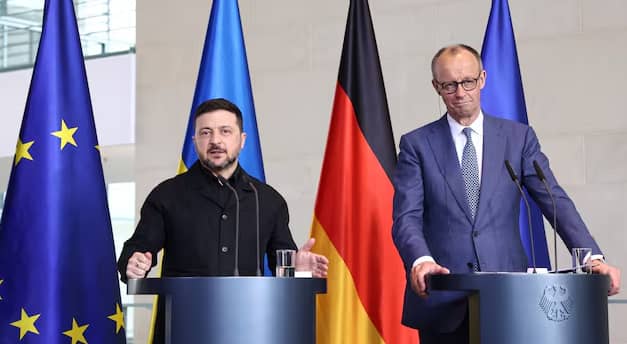
German Chancellor proposes 'associate' EU membership for Ukraine
Note: AI technology was used to generate this article’s audio.
- German chancellor sends proposal letter to EU leaders
- ‘Associate membership’ proposed to support efforts to end the war
- Merz says Kyiv may join EU meetings without voting rights
- Proposal set for discussion among EU member states
German Chancellor Friedrich Merz has pitched a novel interim step for Ukraine’s integration into the European Union, proposing an "associate member" status designed to accelerate a diplomatic resolution to the war triggered by Russia's invasion.
In a letter sent to EU leaders and reviewed by Reuters, Merz outlined a plan to give Ukrainian officials a direct role in European Union structures without waiting for the typically long and bureaucratic full accession process.
Under this newly proposed category -which does not exist under current EU rules- Ukrainian officials would be permitted to participate in EU summits and ministerial meetings, though they would not hold voting rights.
Additionally, the German proposal suggests that Ukraine receive a non-voting associate commissioner on the European Commission and non-voting representatives within the European Parliament.
Strategic peace bridge
The German leader's initiative represents a middle ground between Ukraine's current standing as a candidate country at the starting phase of accession and full membership.
European officials note that full EU membership remains unrealistic within the next few years, despite a target date of 2027 being penciled into a 20-point peace plan discussed between the United States, Ukraine, and Russia.
Analysts indicate that a definitive path into the EU could be vital for President Volodymyr Zelenskiy to successfully present any future peace settlement to the Ukrainian public.
This is particularly crucial if a negotiated end to the conflict requires Ukraine to forego joining the NATO military alliance or leave it unable to regain control over all of its territory.
To reinforce this transition, Merz proposed that EU member states make a “political commitment” to extend the bloc’s mutual assistance clause to Ukraine, establishing a substantial security guarantee.
"My proposal reflects Ukraine's particular situation, a country at war. It will help facilitate the ongoing peace talks as part of a negotiated peace solution," Merz wrote in the letter, emphasizing that the move is "essential not only for Ukraine's but for the entire continent's security."
Next steps
Recognizing that standard EU accession demands unanimous consent and ratification by all 27 member states -a process prone to significant obstacles- Merz's framework introduces specific conditional safeguards.
The chancellor outlined a potential "snap-back mechanism" or "sunset clause" that would be triggered if Ukraine backslides on democratic rule-of-law standards or the broader accession process.
Merz clarified that this innovative arrangement is tailored strictly to Ukraine's wartime reality and will not impact other candidate countries.
However, he suggested the bloc should also explore "innovative solutions" for long-standing candidates working toward entry.
Moving forward, Chancellor Merz stated he intends to discuss these ideas directly with fellow European leaders, writing, "My aim would be to reach an agreement soon, and to set up a dedicated Task Force to work out the details."