


Day 78 | ‘Israel’ on alert for possible Iran escalation as Lebanon ceasefire extended 45 days
‘Israel’ remains on high alert as it awaits US President Donald Trump’s decision on the next steps regarding Tehran, according to ‘Israeli’ media reports.
At the same time, the US State Department announced a 45-day extension of the ceasefire between Lebanon and ‘Israel’, with a fourth round of indirect negotiations scheduled for the second and third of next month.
Tensions also escalated along the northern front, as air raid sirens sounded twice within minutes in Rosh HaNikra and later in Kiryat Shmona following reports of a hostile drone infiltration.
Meanwhile, ‘Israeli’ airstrikes targeted the southern Lebanese towns of Arab Salim in Nabatieh district and Arab al-Jal in Sidon district.
A Hezbollah official told Al Jazeera that the group reserves the right to respond in kind to any ‘Israeli’ violations of the ceasefire or attempts to expand operational freedom in Lebanese territory.
Regionally, China’s foreign minister called for the swift reopening of the Strait of Hormuz amid growing international concern over maritime security.
Pakistan’s foreign minister said 11 Pakistani nationals and 20 Iranians had been repatriated after being aboard vessels seized by US forces.
Separately, France’s Ministry of Armed Forces said the aircraft carrier Charles de Gaulle is currently deployed in the Arabian Sea and could take part in efforts to secure navigation through the Strait of Hormuz.
Day 79 of the US-‘Israeli’ war on Iran
For further updates - visit the link below.
Read more: Day 79 | Iran to soon unveil Strait of Hormuz toll framework
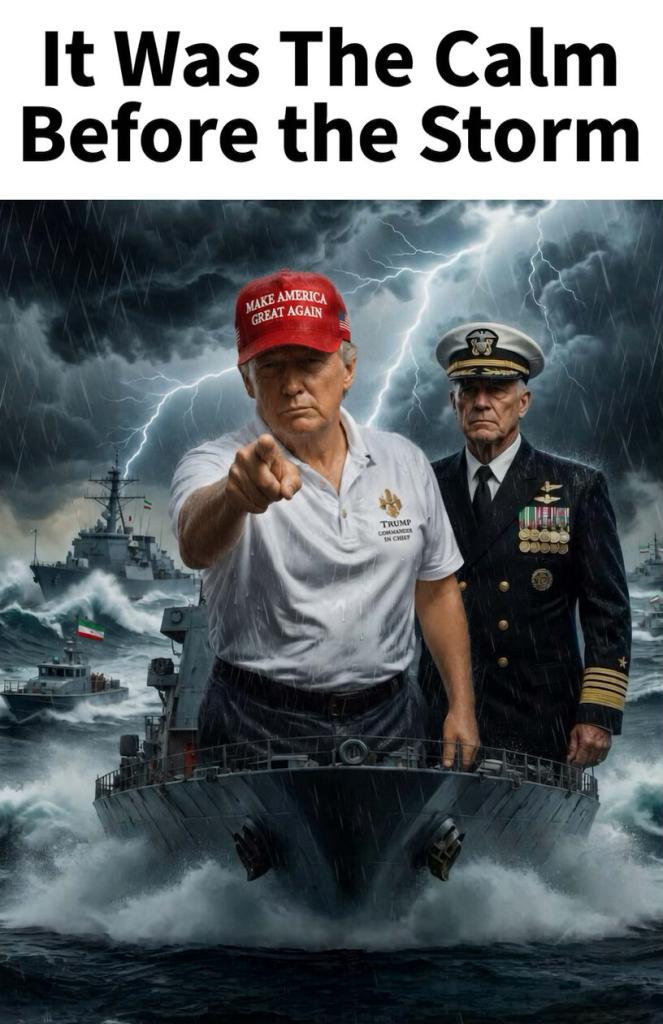
“Calm before the storm”: Trump posts photo in apparent warning to Iran
US President Donald Trump hinted at possible military escalation against Iran, as the two sides remain deadlocked in negotiations after more than a month of a halt in hostilities.
Trump posted what appears to be an AI-generated image of himself aboard a US navy ship with a small Iranian boat in the background; with the caption “It was the calm before the storm”.
‘Israeli’ infantry commander killed in Hezbollah drone attack
An ‘Israeli’ officer was killed in a Hezbollah drone attack in southern Lebanon on Friday, the ‘Israeli’ military said Saturday.
He is identified as a Cpt. Maoz Israel Recanati, 24 years old, a platoon commander in the Golani Brigade’s 12th Battalion
He is the seventh ‘Israeli’ soldier to be killed since the ceasefire in Lebanon on April 16, and the 20th since Hezbollah joined the war in early March after the US-‘Israeli’ strikes on Iran.
Iran says European countries negotiating with Tehran for Hormuz transit
Iranian state television said on Saturday that European countries were in talks with Tehran over transit for ships through the Strait of Hormuz.
"Following the passage of ships from East Asian countries, notably China, Japan and Pakistan, we received information today indicating that Europeans have also begun negotiations with the Revolutionary Guards navy" to get permission to pass, state television reported, without specifying which countries.
Iran has largely blocked shipping through the vital strait since the outbreak of war with the United States and ‘Israel’ on February 28. A fragile ceasefire has been in place since April 8.
Its grip over the waterway has rattled global markets and given Tehran significant leverage, while the United States has imposed its own naval blockade on Iranian ports.
In peacetime, the route accounts for roughly a fifth of global oil and liquefied natural gas shipments, along with other key commodities.
Iran has in recent days allowed passage for dozens of ships including from China "after an agreement on Iran's strait management protocols," the Guards, the ideological arm of Iran's military, said in a statement.
Since the war broke out, Iran has repeatedly said that maritime traffic through the strait would "not return to its pre-war status" and last month said it has received the first revenue from tolls it imposed on the waterway.
On Saturday, Ebrahim Azizi, head of the Iranian parliament's national security commission, said Iran "has prepared a professional mechanism to manage traffic" through the strait, adding that it will be "unveiled soon".
"In this process, only commercial vessels and parties cooperating with Iran will benefit from it," he noted, adding that "the necessary fees will be collected for specialized services".
"This route will remain closed to the operators of the so-called 'freedom project'," he said, referring to a temporary US military operation to guide stranded commercial ships through the strait.
Pezeshkian urges global coalition to counter "illegal" US demands
- Letter to the Pope: Iranian President Masoud Pezeshkian detailed the scale of casualties from US–'Israeli' military campaign.
- He blamed the current closure of the Strait of Hormuz on the American naval blockade.
- Tehran promised a return to normal transit once the blockade is lifted.
- Pezeshkian urged the international community to stand against "illegal US demands" to protect international law and human values.
Iranian President Masoud Pezeshkian has issued a sweeping appeal to international leaders, urging global nations to stand firm against what he characterized as the unlawful and destructive overreach of the United States.
In a deeply symbolic letter addressed to Pope Francis, the Iranian president argued that resisting Washington's policies is no longer just a regional necessity, but a collective defense of international law and universal human values.
The letter provided the most explicit details to date from the Iranian executive branch regarding the devastating impacts of the US–'Israeli' military campaign launched on February.
Pezeshkian confirmed that the attacks resulted in the assassination of Supreme Leader Ayatollah Ali Khamenei, along with numerous senior political and military figures.
He stated that 3,468 Iranian citizens have been killed, citing extensive destruction to hospitals, schools, universities, and critical infrastructure as clear evidence of "war crimes."
Hormuz crisis
Addressing the global economic chokehold in the Persian Gulf, Pezeshkian explicitly shifted the blame for the maritime crisis onto Western shoulders.
He asserted that the current instability plaguing the Strait of Hormuz stems directly from unprovoked American military strikes and the subsequent naval blockade imposed on Iranian ports.
Pezeshkian clarified that Tehran does not seek a permanent disruption to global commerce but will maintain its current posture as long as it is under siege.
"Normal transit will resume once insecurity is lifted," Pezeshkian wrote, noting that Iran intends to apply regulatory mechanisms strictly aligned with international maritime law once the conflict subsides.
He defended recent Iranian strikes on assets within neighboring Persian Gulf littoral states, stating that the use of U.S. military bases in those countries to launch attacks left Iran with no choice but to strike back in legitimate self-defense.
Appeal to faith
Quoting both Quranic and Biblical passages that condemn arrogance and tyranny, Pezeshkian praised the Pope's "moral, logical, and fair positions" regarding the outbreak of the war.
He heavily criticized the Trump administration, claiming that the US president's stated intent to "destroy Iran's historic civilization" exposed a dangerous illusion of absolute power.
Pezeshkian emphasized that Iran’s diverse fabric of Muslims, Christians, and other religious communities has coexisted peacefully for centuries, and that the nation has never historically threatened its neighbors.
Despite what he termed "repeated US betrayals" during negotiations that were allegedly used as false pretexts for the initial February strikes, Pezeshkian reaffirmed that Tehran has not abandoned the political track.
He noted that Iran remains fully committed to the ongoing, Pakistan-mediated peace talks. Concluding his message, the Iranian president called for a realistic and fair international response, reiterating that Iran prefers a peaceful, lawful, and ethical resolution to the regional crisis if Washington is willing to halt its aggression.
US charges Iraqi, alleged pro-Iran armed group commander, with role in attack plots
The US Justice Department has arrested and charged an Iraqi national and commander of an Iran-backed Iraqi armed group with involvement in at least 18 alleged attacks and attempted attacks across the US, Canada and Europe.
A complaint unsealed on Friday in Manhattan federal court alleges that Mohammad Baqer Saad Dawood al-Saadi, 32, is a senior figure in Kataib Hezbollah, which is linked to Iran’s Islamic Revolutionary Guard Corps (IRGC).
FBI Director Kash Patel said on X that his agency had arrested and returned al-Saadi to the US, calling him a “high-value target responsible for mass global terrorism”.
Al-Saadi appeared on Friday at the Manhattan court where he was charged with six counts, including conspiracy to provide material support to “terrorist groups” Kataib Hezbollah and the IRGC.
He was also charged with conspiring and providing material support for “acts of terrorism” and conspiring to bomb a place of public use.
According to US court filings, al-Saadi and unidentified associates planned, coordinated and claimed responsibility for at least 18 attacks in Europe, and two in Canada.
Those attacks “appear to have been carried out both in retaliation for the United States and Israel’s recent military actions against Iran and to compel the United States and Israel to halt those actions”, the criminal complaint states.
Al-Saadi’s defence lawyer, Andrew Dalack, stated that his client was taken into custody in Turkiye before being transferred to US custody.
China says US-backed Hormuz resolution at UNSC is ‘not right’, signals likely veto
China’s UN ambassador to the United Nations has criticised a proposed US-Bahraini resolution at the UN Security Council on the Strait of Hormuz, saying the content and timing were not right and that passing such a resolution would not be helpful.
The draft resolution demands Iran halt attacks and mining in the strait, but diplomats have said it is likely to meet with Russian and Chinese vetoes if it comes to a vote.
Both countries vetoed a similar US-backed resolution last month, arguing it was biased against Iran.
The PassBlue news portal, which focuses on UN news, posted a short clip of an impromptu interview with China’s UN envoy Fu Cong in which he said, when asked about the resolution: “We don’t think the content is right, and the timing is not right.”
“What we need is to urge both sides to engage in serious and good-faith negotiations that can resolve the issue,” Fu said.
“So passing a resolution at this stage, we don’t think is going to be helpful,” he added.
Iranian spokesman invokes anti-colonial text in apparent shot at US
Iran’s Foreign Ministry spokesperson, Esmaeil Baghaei, has cited a passage from the Martinican poet and political thinker Aime Cesaire’s seminal anti-colonial text Discourse on Colonialism in what appears to be a rebuke of the US as “a decadent civilisation”.
Cesaire, who was one of the foundational voices of the “Negritude” movement, wrote Discourse on Colonialism in 1950 as a deep critique of European imperialism and the moral contradictions embedded in colonial “civilisation”.
A civilization that proves incapable of solving the problems it creates is a decadent civilization;
— Esmaeil Baqaei (@IRIMFA_SPOX) May 15, 2026
A civilization that chooses to close its eyes to its most crucial problems is a sick civilization;
A civilization that plays fast and loose with its principles is a dying…
Iranian media releases final note from slain military commander Mousavi
Iranian Tasnim news agency has published what is said to be the last handwritten note penned by the Chief of Staff of the Iranian Armed Forces, Lieutenant General Abdolrahim Mousavi, shortly before his death when US and Israeli forces launched their war on February 28.
The poignant message reflects on the fleeting nature of material possessions:
“The world is a bad thing, because even if you acquire all of it, you have acquired nothing. But this is also the good side of the world, because even if you lose all of it, you have lost nothing,” Mousavi wrote, according to Tasnim.
New York City Mayor Mamdani posts video marking Nakba
New York Mayor Zohran Kwame Mamdani has posted a video marking the Nakba, Arabic for “catastrophe,” the displacement of an estimated 750,000 Palestinians during the establishment of 'Israel'.
The video features Inea, a New Yorker, who says she lived through the events from 1948 onwards in Palestine.
Today marks Nakba Day, an annual day of remembrance to commemorate the expulsion of more than 700,000 Palestinians between 1947 and 1949 during the creation of the State of Israel and the year that followed.
— Mayor Zohran Kwame Mamdani (@NYCMayor) May 15, 2026
Inea is a New Yorker and a Nakba survivor. She shared her story with us… pic.twitter.com/z2PBOaJq5Z
Trump says 20-year nuclear program suspension by Iran would be enough
US President Donald Trump has said he would accept a 20-year suspension of Iran’s nuclear programme, signaling what appears to be a significant shift from his earlier insistence on a permanent halt to Tehran’s uranium enrichment activities.
Speaking to reporters aboard Air Force One following talks in Beijing with Chinese President Xi Jinping, Trump said any agreement must include firm guarantees.
“Twenty years is enough, but the level of guarantee from them, in other words it’s got to be a real 20 years,” Trump said when asked whether such a suspension would be sufficient.
Iran’s FM warns US of rising economic costs from Trump’s ‘war of choice’
Iran’s Foreign Minister Abbas Araghchi says the American people will bear rising economic costs from what he described as a “war of choice” on Iran, pointing to higher US Treasury yields and warning of pressure on debt, mortgages and consumer loans.
Araghchi highlighted rising 2-, 10- and 30-year yields as evidence of tightening financial conditions.
He also argued energy prices and household credit stress would worsen, calling the situation entirely “avoidable” after the US and 'Israel' launched the war on his country.
Americans are told that they must absorb rocketing costs of war of choice on Iran.
— Seyed Abbas Araghchi (@araghchi) May 15, 2026
Put aside gas price hike and stock market bubble. Real pain begins when U.S. debt and mortgage rates start to jump. Auto loan delinquencies are already at 30+-year high.
This was all avoidable. pic.twitter.com/dhjcdzTOHc
UAE says it won’t be deterred from ‘protecting supreme national interests’
The United Arab Emirates has released a statement emphasising its “firm approach based on supporting the security and stability of the region”.
The Foreign Ministry “condemned in the strongest terms the Iranian attacks and threats that targeted the state and the countries of the region”.
This included “the launching of approximately 3,000 ballistic missiles, cruise missiles, and drones toward the United Arab Emirates”. The statement said the strikes “resulted in deaths and injuries among civilians in addition to damage caused to civil infrastructure”.
The government described the incidents as a “clear violation of the sovereignty of states and a direct threat to the security and stability of the region”. All defensive measures are “aimed at protecting its sovereignty, civilians, and critical infrastructure”.
The UAE “retains its full sovereign, legal, diplomatic, and military rights in confronting any threat or hostile act”, it added.
Any “attempts at pressure or promoting malicious allegations will not affect its firm positions”, the ministry said, and such efforts “will not deter it from protecting its supreme national interests and preserving its sovereignty and independence of decision”.
Iran says UN states backing Hormuz resolution may share responsibility for escalation
Iran’s mission to the United Nations says the United States is trying to “manufacture a false image” of broad international backing by highlighting the number of co-sponsors of a Bahrain-backed UN draft resolution on the Strait of Hormuz.
It warned any states backing the text could share “international responsibility” if escalation follows, adding there is “no political excuse or diplomatic cover” for what it described as enabling US “aggression”.
The resolution, supported by the US and Bahrain with backing from Gulf states, calls for freedom of navigation and an end to Iranian attacks in the Gulf.
Democrats slam Trump’s Iran war for driving up fertilizer and energy costs
Democrats have continued to criticise the domestic impact of President Trump’s war on Iran.
Senator Tammy Baldwin said in a post on X: “President Trump’s war of choice in Iran has sent the cost of fertilizer and gas through the roof for our farmers.”
A large share of the world’s fertiliser supply is exported by Gulf states and moves through the Strait of Hormuz.
Mark Warner, chair of the Senate intelligence committee, said: “From gas prices to home costs, Trump’s war of choice is making it harder and harder to afford the life you want.”
Senator Mark Kelly said Trump’s war had “no goal in mind”, and Americans are already paying through higher energy costs.
“We need leaders who are laser focused on lowering costs because this administration is making life more expensive,” Kelly wrote.
US arrests Iraqi Kataib Hezbollah leader, transfers him to United States
The United States Department of Justice confirmed the arrest of Mohammed Baqir al-Saadi, a senior figure in Iraq’s Kataib Hezbollah, and his transfer to the United States for prosecution.
The department said the arrest was carried out in coordination with US security agencies, but did not immediately provide details on where or how the operation took place.
According to the announcement, al-Saadi has been brought to the United States to face federal legal proceedings.
Trump aides draft military options for renewed Iran strikes: NYT
Senior aides to Donald Trump have drawn up detailed military plans for a possible return to strikes on Iran if he decides to break the current diplomatic stalemate, according to the New York Times, citing US officials.
The report says the proposals remain under review and no decision has been made, with advisers stressing that the president has not approved any next steps.
According to officials quoted by the newspaper, the options being discussed include more intensive bombing campaigns targeting Iranian military infrastructure and facilities linked to the Islamic Revolutionary Guard Corps.
The plans also reportedly include broader strike packages designed to hit strategic sites deeper inside Iranian territory, marking a potential escalation beyond previous US actions.
The New York Times reports that some military discussions have gone further, including the possible use of special operations forces in highly sensitive missions.
One scenario described by officials involves attempts to seize or disrupt facilities tied to Iran’s nuclear programme, including deeply buried materials that conventional airstrikes may not reach.
Officials also acknowledged that any attempt to hold strategic territory, such as Iran’s Kharg Island, would require a sustained ground presence and significant military resources.
US officials quoted in the report emphasised that the proposals are contingency plans and not active orders. They added that internal assessments suggest achieving a decisive military outcome in Iran would be highly complex and uncertain.
Day 77 of the US-‘Israeli’ war on Iran
For coverage of the previous day - visit the link below.
Read more: Day 77 | Trump says China's Xi vowed not to send weapons to Iran


