'Israel' expands control in Gaza… what is the “Secret Orange Line”?
Note: AI technology was used to generate this article’s audio.
- International reports and UN-linked sources say 'Israel' has expanded its control in Gaza to about 64% of the territory.
- The expansion is linked to a gradual westward shift of the “Yellow Line” established under the October 2025 ceasefire.
- 'Israeli' media and satellite imagery published by The Guardian (April 22) show the line has moved, increasing control from about 53% to around 59% over recent months.
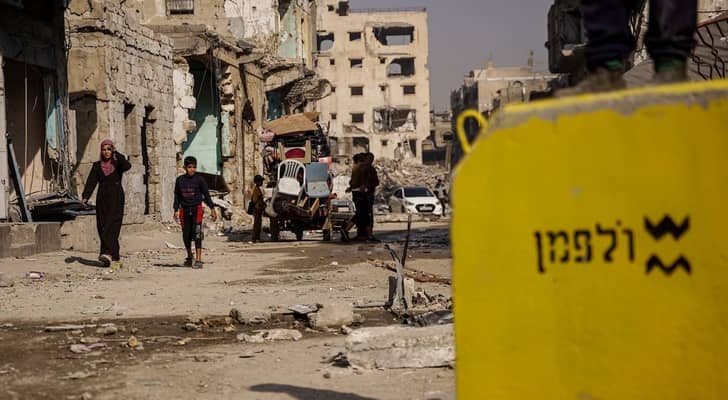
International reports and UN-linked sources have documented a significant expansion of 'Israeli' control inside the Gaza Strip, driven by the gradual westward shift of a military demarcation known as the “yellow line” and the emergence of an additional operational boundary referred to as the “orange line.”
According to these reports, 'Israel’s' control now extends over approximately 64% of Gaza’s territory, marking a substantial increase since the October 2025 ceasefire, when forces withdrew to the “yellow line” under a US-brokered agreement.
'Israeli' media reports, alongside satellite imagery published by The Guardian on April 22, indicate that the yellow line has been progressively pushed westward over recent months. The data suggests 'Israeli'-controlled territory has expanded from around 53% at the start of the ceasefire to approximately 59% in recent assessments.
The Guardian analysis, based on satellite imagery and field reporting, shows concrete boundary markers being repositioned deeper into Gaza, alongside the construction of earth berms, military outposts, and fortified positions that reinforce the evolving line of control.
The report also highlights the emergence of an unmarked operational boundary referred to by aid agencies as the “orange line.” Unlike the visible yellow markers, the orange line exists primarily on military coordination maps and is not physically demarcated on the ground. Humanitarian organizations say they are instructed by 'Israeli' liaison units to coordinate movements relative to this line, which reportedly varies in distance from 200 to 500 metres beyond the yellow line.
As the yellow line advances, the orange zone, described as a “free-fire area” in operational terms, has also shifted westward, placing additional parts of Gaza under immediate military risk designation. UN data cited in the reporting indicates that hundreds of Palestinians have been killed in areas near these shifting boundaries during the ceasefire period, including a significant number of children.
The 'Israeli' military has stated that it updates and marks operational lines based on evolving security assessments and "terrain conditions". It claims it informs the local population in order to reduce friction. It also allegedly maintains that its forces operate in accordance with international law and do not target civilians.
However, UN High Commissioner for Human Rights Volker Türk has rejected claims that proximity to military deployment lines can justify civilian targeting, stating that “targeting civilians not taking direct part in hostilities is a war crime, regardless of their proximity to deployment lines.”
The shifting boundaries have had a direct impact on civilians across Gaza. Residents in areas such as Jabaliya and Beit Lahiya report repeated overnight movements of the line, forcing sudden displacement or exposing them to newly designated high-risk zones. Aid agencies have also reported that several UN facilities, including emergency shelters, were found to be inside newly adjusted operational zones.
Researchers and legal analysts have raised concerns that the gradual movement of these lines may amount to de facto territorial consolidation. Some argue the system creates conditions that blur the distinction between temporary military control and long-term territorial change, though Israel maintains the measures are security-driven and tied to ongoing threats.