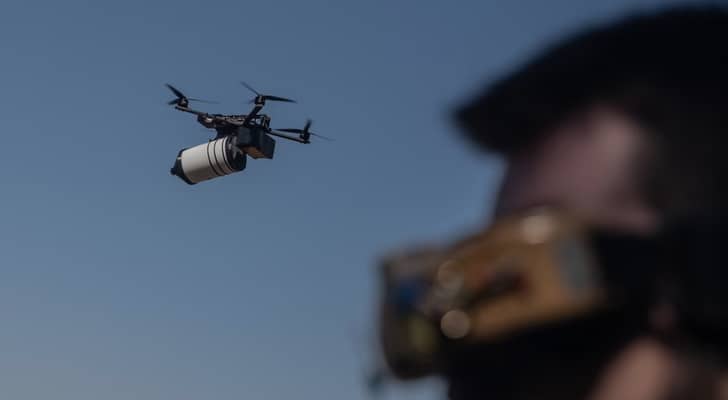
Hezbollah’s First Person View (FPV) drones

No “magic way” to stop Hezbollah FPV drone strikes, ‘Israel’ admits
Note: AI technology was used to generate this article’s audio.
- 'Israeli' Air Force (IAF) admitted that there is "no magic" solution to stop Hezbollah’s FPV drones.
- Officials believe removing US-imposed restrictions on strikes north of the Litani River could reduce the threat by 80%.
'Israel' Occupation Forces (IOF) issued an assessment on Friday, to local media, acknowledging that the IOF currently lacks a comprehensive technological "answer" to the lethal threat posed by Hezbollah’s First Person View (FPV) drones.
Despite improvements in overall drone defenses since 2023, the Air Force stated that the manual nature of FPV technology -where operators "ride" the drone via virtual reality headsets- makes these devices exceptionally difficult to jam or intercept before impact.
Several recent incidents in Southern Lebanon have resulted in 'Israeli' casualties directly attributed to these precise, low-altitude strikes.
The "Litani factor"
While IOF is testing new tactics and defensive measures, the Air Force emphasized that the most effective solution is not technological, but political.
According to 'IAF' sources, the single largest "positive change" in the drone war would occur if the United States removed current restrictions preventing 'Israel' from attacking Hezbollah targets north of the Litani River.
"Removing such restraints could help Israel reduce the FPV drone threat by around 80%," an Air Force source stated to 'Israeli' media.
This strategy would allow the IDF to shift from a "defensive" posture -trying to catch drones mid-flight- to an "offensive" one, targeting the entire ecosystem: production sites, storage facilities, and command centers located deeper in Lebanese territory.
Targeting the ecosystem
IOF sources revealed that prior to the recent ceasefire, intelligence units had already begun a wider campaign to dismantle Hezbollah’s FPV infrastructure. This includes:
Material disruption: Targeting the supply chains for the components and electronics used to build the drones.
Command centers: Striking the facilities where pilots are trained and missions are planned.
Pilot elimination: Tracking and neutralizing operators even when they are not actively flying a mission.
New tactics in the pipeline
Despite the admission of current gaps, the Air Force noted that it is "hard at work" on specific new tactics to counter FPVs. Results from tests conducted two weeks ago are currently being analyzed and could have "major ramifications" for how the IOF handles the issue on the front lines.
Until then, however, IOF warned that the FPV threat remains a "deadly and difficult" challenge that cannot be eliminated all at once, especially while diplomatic constraints limit the scope of the Air Force's reach in Northern Lebanon.