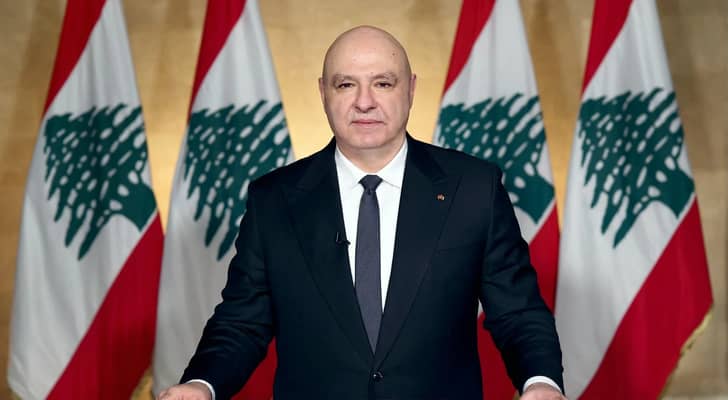
Lebanese Prime Minister Nawaf Salam

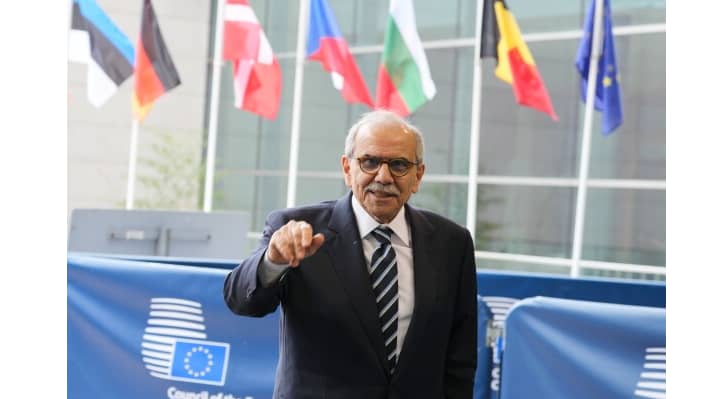
Lebanese PM says state must monopolize arms
Note: AI technology was used to generate this article’s audio.
- Addressing the EU in Luxembourg, the Lebanese PM declared that the state must hold the sole authority over decisions of war and peace.
- He announced strict measures to make Beirut a weapons-free zone, ban Hezbollah's military activities, and deport covert IRGC elements.
- The Prime Minister appealed for increased European support to rebuild the economy and strengthen the Lebanese Armed Forces.
Lebanese Prime Minister Nawaf Salam addressed the European Union Foreign Affairs Council in Luxembourg on Tuesday, delivering a speech outlining his government’s strategy to reclaim state sovereignty following a recently brokered ceasefire.
Speaking before EU High Representative Kaja Kallas and European foreign ministers, the Prime Minister emphasized that Lebanon is entering a critical new phase aimed at ending the proxy wars that have ravaged the country for years.
Reclaiming sovereignty and disarming militias
A central theme of the Prime Minister's address was the absolute necessity of state control over all armed forces. He stated that a state lacking a monopoly on decisions of war and peace will always remain vulnerable.
"The time has come to enshrine a clear, unequivocal principle: there can be no independent state without the components of its sovereignty, and no sovereignty without a single legitimate authority that monopolizes national decisions," he told the European delegation.
To achieve this, the PM detailed a series of decisive internal measures currently underway:
- Securing the capital: The government has begun implementing a plan to declare Beirut a completely weapons-free zone.
- Banning Hezbollah: Official bans have been placed on all of Hezbollah's military and security activities.
- Targeting IRGC operatives: Security forces have been explicitly instructed to track down, arrest, and deport covert elements of Iran's Islamic Revolutionary Guard Corps (IRGC) operating on Lebanese soil.
- Deploying the Army: The Lebanese Armed Forces have concluded the first phase of their deployment south of the Litani River, establishing operational control in areas outside of Israeli occupation.
Diplomatic talks and UNIFIL safety
Addressing the international diplomatic track, the Prime Minister said that Lebanon has recently engaged in "preparatory, direct talks" with 'Israel' in Washington, brokered by the United States.
He defended the choice of diplomacy as an act of national responsibility, aiming to secure the release of prisoners, end the occupation, and allow displaced citizens to return home.
Furthermore, he strongly condemned recent attacks on UNIFIL forces in southern Lebanon. Taking the opportunity to directly address the French delegation, he offered his deepest condolences for the recent death of a French peacekeeper and wished a speedy recovery to the injured, asserting that UN forces must not be victims of the conflict.
A staggering economic and humanitarian toll
The Prime Minister painted a grim picture of the war's domestic impact. He noted that Lebanon was dragged into a conflict it did not choose, exacerbating an already dire economic crisis.
According to preliminary World Bank estimates cited in his speech, the first month of the conflict alone caused $1.4 billion in infrastructure and housing damages.
With 40,000 housing units damaged or destroyed, over a million people have been displaced. The national poverty rate has now spiked to over 40%, and the economy is expected to contract by 7.5% this year.
A plea for European partnership
Outlining a first-year relief cost estimated at $500 million, the PM expressed deep gratitude for the EU's recent provision of €100 million in emergency humanitarian aid and €1 billion in development assistance for 2024-2027.
Concluding his address, he urged the European Union to deepen its partnership with Lebanon across three main pillars:
- Continuing critical humanitarian support.
- Bolstering the Lebanese Army and Internal Security Forces, specifically through the European Peace Facility, noting that "the stronger the Lebanese Army, the weaker the illegal armed groups."
- Backing comprehensive recovery and reconstruction efforts to ensure long-term stability in Lebanon and the wider region.