


Day 49 | Lebanon ceasefire begins following Trump announcement
The 2026 Iran War began on February 28, when the United States and ‘Israel’ launched a large-scale attack on Iran, unleashing nearly 900 airstrikes within 12 hours on the Islamic Republic’s missile systems, air defenses, nuclear facilities, military bases, and leadership targets.
The assault followed years of shadow conflict, including direct missile exchanges in 2024 and a limited 12-day war in 2025 that damaged Iran’s nuclear and ballistic capabilities.
Supreme Leader Ayatollah Ali Khamenei and senior officials were killed in the opening strikes. Iran responded within hours, launching waves of ballistic missiles and drones at ‘Israel’, US bases, and targets across the Gulf.
On April 8, the United States, Iran, and ‘Israel’ agreed to a temporary two-week ceasefire, brokered by Pakistan, with Iran committing to reopen the Strait of Hormuz while negotiations continue toward a broader agreement.
The fragile truce has since come under strain, particularly as ‘Israel’ launched major bombardments in Lebanon and clashes with the Iran-backed group Hezbollah intensified.
Here’s the latest:
• Trump hints at renewed talks: US President Donald Trump said “something could be happening” over the next two days regarding negotiations with Iran in Pakistan after previous talks faltered.
• Key sticking points remain: Officials say both sides have floated a suspension of Iranian uranium enrichment, but remain divided over the timeline. The US is also pushing for the dismantling of Iran’s major nuclear enrichment facilities and the full reopening of the Strait of Hormuz.
• US marine blockade: Washington has declared a marine blockade, though shipping data shows several Iran-linked vessels have continued transiting the Strait of Hormuz. Overall activity at Iranian ports appears to have declined.
• 'Israel'-Lebanon talks conclude: After the first direct negotiations in decades, 'Israel' and Lebanon agreed to hold further talks “at a mutually agreed time and venue,” according to the US State Department. 'Israel' declined to commit to a ceasefire in southern Lebanon.
• Lebanon strikes strain truce: ‘Israel’ has carried out its heaviest strikes on Lebanon, including in densely populated areas of central Beirut, since Hezbollah joined the war in early March.
• Iran warns talks may collapse: Iran’s parliament speaker Mohammad Bagher Ghalibaf said the “workable basis” for negotiations had already been violated, suggesting further talks could be “unreasonable.”
• Confusion over ceasefire terms: A senior US official said Iran’s 10-point proposal does not match the conditions the White House says were agreed to when the war was paused.
Thread ended
This live thread has ended. Follow our online coverage of day 50 of the war, as Iran opens the Strait of Hormuz and a fragile truce in Lebanon takes place.
Read more: Day 50 | Iran opens Hormuz strait as Trump optimistic about deal
Trump shocks Netanyahu with ‘PROHIBITED’ Lebanon strikes remark
‘Israel’ has sought clarification from the White House following remarks by President of the United States Donald Trump stating that ‘Israel’ is prohibited from carrying out airstrikes in Lebanon, according to US sources cited by Axios.
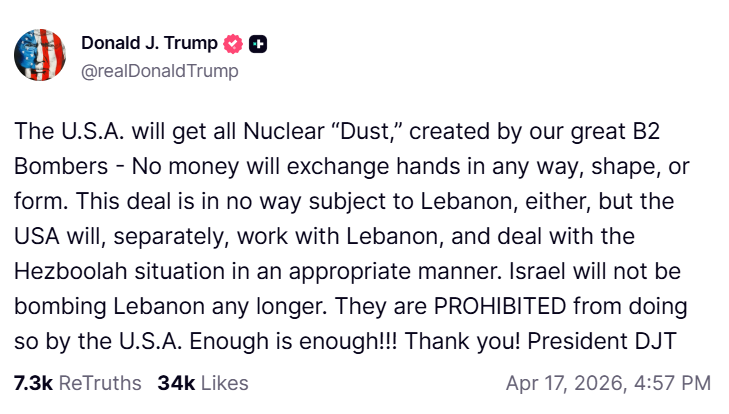
The reports said 'Israeli' Prime Minister Benjamin Netanyahu and his advisers were "shocked" by Trump’s comments, with Netanyahu himself said to be “stunned and alarmed” after learning of the statement through media coverage.
Trump had said that “Israel will not be bombing Lebanon any longer” and that such actions were “PROHIBITED” by the United States, language that 'Israeli' officials viewed as contradicting the publicly released terms of the ceasefire agreement.
- What does the agreement say? -
According to the agreement, ‘Israel’ committed to refraining from offensive military operations against Lebanese targets, but retained the right to act in self-defense against “planned, imminent, or ongoing attacks.”
'Israeli' officials moved quickly following the remarks, with aides, including the ambassador to Washington, seeking urgent clarification from US counterparts to determine whether there had been any shift in policy.
- Self-defense greenlight from US official -
A US official later reaffirmed that the ceasefire terms remain unchanged, stressing that while offensive operations are restricted, ‘Israel’ retains the right to respond to threats under the self-defense clause, according to Axios.
The issue gained further urgency after reports of an ‘Israeli’ drone strike in southern Lebanon shortly before Trump reiterated his position, with 'Israeli' sources claiming the action was taken in response to a violation of the ceasefire.
Etihad resumes Tel Aviv flights, offers US routes via Abu Dhabi
- Etihad restarts flights to Tel Aviv with US connections
- Other airlines expand routes as market reopens
Etihad Airways has resumed flights to Tel Aviv, restoring connections to the United States via Abu Dhabi after a suspension triggered by regional conflict.
Operations were halted on February 28, 2026, following a sharp escalation involving the United States, ‘Israel’, and Iran, when the two allies attacked Iran leading to widespread airspace closures across the Middle East. At the peak of the disruption, a significant share of regional departures was grounded, while rising security risks forced airlines to suspend routes.
The resumption follows a two-week ceasefire announced on April 8, allowing authorities to reopen key air corridors and enabling international carriers to gradually return to Ben Gurion Airport.
Etihad relaunched the route with two daily flights and plans to expand to four by May using Airbus A321LR aircraft. The airline is offering onward travel to US cities including New York, Chicago, and Washington, with connection times of just over two hours.
A key feature of the service is the US preclearance facility at Zayed International Airport, allowing passengers to complete immigration procedures before departure and arrive in the United States as domestic travelers.
Introductory fares start at around $1,000, with additional connections available to Asian destinations such as Bangkok, Shanghai, and Tokyo.
The return of Etihad and other carriers - such as TUS Airways and Blue Bird Airways - signals a gradual recovery in regional aviation, though analysts say flight schedules remain dependent on the durability of the current ceasefire and overall security conditions.
Iran rejects transfer of enriched uranium abroad
Iran’s Foreign Ministry spokesperson Esmail Baghaei said decisions on opening or closing the Strait of Hormuz are determined “on the ground,” not by public statements, stressing that any reported naval blockade would face a “decisive” Iranian response.
Baghaei rejected proposals to transfer Iran’s enriched uranium abroad and said compensation for damages is a key issue in ongoing negotiations.
He added that diplomacy is continuing alongside military efforts, noting that recent talks in Islamabad clarified key points and red lines, leaving “no ambiguity” in the negotiation process.
Iran restricts military ship passage through Strait of Hormuz, says IRGC Navy
Iran’s Islamic Revolutionary Guard Corps (IRGC) Navy said military vessels are currently prohibited from transiting the Strait of Hormuz, adding that all maritime traffic is now subject to prior approval and designated routes set by Iranian authorities.
The force said only non-military ships are allowed passage under what it described as regulated corridors.
The IRGC Navy said the measures are part of arrangements linked to a ceasefire framework, including developments tied to the implementation of a truce in Lebanon.
It warned that any violation of the navigation rules would be met with a response.
Lebanese president says talks with ‘Israel’ are not a sign of weakness
Lebanese President Joseph Aoun said that direct negotiations with ‘Israel’ should not be seen as a sign of weakness or retreat, stressing that Lebanon is now entering a new phase focused on permanent agreements.
He said Lebanon is “no longer a pawn in anyone’s game,” adding that current efforts aim to protect sovereignty, land unity, and national rights.
Iran naval commander calls Trump blockade “piracy”
A commander in Iran’s navy said Donald Trump’s statements about a naval blockade are “just words,” adding that the United States is imposing pressure on its allies rather than Iran, according to remarks reported by Fars.
The commander described the reported maritime blockade as “piracy,” amid rising tensions in the region.
Iran says no talks held on extending ceasefire
Iran’s Foreign Ministry spokesperson said no talks have taken place regarding extending the current ceasefire, according to remarks reported by Fars news agency.
The spokesperson said Iran’s focus in recent days has been on creating the necessary conditions for a full end to the war, in line with what he described as the rights of the Iranian people.
US deploys 10,000 troops in naval blockade on Iranian ports
- Over 10,000 US personnel involved in maritime operation
- Blockade targets Iranian ports and coastal waters
- Move follows breakdown of Islamabad talks
The United States' large-scale naval operation to enforce a blockade on Iranian ports and surrounding coastal areas is still ongoing, according to the US Central Command (CENTCOM).
In a statement, CENTCOM said more than 10,000 US sailors, Marines, and Airmen are participating in the operation, which involves naval carrier groups and destroyers operating in the region.
Imagery released showed an F/A-18E Super Hornet operating from the USS Abraham Lincoln, sailing alongside the USS Delbert D. Black, as part of the deployment.
An F/A-18E Super Hornet taxis on the flight deck of Nimitz-class aircraft carrier USS Abraham Lincoln (CVN 72) as it sails alongside the USS Delbert D. Black (DDG 119), April 16.
— U.S. Central Command (@CENTCOM) April 17, 2026
Over 10,000 U.S. Sailors, Marines, and Airmen are enforcing the blockade against ships attempting… pic.twitter.com/yHzHPxYnzr
The operation is aimed at restricting maritime access to and from Iranian ports, in what CENTCOM described as an effort to prevent the movement of ships attempting to enter or leave the country.
The announcement follows reports of stalled negotiations in Islamabad and comes amid heightened tensions in the region, with diplomatic efforts continuing alongside the escalation.
UN maritime agency warns of shipping crisis near Strait of Hormuz
- Around 2,000 commercial ships reportedly unable to transit Strait of Hormuz
- More than 20,000 seafarers affected, says IMO chief
- Warnings of food, fuel shortages and global energy shock
The Secretary-General of the International Maritime Organization (IMO), Arsenio Dominguez, has warned of a deepening humanitarian and logistical crisis in the Gulf, saying around 2,000 commercial vessels are currently “stranded” and unable to pass through the Strait of Hormuz amid ongoing regional escalation.
In remarks cited by Spanish newspaper El País, Dominguez said more than 20,000 seafarers are now facing a critical situation as ships remain immobilised in key waterways.
He said vessels are already beginning to ration essential supplies, including food, water, and fuel, as uncertainty over safe passage continues. He also praised neighbouring states for providing limited medical and logistical support to crews despite the deteriorating security environment.
Dominguez added that the IMO is in consultations with Iran and Oman on potential evacuation and de-escalation mechanisms once conditions allow, stressing that any resumption of normal shipping would depend on clearing the waterway and ensuring it is free from maritime threats, including possible mines.
The warning comes as international economic institutions caution that prolonged disruption in the Strait of Hormuz could trigger a severe global energy shock, with significant consequences for supply chains and economic growth worldwide.
Drone strike kills three Iranian Kurdish opposition members near Erbil
Three members of Iranian Kurdish opposition groups were killed in a drone strike targeting a camp near Erbil in northern Iraq, according to Iraqi security sources cited by Reuters.
Authorities have not yet confirmed responsibility for the attack, while investigations into the incident are ongoing.
Iran links Hormuz access to Lebanon ceasefire, threatens closure
A senior source in Iran’s Supreme National Security Council said the temporary reopening of the Strait of Hormuz is tied to the implementation of a ceasefire in Lebanon, warning that the passage could be shut again if a maritime blockade continues.
The source said Iran has suspended an agreement with Pakistan on allowing vessel passage through Hormuz, citing what it described as the failure of the Lebanon ceasefire to include Hezbollah and ‘Israel’. It added that US Central Command had previously acknowledged the Islamic Revolutionary Guard Corps’ control over the strategic waterway.
The statement further warned that continued “naval blockade” measures would be considered a violation of the ceasefire, adding that Iran would respond by closing the strait again.
Trump says he will "MAKE LEBANON GREAT AGAIN"
- Trump says Strait of Hormuz deal is finalized
- Claims Lebanon situation is “separate” but addressed by US
- Says NATO offered assistance but was rejected
US President Donald Trump said the Strait of Hormuz is “completely open and ready for business,” adding that a broader agreement involving Iran has been reached and includes provisions on maritime security.
In a series of posts on Truth Social, Trump said the naval blockade targeting Iran will remain in place until the agreement is fully completed, but stressed that the deal is not connected to Lebanon.
He said the United States would separately “work with Lebanon” and address the Hezbollah situation, adding that “Israel will not be bombing Lebanon any longer,” which he said Washington would prohibit.
Trump also said NATO had offered assistance following the developments around the Strait of Hormuz, but claimed he rejected the offer, describing the alliance as a “paper tiger” and saying it should stay away unless involved in oil logistics.
Trump thanked Saudi Arabia, the United Arab Emirates, Qatar, and Pakistan for what he called their support during the process, while also stating that Iran is removing sea mines from key waterways with US assistance.
He added that the agreement is not linked to Lebanon in any way, but repeated his intention to “make Lebanon great again,” without providing details on how that would be implemented.
Trump also claimed Iran has agreed to never close the Strait of Hormuz again, calling it a major shift in regional security and global energy stability.
Netanyahu announces new northern security zone along Lebanon border
- ‘Israel’ says new security zone spans Lebanon-Syria frontier
- Claims major degradation of Hezbollah capabilities
- Signals ongoing diplomatic talks with Lebanon
Prime Minister of ‘Israel’ Benjamin Netanyahu announced what he described as a new security reality on the northern front, including the establishment of a “security zone” stretching along the border with Lebanon and reaching the Yarmouk River in Syria.
Netanyahu said the buffer zone is designed to permanently remove the threat of direct infiltration and push anti-armor missile threats away from northern settlements, framing it as part of a long-term security strategy.
He also outlined what he called strategic gains against Hezbollah, claiming the destruction of a large portion of the group’s rockets, shells, and storage sites, and saying its leadership structure had been significantly weakened.
Netanyahu further said the objective remains the disarmament of Hezbollah, though he acknowledged this would require sustained political and military efforts over time. He added that plans are in place to counter remaining drone and missile threats, without providing operational details.
On the diplomatic front, he described direct talks with Lebanese representatives as the first in more than four decades, while stressing that a path toward broader peace remains distant. He said efforts to restore security in the north are being coordinated with President of the United States Donald Trump, whom he credited with limiting further escalation to allow negotiations to continue.
Germany, Italy leaders arrive in Paris for Hormuz security talks
Trump says Hormuz open, Iran blockade to remain until deal complete
President of the United States Donald Trump said the Strait of Hormuz is “completely open and ready for business and full passage,” while stressing that a naval blockade targeting Iran will remain “in full force and effect” until a final agreement is fully completed.
Trump said the measures apply only to Iran, adding that negotiations are progressing rapidly as “most of the points are already negotiated.” He expressed confidence that the process will conclude quickly, signaling potential movement toward a broader deal between Washington and Tehran.
Iran says Strait of Hormuz fully open to commercial traffic during ceasefire
Iran says the Strait of Hormuz is now fully open to commercial maritime traffic for the duration of the remaining ceasefire period, according to statements carried by international media.
US-Iran talks show progress this week amid major gaps: Axios
Axios reported, citing officials, that negotiations between Washington and Tehran have made progress this week, although significant gaps remain between both sides.
According to the report, the United States is exploring the possibility of releasing around 20 billion US dollars in frozen Iranian assets in exchange for Iran handing over its stockpile of enriched uranium.
Pezeshkian says ‘strong diplomacy’ forced ceasefire in Lebanon
Iranian President Masoud Pezeshkian said that “strong diplomacy” forced the ‘Israeli’ side to agree to a ceasefire in Lebanon.
He said the outcome reflected coordinated political and diplomatic efforts, which he argued led to a halt in hostilities.
UK urges Hezbollah disarmament, calls on ‘Israel’ to halt operations in Lebanon
British Foreign Secretary Yvette Cooper said that Hezbollah must stop its attacks and disarm, while also calling on ‘Israel’ to end its military operations in Lebanon and respect the country’s sovereignty.
Her remarks reflect renewed diplomatic pressure on both sides amid efforts to maintain stability following the ceasefire.
Cooper emphasized the need for both parties to reduce tensions, highlighting the importance of preventing further escalation along the Lebanon-‘Israel’ border.
She said lasting stability would require reciprocal steps and adherence to international commitments.


