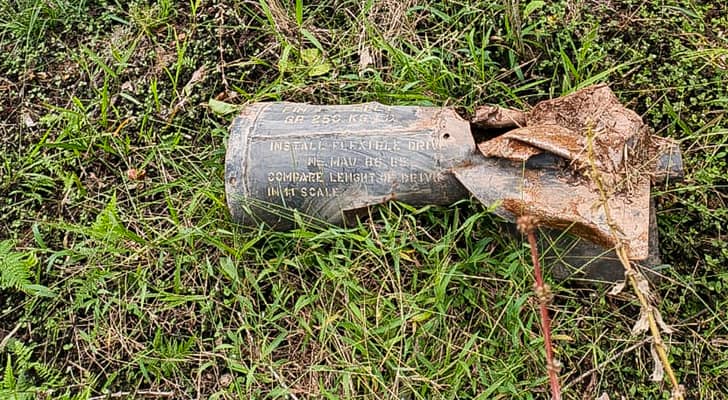
An explosive device is pictured on the ground at Vereda El Amarradero, Narino department near the border with Ecuador. (March 17, 2026)

Colombia, Ecuador leaders clash over bomb dropped near border
Note: AI technology was used to generate this article’s audio.
- Colombian President Gustavo Petro accused Ecuador of dropping a gravity bomb into Colombian territory, claiming it left 27 charred bodies; Ecuador’s President Daniel Noboa denied the breach, asserting his forces only targeted "narco-terrorist" hideouts within their own borders.
- The clash highlights growing regional friction following the launch of the "Shield of the Americas," a US-backed counter-cartel coalition led by President Trump that includes Ecuador but notably excludes Colombia's leftist government.
The leaders of Colombia and Ecuador sparred Tuesday over allegations that the Ecuadoran bombing of suspected criminal hideouts near their shared border had spilled into Colombian territory.
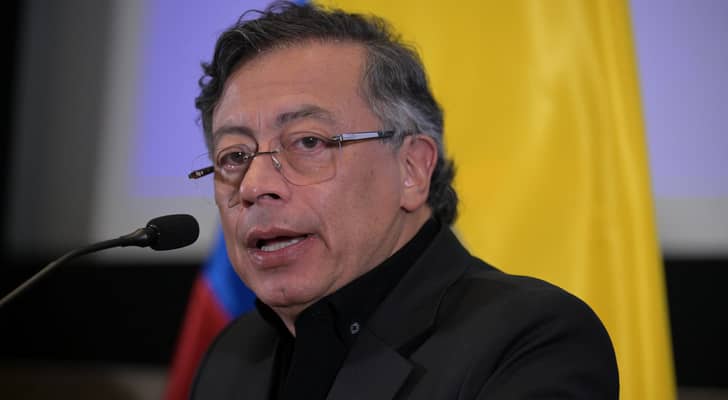
Months of tension between Colombia's leftist President Gustavo Petro and his right-wing Ecuadoran counterpart, Daniel Noboa, an ally of US President Donald Trump, spiked Monday when Petro alleged that an explosive was dropped from a plane near the border.
Petro posted on X on Tuesday night that "it has been confirmed that the bomb on Colombian territory belongs to the Ecuadorian army," without giving specifics.
"The investigation continues and there will be a diplomatic protest note," he wrote.
Earlier on Tuesday, Petro posted a photo of an unexploded "bomb" that he said had fallen on the Colombian-Ecuadoran frontier. He called for a thorough investigation, saying: "It fell 100 meters from the home of a poor family."
"It's a bomb that can only be -- I don't want to say fired, but maybe dropped without intending to fire it -- from a plane," Petro said during a speech Tuesday, adding that it "was not from a small plane, much less a drone."
Experts said the munition is believed to be a "freefall bomb" that is not guided, falling by the force of gravity.
A Colombian armed forces spokesperson told AFP bomb disposal teams successfully deactivated the device Tuesday night.
Local farmers speaking with AFP corroborated Petro's account.
"We were all terrified -- you know, scared -- and worried that those devices might suddenly explode and take our lives," farmer Julian Imbacuan told AFP by phone.
Colombian Defense Minister Pedro Sanchez implored residents to avoid the area, announcing later Tuesday that troops had been deployed there.
Noboa took to X Tuesday to retort that Ecuador is "currently bombing locations that served as hideouts" for criminal groups that are "largely Colombian, and which your government allowed to infiltrate our country due to negligence regarding your border."
"President Petro, your statements are false," Noboa said. "We are operating within our own territory, not yours."
“27 charred bodies”
Petro, however, insisted "there are 27 charred bodies and Noboa's explanation is not credible," without specifying if he was referring to recent casualties.
Colombia and Ecuador share a 586-kilometer (364-mile) border where Colombian guerrilla groups and criminal organizations from both countries operate. They engage in the trafficking of drugs, weapons and people, and illegal mining.
The countries faced a similar rise in tensions in 2008 when Colombia's then-president Alvaro Uribe ordered a strike on Ecuadoran soil to take out a FARC commander.
Ecuador recently began anti-drug operations with US support and also joined the "Shield of the Americas," a 17-nation coalition set up by Trump this month to combat drug trafficking in the region.
Colombia, like other left-wing governments in Latin America, was not invited to join the group even as Bogota and Washington agreed recently to coordinate their efforts against Colombian cartels and guerrilla groups.
The exclusion drew a complaint from Petro.
About 70 percent of the cocaine produced in Colombia and Peru -- the world's largest producers of the drug -- transits through Ecuador to be exported via its Pacific ports.