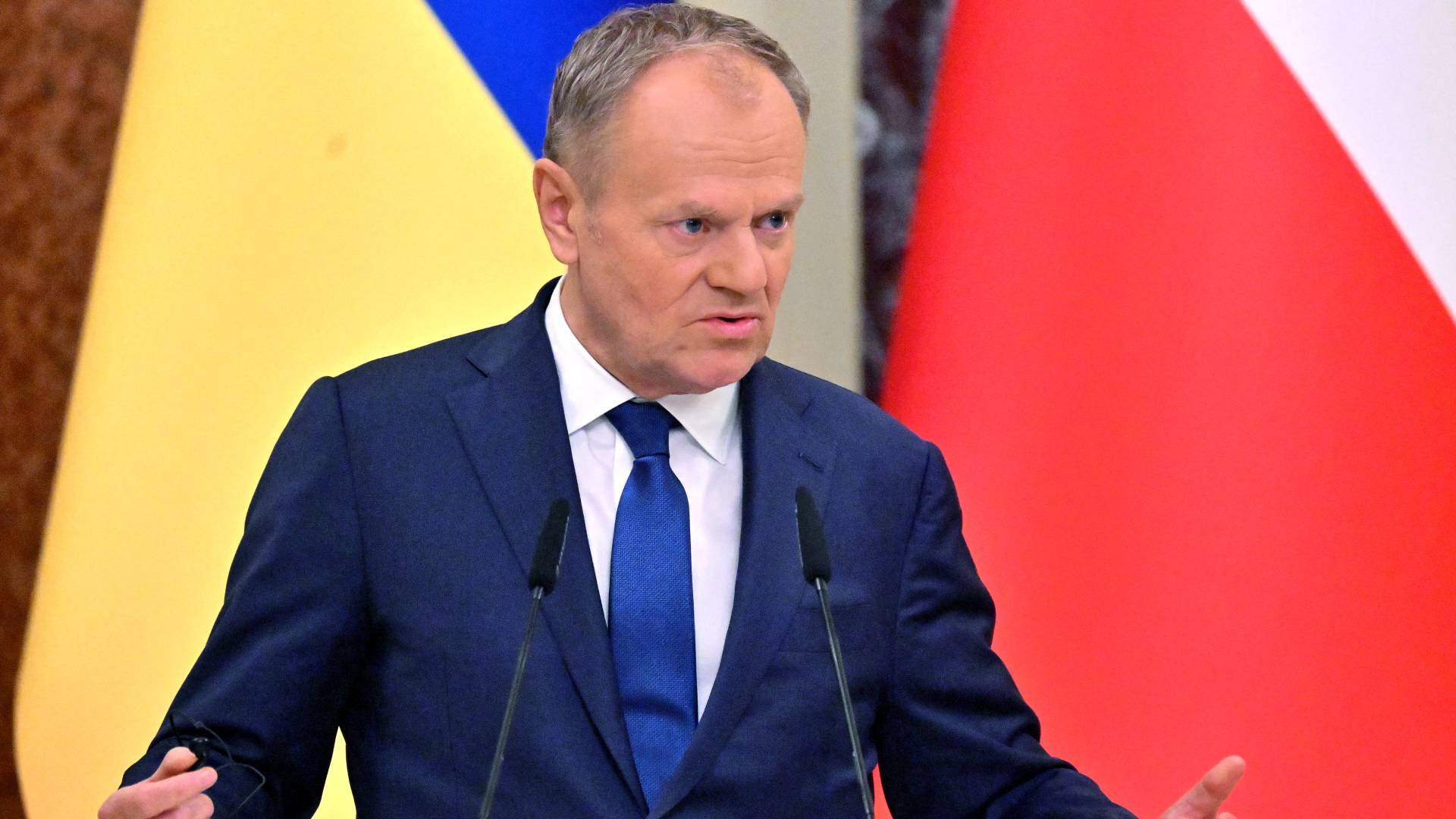
Poland's Prime Minister Donald Tusk at the Mariinskyi Palace in Kyiv. (February 5, 2026)

Poland will not join Trump’s “Board of Peace”: PM
Note: AI technology was used to generate this article’s audio.
- Prime Minister Donald Tusk announced that Poland will not join the US-led "Board of Peace" due to significant concerns regarding its legal structure, objectives, and the potential to undermine established international institutions like the UN.
- While Tusk reaffirmed Poland's alliance with the United States, he stated that participation would only be reconsidered if the board's framework is clarified and the inclusion of controversial invitees—such as Russia and Belarus—is addressed.
Polish Prime Minister Donald Tusk announced that Poland will not participate in the United States-led Board of Peace under present conditions, citing uncertainties regarding its structure and objectives.
During a government meeting, Tusk emphasized that the choice stems from national reservations about the board's framework, principles, legal status, and primary goals.
He stated, "Taking into account certain national doubts regarding the shape of the board, under these circumstances Poland will not join the work of the Board of Peace, but we will analyse it."
Tusk further noted that Poland remains committed to its alliance with the United States, adding that participation could be reconsidered if circumstances evolve to address these concerns.
The Board of Peace represents a new international body initiated by President Trump to facilitate conflict resolution, beginning with efforts to solidify a ceasefire in Gaza.
Trump envisions the board expanding its scope to address broader global disputes, positioning it as a platform for diplomatic engagement beyond traditional institutions.
Launched in January 2026, the board's inaugural session is scheduled for February 19 in the United States. Invitations have been extended to various nations, including Russia and Belarus, which has heightened skepticism among Western countries about the initiative's legitimacy and potential to undermine established frameworks such as the United Nations.