

UK prosecutors appeal terror charge dismissal against pro-Gaza Kneecap rapper
Note: AI technology was used to generate this article’s audio.
- The UK’s Crown Prosecution Service (CPS) petitioned the High Court to reinstate a “terrorism” charge against Kneecap rapper Liam Óg Ó hAnnaidh (Mo Chara), arguing that a lower court's dismissal of the case over a one-day technical delay was "wrong in law."
- As the band’s supporters rallied outside the Royal Courts of Justice, defense lawyers maintained that the charge, stemming from the alleged display of a Hezbollah flag at a 2024 concert, was invalidly issued after a six-month statutory limit, while the band characterized the appeal as a "British state witch-hunt" aimed at silencing their advocacy for Gaza.
UK prosecutors launched a High Court challenge Wednesday to appeal a judge's decision to throw out a charge of "supporting terrorism" against an Irish-language singer from the punk-rap group Kneecap.
The Crown Prosecution Service (CPS), which operates in England and Wales, argued a chief magistrate had erred in September when he dismissed the case against Liam O'Hanna over a technical error.
O'Hanna was charged with displaying a flag of the proscribed Iran-backed Lebanese group Hezbollah at a November 21, 2024 concert in London, breaching the UK's 2000 Terrorism Act.
The CPS "submits that the Learned judge was wrong to find that the proceedings... were not instituted in the correct form", it said in written submissions unveiled in court.
Paul Jarvis, for the prosecution, insisted in court that the proceedings against O'Hanna "are and remain valid in law".
The argument turns on the date the charge was brought, which was May 21 -- six months to the day after the concert. But the attorney general did not approve the charge until May 22, which O'Hanna's legal team argues fell outside a six-month time limit.
A “witch-hunt”
O'Hanna, who performs under the name Mo Chara, did not attend London's Royal Courts of Justice for the hearing before two judges.
But bandmate JJ O Dochartaigh -- better known by his stage name DJ Provai -- was in court alongside the band's manager, Dan Lambert, and the band's lawyers.
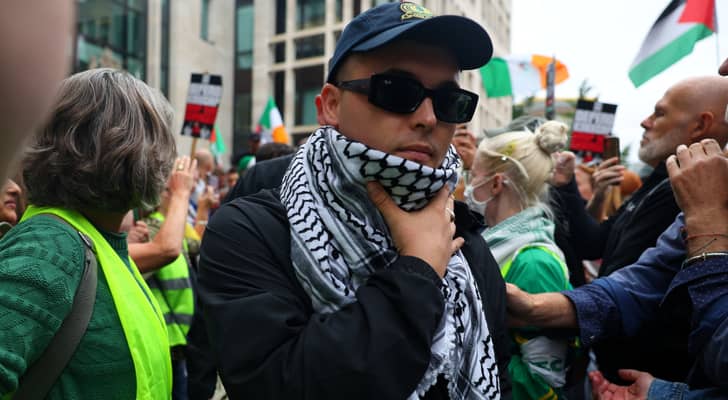
Kneecap had urged its supporters to rally outside and about 100 showed up, holding Irish and Palestinian flags, singing songs and listening to speeches by speakers including Sinn Fein MP John Finucane.
The band has called the attempted prosecution a "British state witch-hunt". They celebrated last year after chief magistrate Paul Goldspring, sitting at London's Woolwich Crown Court, threw out a charge of supporting terrorism brought against O'Hanna.
Goldspring agreed with O'Hanna's lawyers that the legal proceedings had not been "instigated in the correct form" due to time limits on bringing criminal charges.
Kneecap has vowed to "win again", with its legal filings arguing Goldspring "was plainly correct" in his September decision.
A decision by the High Court is not expected immediately.
“We will not be silent”
O'Hanna, 28, named Liam Og O Hannaidh in Irish, was charged in May after a video emerged from the London concert in which he allegedly displayed the Hezbollah flag, an offence the singer has denied.
The band, whose members sing in Irish and regularly lead crowd chants in support of the Palestinians in Gaza, have had multiple international concerts cancelled over their pro-Palestinian stance and other controversies.
Canada barred Kneecap in September from entering the country, citing the group's alleged support for Hezbollah and the Palestinian group Hamas.
But their performance in Paris in September went ahead despite objections from French Jewish groups and government officials.
The group also played southwest England's vaunted Glastonbury Festival in June and drew packed audiences in Tokyo last week.
Posting on X on January 1 about the appeal, Kneecap said: "It is the view of our legal team that there is not an iota of logic for this, it is without any sound legal basis.
"We will not be silent," the group vowed.
O'Hanna has maintained that the band's stand "was always about Gaza, about what happens if you dare to speak up".







