
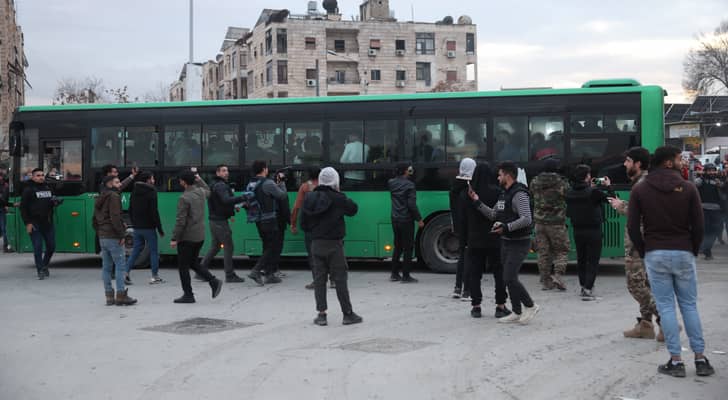
A bus carrying Kurdish fighters prepares to leave Aleppo's Kurdish-majority Sheikh Maqsud neighbourhood. (January 10, 2026)

US envoy urges Syria govt & Kurds to “return to dialogue”
Note: AI technology was used to generate this article’s audio.
- Following a high-level meeting with Syrian President Ahmed al-Sharaa, US Envoy Tom Barrack urged an immediate return to dialogue between the central government and Kurdish authorities, citing the "deeply concerning" risk that recent Aleppo clashes could undermine progress made since the fall of the Assad regime.
- While Syrian authorities reported a "clearing operation" and the transfer of surrendering Kurdish fighters by bus to the northeast, Kurdish officials denied a total withdrawal, labeling those being removed as "abducted civilians" amid a humanitarian crisis that has displaced an estimated 155,000 people.
The United States on Saturday urged the Syrian government and Kurdish authorities to return to negotiations after days of deadly clashes in the northern city of Aleppo.
Conflicting reports emerged from the city, as authorities announced a halt to the fighting and said they began transferring Kurdish fighters out of Aleppo, but Kurdish forces denied the claims shortly after.
At least five buses were seen on Saturday carrying men leaving the Kurdish-majority Sheikh Maqsud district accompanied by security forces, with authorities saying they were fighters though Kurdish forces insisted they were "civilians who were forcibly displaced".
It came as US envoy Tom Barrack on Saturday met with Syrian President Ahmed al-Sharaa, and afterwards issued a call for a "return to dialogue" with the Kurds in accordance with an integration agreement sealed last year.
The violence in Aleppo erupted after efforts to integrate the Kurds' de facto autonomous administration and military into the country's new government stalled.
Since the fighting began on Tuesday, at least 21 civilians have been killed, according to figures from both sides, while Aleppo's governor said 155,000 people have been displaced.
On Saturday evening, state television reported that Kurdish fighters "who announced their surrender... were transported by bus to the city of Tabaqa" in the Kurdish-controlled northeast.
In a statement to the official SANA news agency, the military announced earlier on Saturday "a halt to all military operations in the Sheikh Maqsud neighbourhood".
A Syrian security source had told AFP that the last Kurdish fighters had entrenched themselves in the area of al-Razi hospital in Sheikh Maqsud, before being evacuated by the authorities.
Kurdish forces said in a statement that news of fighters being transferred was "entirely false" and that the people taken included "young civilians who were abducted and transferred to an unknown location".
The clashes, some of the most intense since Syria's new authorities took power, present yet another challenge as the country struggles to forge a new path after the ousting of longtime ruler Bashar al-Assad in December 2024.
Both sides have blamed the other for starting the violence in Aleppo.
The Kurdish-led Syrian Democratic Forces (SDF) control swathes of the country's oil-rich north and northeast, much of which they captured during Syria's civil war and the fight against Daesh.
But Turkey, a close ally of neighbouring Syria's new leaders, views its main component as an extension of the Kurdistan Workers' Party (PKK), which agreed last year to end its four-decade armed struggle against Ankara.
Turkey has launched successive offensives to push Kurdish forces from the frontier.
Elham Ahmad, a senior official in the Kurdish administration in Syria's northeast, accused Syrian authorities of "choosing the path of war" by attacking Kurdish districts and of "seeking to put an end to the agreements that have been reached".
"We are committed to them and we are seeking to implement them," she told AFP.
The March integration agreement was meant to be implemented last year, but differences, including Kurdish demands for decentralised rule, have stymied progress as Damascus repeatedly rejected the idea.
Nanar Hawach, senior Syria analyst at the International Crisis Group, said the renewed clashes cast doubt on the government's ability to unite the country after years of civil war.







