

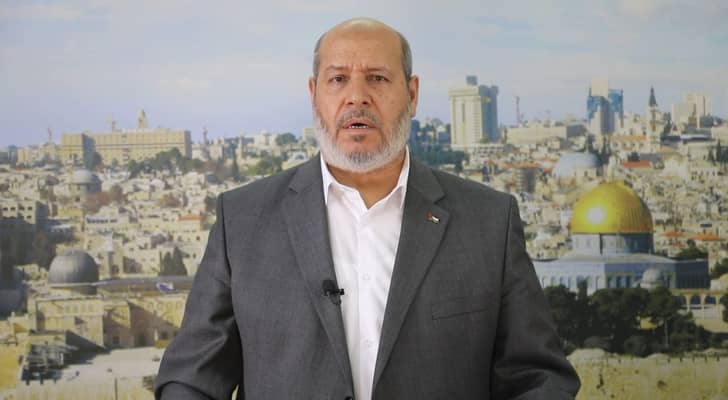
Hamas marks 38th anniversary, rejects all forms of guardianship over Palestinians
Note: AI technology was used to generate this article’s audio.
- Hamas leader Khalil al-Hayya marks 38th anniversary, commemorates martyrs, and outlines resistance priorities amid ongoing 'Israeli' aggression.
Khalil al-Hayya, head of Hamas in the Gaza Strip, delivered a speech marking the 38th anniversary of the movement’s founding, highlighting the ongoing struggles of the Palestinian people, commemorating martyrs, and outlining the movement’s strategic priorities for the future.
Al-Hayya began by acknowledging the severe challenges faced by Palestinians amid 'Israeli' aggression, noting the deaths of over 70,000 people in Gaza, including men, women, and children.
He paid particular tribute to the recently killed Hamas commander Raed Saad, describing him as a devoted and pious leader who dedicated his life to the cause and resisted the occupation for decades.
He condemned systematic 'Israeli' actions in the occupied West Bank, including military operations, settler attacks, checkpoints, killings, arrests, land confiscations, and house demolitions, emphasizing that Palestinians continue to resist and preserve their national identity.
Al-Hayya also highlighted the ongoing threats to Jerusalem’s Aqsa Mosque, citing repeated settler intrusions and efforts to divide or alter its sacred spaces.
Addressing the hardships faced by Palestinians in exile and refugee camps, he referenced the recent massacre at the Ain al-Hilweh camp in Lebanon, which claimed the lives of 13 young Palestinians. Despite these challenges, he affirmed that Hamas and the broader resistance remain resilient, demonstrating that 'Israel' can be challenged and Palestine can be liberated through careful planning, unity, and determination.
Al-Hayya reflected on the achievements of the resistance, noting how it has challenged 'Israel’s' narrative of deterrence and security superiority, exemplified by the October 7 operations.
He highlighted efforts to expose 'Israeli' leaders to international scrutiny, challenge longstanding Zionist narratives, slow normalization with 'Israel', restore prominence to the Palestinian cause, and elevate the resistance as a model of liberation for Arab and Muslim peoples. He also emphasized that 'Israel’s' military sites are no longer invulnerable and that societal fissures within 'Israel' are beginning to emerge, shaking confidence in its leadership.
Looking ahead, al-Hayya outlined Hamas’ priorities for the coming period. He stressed the continuation of ceasefire efforts and the provision of humanitarian aid, including medical support and the operation of the Rafah crossing.
He reaffirmed the movement’s rejection of external control over Gaza while supporting the establishment of a technocratic committee of independent Palestinians to manage the territory. He reiterated the right to armed resistance under international law in pursuit of an independent Palestinian state and emphasized the importance of unity among Palestinian factions and rebuilding national institutions to ensure self-determination.
Al-Hayya also highlighted the need to strengthen international support for the Palestinian cause, hold 'Israel' accountable for war crimes and human rights violations, prioritize the welfare of Palestinian prisoners, and combat 'Israeli' divisive policies to foster national solidarity.
He concluded by commemorating past and present martyrs, including founders like Sheikh Ahmed Yassin and leaders such as Ismail Haniyeh and Yahya Sinwar.
Al-Hayya expressed gratitude to international supporters, including countries and humanitarian organizations, and reaffirmed Hamas’ commitment to resistance, the liberation of Palestine, and the preservation of the Palestinian cause.







