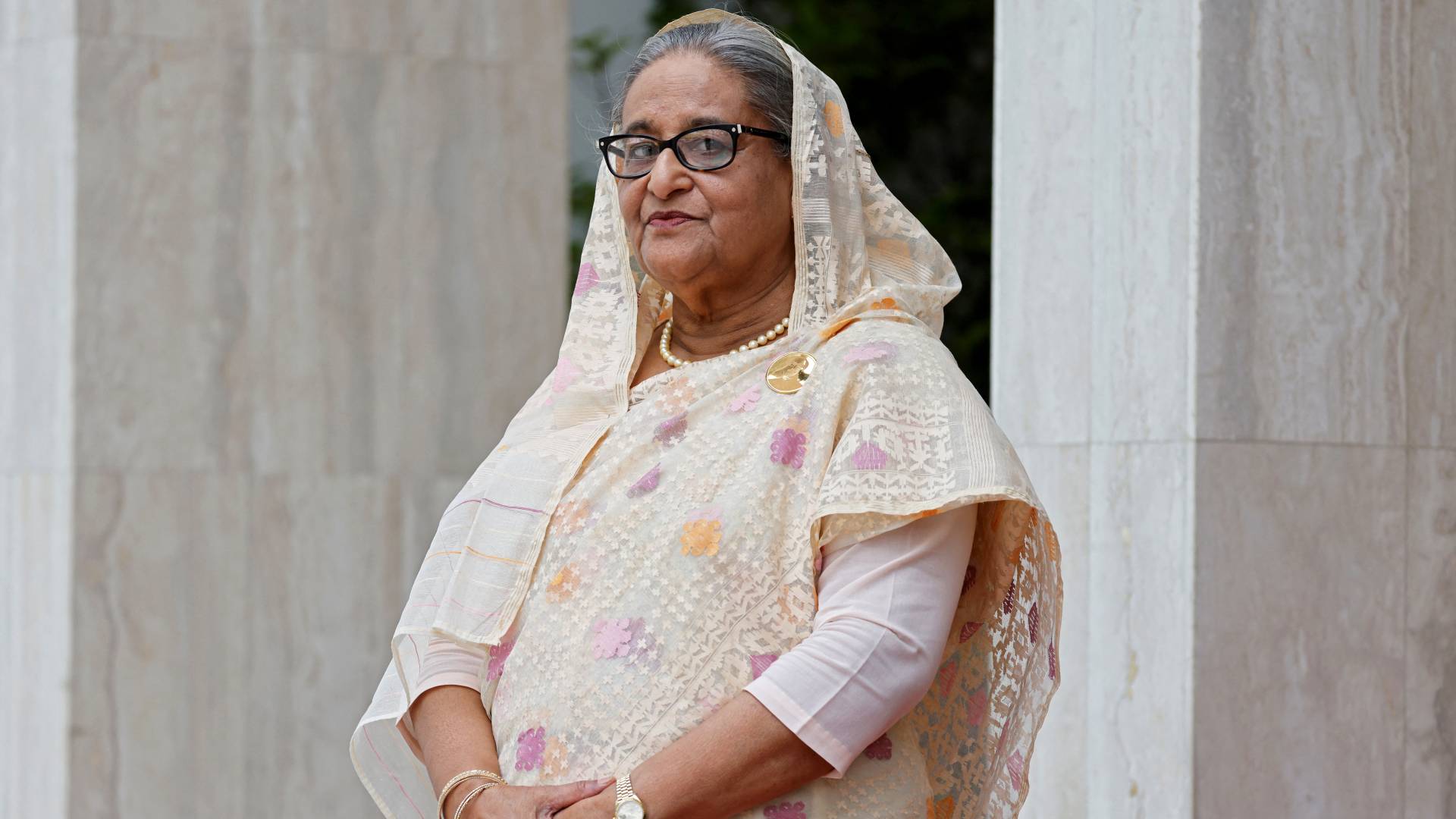
Bangladesh's Prime Minister Sheikh Hasina at the Prime Minister's office in Dhaka. (September 11, 2023)

Bangladesh court sentences ex-PM to be hanged
Note: AI technology was used to generate this article’s audio.
- A Bangladesh court sentenced former Prime Minister Sheikh Hasina to death for crimes against humanity related to the bloody security crackdown during the August 2024 student uprising.
- Hasina, currently in self-imposed exile in India, rejected the "politically motivated" and "biased" ruling, calling the court "illegal" and asserting her innocence.
A Bangladesh court sentenced former Prime Minister Sheikh Hasina to death on Monday after convicting her of crimes against humanity stemming from the deadly security crackdown during the student-led uprising in August 2024 that ultimately toppled her government.
A court in the capital, Dhaka, concluded its five-month trial, finding Hasina guilty of crimes against humanity, including incitement and ordering murder.
"All the elements... that constitute the crime against humanity are present," said Judge Ghulam Mortaza Mazumder as he delivered the verdict. "We decided to impose a single penalty: death."
Hasina Rejects Ruling as “Political”
Hasina, who has consistently denied the charges, immediately issued a statement from her self-imposed exile in India, claiming the verdict was "politically motivated."
She described the ruling as "biased" and originating from an "illegal court, appointed and chaired by an unelected government without a democratic mandate."
Hasina affirmed that the conviction "was predetermined," and insisted she is not afraid to face her accusers "in an impartial court that fairly examines the evidence."
At least 1,400 people, mostly civilians, died during the popular student protests in July and August 2024, according to the United Nations. The mass demonstrations forced Hasina to resign and leave the country after 15 years of iron-fisted rule.
The anticipated ruling on Sheikh Hasina comes amid high political tensions in Bangladesh, particularly with parliamentary elections scheduled to take place in three months.
Calls for Execution and Extradition
The head of the interim government and Nobel Peace laureate, Muhammad Yunus, praised the "historic verdict" but warned against any "unruly behavior" or "action... that may be considered contrary to the law."
The capital police mobilized a large number of officers, conducting stringent searches around the court and setting up barricades at all key locations in the city, Agence France-Presse (AFP) reporters observed.
During the trial's conclusion last month, Dhaka Prosecutor Tajul Islam requested the death penalty for Hasina. "We demand the maximum penalty," he told the court. "The death penalty is the norm for simple murder. But for 1,400 murders, she deserves death 1,400 times."
Hasina's denial statement Monday refuted the prosecution's evidence, specifically regarding leaked recordings that allegedly indicated she authorized the use of "lethal weapons" against protesters. Hasina described these recordings as "fragmented and taken out of context," asserting that Bangladeshi officials acted in good faith to "minimize the loss of life."
Bangladesh's Foreign Ministry formally requested that India surrender Hasina, who fled to New Delhi after her overthrow. "We urge the government of India to immediately hand over the convicted individuals [Hasina and former Interior Minister Asaduzzaman Khan Kamal, who was also sentenced to death] to the Bangladeshi authorities," the ministry said, calling it a "mandatory responsibility for India." Bangladesh warned that "granting asylum to these convicts... would be an unfriendly step and an insult to justice."
India's Foreign Ministry acknowledged being "aware of the ruling" but did not directly address the extradition request. In a statement, the ministry said, "India remains committed to the highest interests of the people of Bangladesh, including peace, democracy, inclusiveness, and stability."
The spokesperson for the U.N. High Commissioner for Human Rights, Ravina Shamdasani, noted in a statement that the sentences "constitute a significant moment for the victims of the serious violations committed during the suppression of demonstrations last year," but expressed regret over the imposition of the death penalty, which the U.N. opposes "in all circumstances."
Former Minister Convicted, Political Implications
The opposition Bangladesh Nationalist Party (BNP), which was in opposition during Hasina's rule, is the favorite to win the upcoming elections. Thomas Kin, an analyst at the International Crisis Group, said the verdict makes the "possibility of Sheikh Hasina arranging her return to Bangladesh very slim."
The court also sentenced former Interior Minister Asaduzzaman Khan Kamal, who remains at large, to death in absentia. Former police chief Chowdhury Abdullah Al-Mamun, who was arrested and pleaded guilty, was sentenced to five years in prison.
Hasina faces multiple other legal issues related to alleged murders and kidnappings during her tenure. She reiterated her denial of these charges, affirming Monday she is "very proud" of her government's record on "human rights and development."